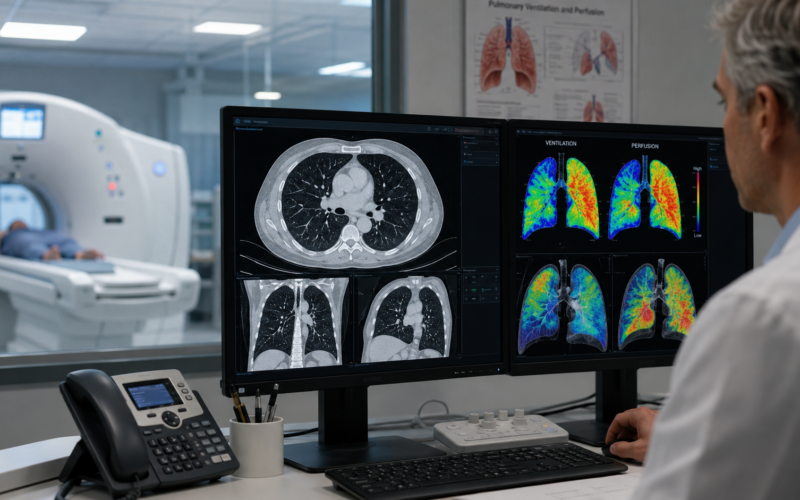
4DMedical (ASX: 4DX) shares rose 7.31 per cent to A$4.11 on Friday, taking the twelve-month gain to 1,367 per cent and lifting market capitalisation to A$2.44 billion. The Australian medical technology company has built the first non-invasive, contrast-free imaging technology for lung function assessment, with its CT:VQ software converting standard CT scans into ventilation and perfusion maps that replace the nuclear medicine VQ scan workflow used for decades. FDA clearance in September 2025 has been followed by deployments at Stanford, Cleveland Clinic, UC San Diego, University of Miami, and most recently Mayo Clinic, alongside Medicare reimbursement codes, S&P/ASX 200 inclusion, and a GlaxoSmithKline contract starting 1 May 2026. The retail debate now centres on whether scan volumes can scale fast enough to justify the multiple.
What does 4DMedical’s XV Technology platform actually do for clinicians?
4DMedical’s patented XV Technology transforms standard CT scans into rich functional insights that allow physicians to detect, diagnose, and monitor lung disease earlier than conventional imaging permits. The product suite includes CT:VQ for ventilation and perfusion analysis, CT LVAS for regional lung function imaging, IQ-UIP for usual interstitial pneumonia assessment, XV LVAS for lung airflow imaging, CAC for non-contrast cardiothoracic risk assessment, LDAf and LDAi for emphysema detection, LTA for lung texture visualisation, and PHA Analysis for fully automated imaging workflows. The platform is delivered as software-as-a-service, integrating into existing hospital CT workflows rather than requiring new hardware. The 2023 Imbio acquisition added AI-driven analysis capabilities that have since been woven into the broader product portfolio. The strategic positioning is to displace nuclear medicine VQ scans, a US$1 billion annual market, with a logistically simpler, lower-cost alternative that uses CT scanners already installed in every major hospital.

Why does Mayo Clinic adoption of CT:VQ matter beyond a single contract?
Mayo Clinic entered an agreement to deploy CT:VQ for ventilation and perfusion analysis over an initial 90-day period, integrating it into clinical workflows across pulmonary and cardiothoracic applications. The financial value of the trial deployment itself is modest. The strategic value is that Mayo influences clinical guidelines, physician behaviour, and procurement decisions across the United States and internationally. Since FDA clearance in September 2025, 4DMedical has placed CT:VQ at Stanford Health Care, University of Miami Health System, Cleveland Clinic, UC San Diego Health, and now Mayo Clinic. UC San Diego in particular has moved from pilot to embedded clinical workflow use, which is the transition that distinguishes validation deployments from revenue-generating deployments. This academic medical centre strategy is deliberately sequenced because these institutions are reference sites that drive procurement decisions at the broader community hospital level.
What does the GlaxoSmithKline contract reveal about 4DMedical’s pharmaceutical applications?
In April 2026, 4DMedical secured a one-year contract with GlaxoSmithKline, in association with Flywheel Exchange, to supply quantitative lung imaging analytics for pulmonary drug development and clinical research beginning 1 May 2026. The contract builds on existing work with AstraZeneca in pulmonary trials, and reinforces a growing role in pharmaceutical trials where precision and reproducibility are increasingly critical. The strategic significance is that 4DMedical’s imaging technology is being used not just for diagnosis but as a measurable endpoint in drug development, an area traditionally dominated by more complex and costly methods. Pharmaceutical contracts carry higher gross margin than hospital scans and offer multi-year visibility tied to trial timelines. The pharma revenue layer is also less sensitive to clinical adoption pace, which provides some insulation against the slower variable of hospital procurement cycles.
How does Medicare reimbursement for IQ-UIP and the new HCPCS code change the commercial pathway?
The Centers for Medicare and Medicaid Services established a US$650 reimbursement for IQ-UIP, and a new HCPCS code G0680 provides US$15.50 per study for AI-enabled coronary artery calcium analysis. The per-scan IQ-UIP reimbursement is meaningful because it sets a clear payment pathway for a specific clinical use case, removing one of the largest historical barriers to medical technology adoption in the United States. Reimbursement uncertainty has stalled countless medical devices that were clinically superior but commercially unviable. With a dedicated payment code in place, hospitals can integrate the technology into routine practice without bearing the reimbursement risk themselves. The CAC code at US$15.50 is modest on a per-scan basis but creates a defined payment pathway that compounds with volume. For a SaaS-style business, every additional reimbursement code expands the addressable transaction layer.
How does the Philips reseller partnership scale the distribution model?
The reseller agreement with Philips is expected to bring contracts and meaningful revenue before 30 June 2026, with Philips’ 250 salespeople now selling 4DMedical products into hospital systems they already serve as imaging hardware suppliers. The leverage is structural rather than tactical. 4DMedical has historically built a US sales motion from scratch, which is capital-intensive and slow. Philips brings established hospital relationships, procurement channels, and credibility with chief radiology officers. The reseller economics dilute headline margin slightly but accelerate volume meaningfully. Combined with the upcoming VQ product launch positioned as a superior logistical alternative to nuclear medicine VQ scans in a US$1 billion US market, the Philips channel becomes the scaling mechanism for translating clinical validation into commercial revenue.
What execution risks should retail investors weigh against the run rate?
Three risks dominate the medium-term path. First, scan volume conversion remains the central question. 4DMedical remains pre-profitability, with the half-year results to December 2025 reflecting a business still in commercial build-out. Academic medical centre deployments build credibility but do not generate the scan volumes that hospital systems do, and the bridge between the two is multi-quarter. Second, valuation. At A$2.44 billion market capitalisation and limited current revenue, the stock is pricing significant future adoption. Any quarter where scan volumes disappoint will compress the multiple sharply. Third, competition from established imaging incumbents who may build or acquire competing AI-driven lung function analytics. The first-mover advantage is meaningful but not permanent. Five Simply Wall St community fair value estimates around A$11.11 reflect bullish scenarios that depend on aggressive revenue expansion materialising over the next two years.
What are the key takeaways for retail investors watching 4DMedical?
- The Mayo Clinic 90-day trial deployment of CT:VQ joins existing placements at Stanford, Cleveland Clinic, UC San Diego, and University of Miami, building reference site credibility for broader commercial adoption.
- The GlaxoSmithKline one-year contract starting 1 May 2026 establishes a pharmaceutical revenue layer with higher gross margin and longer visibility than hospital scan revenue.
- Medicare reimbursement of US$650 for IQ-UIP and the new HCPCS code G0680 at US$15.50 per study remove the historical reimbursement barrier that stalls most medical technology adoption.
- The Philips reseller agreement leverages 250 Philips salespeople to accelerate hospital distribution, with meaningful revenue expected before 30 June 2026.
- At A$2.44 billion market capitalisation and pre-profitability, scan volume conversion in the next two quarters is the dominant test of whether the multiple is sustainable.
Discover more from Business-News-Today.com
Subscribe to get the latest posts sent to your email.