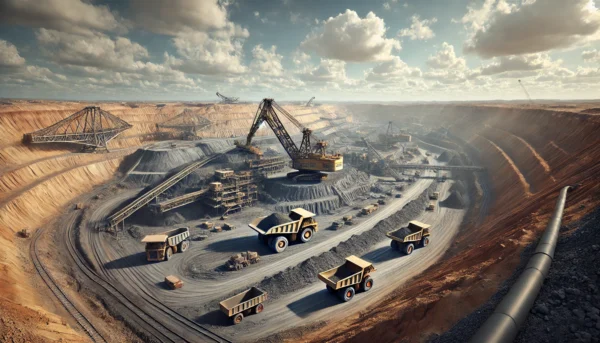
Denison Mines Corp. (TSX: DML, NYSE American: DNN) has moved its Phoenix in-situ recovery uranium mine from regulatory milestone to construction execution after reporting first-quarter 2026 financial and operational results. The Toronto-based uranium developer said site preparation and early works are now underway at Phoenix, part of the Wheeler River uranium project in northern Saskatchewan. The update matters because Phoenix is the first large-scale Canadian uranium mining project in more than two decades to secure the approvals needed to begin construction, placing Denison Mines Corp. in a rare position among uranium developers seeking to bring new supply into a tightening nuclear fuel market. DNN shares were recently trading near US$3.70, with a market value of about US$3.3 billion, leaving the stock well above its 52-week low but still below its January 2026 high of US$4.43.
Why does Denison Mines’ Phoenix ISR uranium mine matter for North American nuclear fuel supply?
Denison Mines Corp.’s first-quarter update is not just another quarterly progress note from a mining developer. It marks the shift from permitting optionality to construction accountability at one of the most closely watched uranium projects in Canada’s Athabasca Basin. Phoenix received Canadian Nuclear Safety Commission approval for the environmental assessment and the Licence to Prepare a Site and Construct in February 2026, after the Province of Saskatchewan had already approved the project’s environmental assessment. That sequence effectively removed the final regulatory barrier to construction and allowed the board of Denison Mines Corp. to approve the final investment decision for Phoenix.
The strategic importance is straightforward. Utilities want reliable uranium supply, Western governments want lower exposure to geopolitically sensitive nuclear fuel chains, and investors want developers that can move from resource statements to production. Denison Mines Corp. is trying to sit at the intersection of all three. The company has said Phoenix remains on track for first uranium production in mid-2028, which would position the project as a meaningful new source of supply before the end of the decade if execution remains intact.
The timing gives Phoenix a broader industry role. Uranium demand has been supported by nuclear life-extension programs, new reactor planning, small modular reactor development and policy support for low-carbon baseload power. However, uranium mine development remains capital-intensive, regulated and slow. That mismatch between policy enthusiasm and actual mine supply is exactly why Phoenix has become a strategic project rather than merely a company-specific construction story.
How far has Denison Mines moved Phoenix from approval into real construction activity?
Denison Mines Corp. said the Denison-Wood integrated project management team mobilized to Wheeler River in early March 2026 and began schedule-critical site preparation and early works. By the end of the first quarter, and into April, the company had completed tree clearing across the primary mine site area, installed construction management facilities, built an on-site helipad, advanced civil works for the concrete batch plant pad and started aggregate production at a nearby quarry. The release also noted that civil activities are continuing for access roads and clearings needed to establish the future airstrip.
This matters because early works at a greenfield uranium project are not cosmetic. They are the operational plumbing that determines whether full-scale construction can begin on schedule. The helipad, batch plant pad, quarry access and airstrip preparation are not headline-grabbing assets, but they decide how labour, concrete, equipment and consumables move through a remote northern Saskatchewan site. In mining, the glamorous parts usually arrive late. The unglamorous logistics decide whether they arrive on time.
Denison Mines Corp. expects construction staffing and activity to ramp up before the end of the second quarter of 2026. Once the project reaches full-scale construction, the company expects Phoenix to take about two years to complete. That is the core investor clock now attached to DNN stock. The story has moved from “can Denison Mines Corp. get permitted?” to “can Denison Mines Corp. build on schedule and within the revised cost envelope?”
Why are uranium contracts becoming central to Denison Mines’ Phoenix financing strategy?
Denison Mines Corp.’s commercial update may be as important as the construction update. The company has contracted firm uranium sales commitments for nearly 8 million pounds of U3O8 and is in advanced negotiations for another roughly 8 million pounds. That would represent around 16 million pounds of contracted and advanced-negotiation sales commitments, including customers that the company described as major North American nuclear power utilities collectively responsible for more than 50 reactors.
The near-term uranium sales are also financially relevant. In the first quarter of 2026, Denison Mines Corp. agreed to sell 550,000 pounds of U3O8 for delivery between the second quarter of 2026 and the first quarter of 2027 at an average price of US$99.07 per pound. By the end of the quarter, 1.35 million pounds were committed for delivery between the second quarter of 2026 and the second quarter of 2027, including 950,000 pounds at fixed pricing for gross proceeds of US$87.5 million. Around 500,000 pounds of physical uranium holdings and inventory remained uncommitted.
The implication is that Denison Mines Corp. is using its physical uranium position as a bridge between market strength and project funding. That is a meaningful distinction. Many developers are dependent almost entirely on equity markets, debt markets or strategic investors. Denison Mines Corp. has a uranium inventory lever that can be converted into cash while also demonstrating buyer interest from utilities. The risk is that selling physical uranium too aggressively could reduce future upside if uranium prices continue to rise. The benefit is that project financing becomes less hostage to capital-market mood swings.
What does the updated Phoenix capital cost say about execution risk for Denison Mines Corp.?
Denison Mines Corp. reported in January 2026 that the post-final investment decision initial capital estimate for Phoenix was around C$600 million, reflecting inflation, cost increases and project refinements since the 2023 feasibility study. That estimate is now the number investors will use to judge execution discipline.
The C$600 million figure is not excessive by major mining standards, but for a developer it is large enough to make sequencing critical. Cost inflation, remote logistics, labour availability, procurement timing and seasonal access can all reshape the economics of a project before production begins. The company has also flagged widespread flooding affecting parts of the northern Saskatchewan road network, noting that helicopter access remains available but heavy equipment and some supplies could be affected if flooding persists.
That caveat deserves attention. It does not mean the project timetable is broken, but it shows how quickly a clean construction narrative can encounter field-level friction. In remote mining, a two-week logistical delay can become a procurement problem, a contractor problem and then a budget problem if not absorbed early. Denison Mines Corp.’s challenge is therefore not only to build Phoenix, but to prove that the integrated construction model with Wood Canada Limited can absorb shocks without eroding investor confidence.
How should investors read DNN stock after the Q1 2026 Phoenix update?
DNN stock remains a uranium development story with unusually visible catalysts, but the risk profile is changing. Denison Mines Corp. has already captured a major valuation unlock by securing approvals and moving to construction. The next phase is less about regulatory surprise and more about schedule adherence, capital discipline and commercial execution.
The stock’s current setup reflects that transition. DNN was recently quoted near US$3.70, compared with a 52-week range of US$1.39 to US$4.43, meaning the market is still assigning value to Phoenix momentum but has not priced the stock as if construction risk has disappeared.
A neutral reading suggests that DNN now trades more like an execution-sensitive uranium developer than a pure optionality vehicle. Positive sentiment can be supported by the mid-2028 production target, contracted uranium demand and stronger nuclear-sector fundamentals. However, any signal of cost creep, site access disruption, permitting friction at later stages or slippage in full-scale construction could matter more than it did when the stock was still mainly trading on permitting progress.
Why does McClean Lake still matter while Phoenix gets most investor attention?
Phoenix is the flagship story, but Denison Mines Corp.’s 22.5 percent-owned McClean Lake operation remains relevant because it gives the company exposure to active uranium production. The company said mining activities at the McClean North SABRE mine were minimal during the first quarter, with work focused on resource confirmation drilling before the planned resumption of active mining later in the second quarter.
That matters because production exposure gives Denison Mines Corp. a different profile from developers that have no operating link to the market. McClean Lake also supports the company’s broader Athabasca Basin platform, which includes the McClean Lake uranium mill, Midwest assets, Waterbury deposits and interests held through JCU Canada Exploration Company, Limited. In practical terms, Phoenix may be the valuation engine, but the surrounding portfolio provides strategic depth.
The portfolio also gives Denison Mines Corp. optionality beyond one mine build. If Phoenix proves the technical and economic case for ISR uranium mining in this setting, the market may begin to reassess how the company’s broader land package is valued. That is not guaranteed, but it is the kind of second-order consequence investors often look for when a developer moves from paper project to operating template.
What happens next if Denison Mines keeps Phoenix on schedule through 2026?
The next major test is whether Denison Mines Corp. can complete early works, ramp construction and maintain the mid-2028 first production target. If the company reaches full-scale construction by the end of the second quarter of 2026, investor attention will likely shift to procurement discipline, site workforce scaling, construction progress, financing updates and additional uranium sales contracts.
If execution goes well, Denison Mines Corp. could strengthen its standing as one of the few Western uranium developers with a credible path to production before 2030. That would matter not only for DNN valuation, but also for utilities seeking future supply and for policymakers focused on nuclear fuel security. If execution falters, the stock may face a harsher reset because the market has already rewarded the company for moving beyond the permitting stage.
The broader read-through is that uranium investors are entering a more selective phase. The market may still like the nuclear growth story, but it will increasingly separate developers with permits, contracts, construction teams and financing pathways from companies that mainly have exploration upside. Denison Mines Corp. is closer to the first group than most, but Phoenix now has to prove that the difference can survive real-world construction.
Key takeaways on Denison Mines Corp., DNN stock and the Phoenix uranium mine construction outlook
- Denison Mines Corp. has moved Phoenix from regulatory approval into early works, making execution rather than permitting the main DNN stock catalyst.
- Phoenix is strategically important because new Western uranium supply remains scarce while nuclear fuel demand is strengthening.
- The mid-2028 first production target remains central to the investment case and will shape investor sentiment through 2026 and 2027.
- Contracted uranium sales of nearly 8 million pounds, with another roughly 8 million pounds in advanced negotiations, strengthen the project’s commercial credibility.
- Near-term uranium sales above US$99 per pound show how Denison Mines Corp. is converting physical uranium holdings into project-financing flexibility.
- The revised C$600 million initial capital estimate gives investors a clearer benchmark for judging construction discipline.
- Northern Saskatchewan flooding is a reminder that remote mine development carries logistical risks even after permits are secured.
- McClean Lake gives Denison Mines Corp. active uranium exposure while Phoenix remains under construction.
- DNN stock already reflects meaningful Phoenix optimism, but the discount to the 52-week high shows the market still wants execution proof.
- If Phoenix stays on track, Denison Mines Corp. could become one of the more strategically relevant uranium suppliers before the end of the decade.
Discover more from Business-News-Today.com
Subscribe to get the latest posts sent to your email.