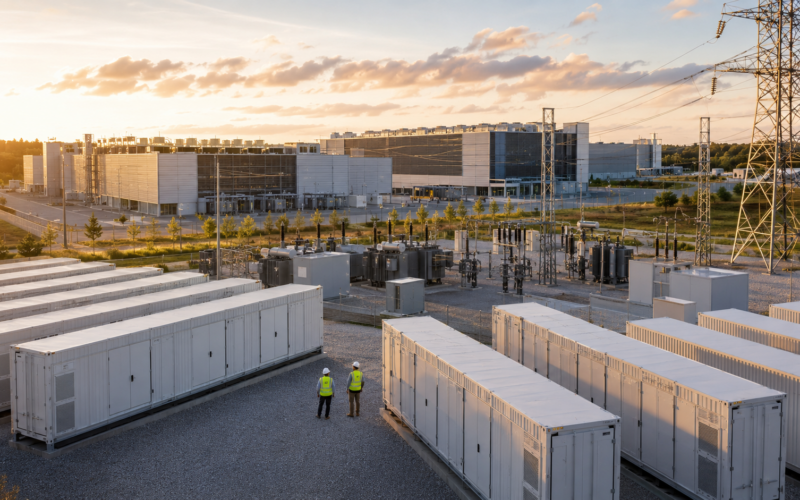
Fluence Energy, Inc. (NASDAQ: FLNC) is one of the standout US gainers on Friday May 8, 2026, with shares trading up around 32% at $25.00 after the grid-scale battery storage company posted fiscal Q2 2026 results that featured a record $5.6 billion contracted backlog, doubled year-to-date order intake, and master supply agreements with two major hyperscale data center operators. The headline revenue figure missed expectations, but the market is pricing in the data center demand ramp rather than the quarterly miss. For retail investors landing on the ticker for the first time, the next major catalyst is whether the first hyperscaler order converts in fiscal Q3 2026 and whether order intake momentum sustains through the back half of the fiscal year.
What does Fluence Energy do and why is grid-scale battery storage suddenly tied to AI data centers?
Fluence Energy, Inc. is an Arlington, Virginia-based provider of utility-scale battery energy storage systems, asset optimisation software, and operational services. The company designs, builds, and operates large battery installations that connect to electricity grids and to behind-the-meter industrial sites. Fluence Energy, Inc. was originally formed as a joint venture between Siemens and AES Corporation before listing on NASDAQ in October 2021, and it now operates as a standalone public company with global delivery capability across the United States, Australia, Europe, and selected emerging markets.
The business has historically been viewed as a utility-scale renewable energy enabler. Battery storage projects sit alongside solar farms and wind installations to firm intermittent generation, smooth grid frequency, and provide capacity during peak demand. That use case still represents the bulk of the addressable market, but the conversation has shifted in the past 18 months. Hyperscale data centers running AI training and inference workloads are now the fastest-growing source of industrial electricity demand globally, and the volatility of that load profile has created a new requirement for high-quality power conditioning that battery storage systems can solve.
Fluence Energy, Inc.’s proprietary Smartstack product is the technical answer. The platform provides high-density modular energy storage with integrated controls capable of absorbing the rapid power spikes characteristic of GPU training clusters, which traditional grid infrastructure handles poorly. The first Smartstack delivery reached commercial operations in fiscal Q2 2026, which is what allowed Fluence Energy, Inc. to qualify in competitive hyperscaler procurement processes that other storage vendors did not pass.
For a retail investor, the short version is that Fluence Energy, Inc. has repositioned itself from a renewable energy supplier into an AI infrastructure supplier, and the market is just starting to assign that re-rated multiple.
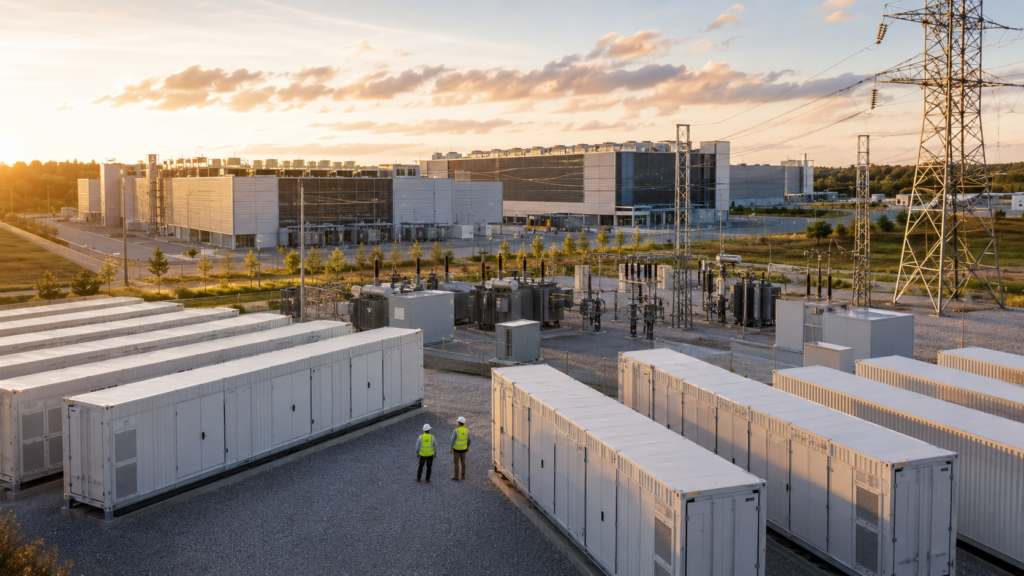
Why did FLNC stock surge after a Q2 2026 revenue miss and what was inside the print?
The fiscal Q2 2026 numbers missed on the top line and beat on the strategic narrative, which is unusual but explains the price action. Revenue came in at $464.9 million against a consensus near $611.5 million, a miss of around 24% on the quarter. Earnings per share was a GAAP loss of $0.16 against a consensus loss of $0.17, broadly in line. Adjusted EBITDA was negative $9.4 million, though it improved 69% year-on-year. Adjusted gross margin recovered to 11.1%, supported by operational discipline rather than pricing power.
What moved the stock was the commercial momentum disclosed alongside the print. Fluence Energy, Inc. reported a record contracted backlog of approximately $5.6 billion as of March 31, 2026. Year-to-date order intake through May 6 reached approximately $2.0 billion, double the $1.0 billion booked in the same period of the prior fiscal year. The company booked over $600 million in fiscal Q3 to date, and roughly half of fiscal 2026 orders came from customers placing their first order with Fluence Energy, Inc., which signals genuine pipeline expansion rather than recycled demand from existing accounts.
Management reaffirmed full-year fiscal 2026 revenue guidance of $3.2 billion to $3.6 billion, with adjusted EBITDA between $40 million and $60 million. The reaffirmation matters more than usual after a 24% revenue miss because it implicitly tells investors that the second-half delivery schedule is locked in. The company also disclosed that it invested $220 million in inventory during the quarter, with another $100 million planned for fiscal Q3, which is the kind of working capital deployment that only makes sense if management has visibility into specific customer ramps.
How do the hyperscaler master supply agreements change the bull case for Fluence Energy?
The single most important disclosure in the fiscal Q2 2026 release was the signing of master supply agreements with two major hyperscalers. Fluence Energy, Inc. was selected through competitive validation processes that involved multiple battery storage vendors, and the company has confirmed it expects to convert the first order from these agreements during fiscal Q3 2026. The data center-specific pipeline grew over 30% since the prior earnings call, reaching approximately 12 gigawatt hours. CEO Julian Nebreda described the company as gaining momentum on its push to broaden its customer base beyond traditional utilities.
A master supply agreement is a framework contract that establishes commercial terms and pre-qualifies a vendor for repeated purchase orders. It is not itself a binding revenue commitment, but it is a high-friction qualification milestone that excludes competitors who did not pass. For a hyperscaler, switching battery storage vendors mid-program is operationally expensive, which means the master supply agreement holders typically capture a disproportionate share of follow-on orders.
The strategic implication for Fluence Energy, Inc. is significant. The company moves from a backlog dominated by utility customers, where pricing is competitive and procurement cycles are slow, to a customer mix that includes hyperscalers willing to pay for power quality features, willing to commit to multi-year programs, and willing to underwrite domestic manufacturing capacity. Analysts at Roth Capital responded by doubling their price target to $26 from $13 and upgrading the stock to Buy from Neutral. Citi’s Vikram Bagri noted that sentiment going into the quarter was negative and that the hyperscaler announcement came sooner than expected.
The risk for retail investors is that the first hyperscaler order has not yet been booked. The fiscal Q3 2026 print, expected in August 2026, is when investors will see whether the master supply agreements convert into reported revenue at the scale the market is now pricing in.
What is the data center power demand backdrop driving FLNC stock higher?
The macro environment underneath Fluence Energy, Inc. has tightened significantly over the past year. AI training and inference workloads have driven a step-change in data center power requirements that utilities cannot meet on the timelines hyperscalers need. New nuclear capacity takes a decade to permit and build, new natural gas plants face permitting and emissions constraints, and renewable generation cannot supply 24-hour data center load without storage. That gap is precisely where battery energy storage systems sit.
Fluence Energy, Inc. disclosed that its total commercial pipeline grew approximately 35% year-to-date to $31.5 billion as of March 31, 2026, up from $23.4 billion at the end of fiscal 2025. The pipeline is heavily concentrated in the United States at 61%, followed by Australia at 18%. The US concentration aligns with regulatory tailwinds from federal investment tax credits that extend energy storage incentives through 2034, and from domestic content requirements that favour US-manufactured battery systems over imported alternatives.
The competitive set has narrowed in this environment. Tesla Megapack remains the dominant US battery storage product, but procurement teams at hyperscalers and utilities increasingly want a second qualified vendor for supply chain resilience. Fluence Energy, Inc. is the natural alternative because of its scale, its joint venture heritage with Siemens and AES, and its established US manufacturing footprint. Eos Energy Enterprises, also up sharply on May 8, occupies an adjacent zinc-battery niche that is technically differentiated but commercially smaller.
The risk on the macro side is a sudden change in federal energy policy or tariff structure that disadvantages either domestic content positioning or import flexibility. Fluence Energy, Inc.’s own filings flag international exposure to tariffs, shifting commodity costs, and logistics headaches as ongoing risks.
How is Fluence Energy positioned on US manufacturing and domestic content compliance?
Fluence Energy, Inc. has built one of the more defensible US domestic supply chain positions in the battery storage industry. The company has established US production for all major components, including battery cells, and signed a new supply agreement following an ownership change at its Tennessee facility to ensure continued eligibility for applicable tax credits. The company secured additional battery cell production from a new US supplier starting in 2027 to supplement the Tennessee operation.
This matters for two reasons. The first is the federal investment tax credit framework, which provides preferential treatment for storage systems that meet domestic content thresholds. The second is the policy framework restricting Prohibited Foreign Entity content and control in subsidised energy infrastructure, which tightens further over the next several years. Fluence Energy, Inc.’s positioning means it can deliver projects that qualify for full credit value while many imported alternatives cannot.
For utilities and hyperscalers planning multi-year project pipelines, this regulatory predictability is a procurement advantage. It is one of the reasons Fluence Energy, Inc. won the hyperscaler master supply agreements over competitors, and it is one of the reasons the company can command pricing in the 11% to 13% adjusted gross margin range that management is now guiding to.
What is the next catalyst timeline for FLNC shareholders watching the fiscal 2026 ramp?
The catalyst calendar through the rest of fiscal 2026 is dense. The first checkpoint is the conversion of the first hyperscaler order under the master supply agreements during fiscal Q3 2026, which Fluence Energy, Inc. has explicitly guided to. The size and disclosure quality of that first order will set the tone for how the market values the remaining 12 gigawatt hour data center pipeline.
The second catalyst is the fiscal Q3 2026 earnings release, expected in August 2026. The print will include the first revenue contribution from new hyperscaler orders, the conversion rate of the $600 million-plus already booked in the third quarter, and any further updates to the full-year guidance. Given that management reaffirmed guidance after a 24% Q2 revenue miss, the second-half ramp is implicit in the reaffirmation, and investors will be watching for evidence that the back-end loaded delivery schedule is on track.
The third catalyst is annual recurring revenue progression toward the $180 million target Fluence Energy, Inc. has guided to by the end of fiscal 2026. Annual recurring revenue from asset optimisation software is the highest-margin component of the business and the metric most relevant to long-term valuation, and consistent quarterly progress on this line would justify a higher software multiple than the hardware-heavy battery business has carried historically.
The fourth catalyst is broader Smartstack adoption. The first Smartstack reached commercial operations during fiscal Q2 2026, and the product line is what enables the hyperscaler use case. Additional Smartstack delivery milestones through 2026 and 2027 will be tracked as proof points for the long-duration storage thesis.
How does the current valuation compare to the analyst price targets after the Q2 print?
Fluence Energy, Inc. shares traded around $13.56 before the fiscal Q2 2026 release on May 6, 2026. The stock surged roughly 40% on May 7 and continued higher into May 8, reaching $25.00 intraday. That move places the stock close to the upper end of the analyst price target range that existed before the print, with several brokers now revising targets upward.
Roth Capital doubled its price target to $26 from $13 and upgraded the stock to Buy. Analysts at JPMorgan, Canaccord, Jefferies, and Goldman Sachs also raised their price targets following the hyperscaler disclosure. Canaccord described the two new master supply agreements as a game-changer for the company. UBS had downgraded Fluence Energy, Inc. to Sell earlier in the week, and that call now looks badly timed against the price action.
The valuation tension for retail investors is straightforward. Fluence Energy, Inc. is still unprofitable on a GAAP basis, with net losses continuing through fiscal Q2 2026. The full-year adjusted EBITDA guidance of $40 million to $60 million implies a thin profitability profile against revenue of $3.2 billion to $3.6 billion. The stock is being valued on the trajectory of the backlog and the data center pipeline rather than on current period earnings, which means a single quarter of soft order intake or a delayed hyperscaler conversion could compress the multiple quickly.
Short interest before the print was meaningful, which contributed to the sharpness of the squeeze. The stock is up 321% over the past 12 months but was down 4% year-to-date heading into May 8, indicating that much of the gain came from a low base after a difficult start to 2026.
Why are retail investors on Stocktwits and X watching Fluence Energy ahead of the next print?
Retail interest in Fluence Energy, Inc. has surged following the fiscal Q2 2026 release. Sentiment on Stocktwits has trended into extremely bullish territory, with message volume at extremely high levels through the May 8 session. The cashtag $FLNC has been a consistent presence on energy transition and AI infrastructure-themed retail watchlists, particularly among traders rotating out of pure-play AI semiconductor names into the picks-and-shovels category that supplies AI data centers with power and cooling.
The retail thesis is conceptually clean. Fluence Energy, Inc. is one of the few liquid US-listed pure plays on the intersection of AI data center power demand, US domestic content tax credit eligibility, and grid-scale battery storage scale. Most comparable exposure either sits inside diversified industrial conglomerates where the storage business is buried in segment reporting, or inside private companies that retail investors cannot access.
The risk inside the retail interest is that the stock has already moved sharply on a forward-looking thesis. Fluence Energy, Inc. needs to deliver the first hyperscaler order, sustain order intake momentum, and demonstrate margin progression against falling average selling prices, all in the same fiscal year. Any single execution miss could unwind the recent re-rating quickly, and the volatility profile of the stock means entry timing matters more than usual.
Key takeaways for retail investors watching FLNC on NASDAQ
- Fluence Energy, Inc. (NASDAQ: FLNC) reported fiscal Q2 2026 revenue of $464.9 million, missing consensus by 24%, but disclosed a record $5.6 billion backlog and master supply agreements with two major hyperscalers, driving the stock up roughly 32% on May 8, 2026.
- Year-to-date order intake doubled to approximately $2.0 billion through May 6, with over $600 million booked in fiscal Q3 alone and roughly half of fiscal 2026 orders coming from new customers.
- Full-year fiscal 2026 revenue guidance was reaffirmed at $3.2 billion to $3.6 billion, with adjusted EBITDA guided to $40 million to $60 million, signalling confidence in the second-half delivery ramp.
- The first hyperscaler order under the new master supply agreements is expected to convert during fiscal Q3 2026, making the August 2026 earnings print the next major catalyst.
- US domestic content positioning, including Tennessee-based battery cell production and a new 2027 US supplier agreement, supports tax credit eligibility under the federal storage investment framework through 2034.
- Roth Capital doubled its price target to $26 from $13 and upgraded to Buy, with JPMorgan, Canaccord, Jefferies, and Goldman Sachs also raising targets following the print.
- Execution risk remains elevated because Fluence Energy, Inc. is still GAAP-unprofitable, with thin adjusted EBITDA margins, and the valuation now prices in sustained order conversion rather than current period earnings.
Share this:
Discover more from Business-News-Today.com
Subscribe to get the latest posts sent to your email.