




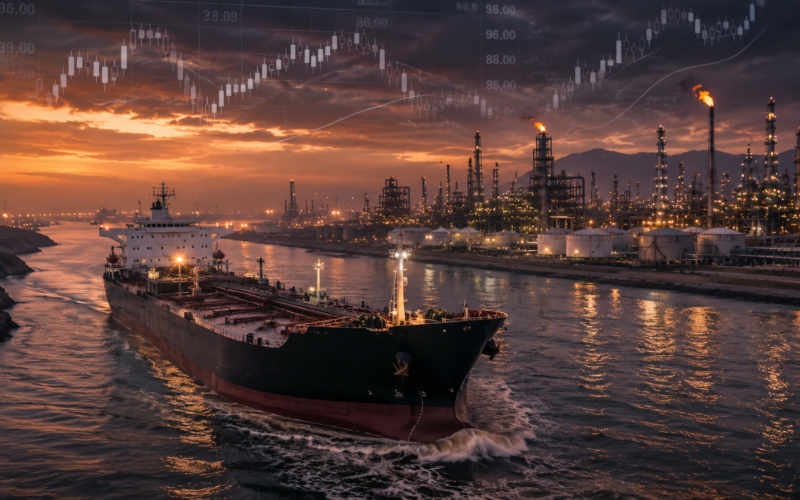
Oil prices rose sharply on Friday as renewed hostilities between the United States and Iran revived fears of disruption around the Strait of Hormuz, pushing Brent crude futures further above $100 per barrel and lifting West Texas Intermediate after a volatile week dominated by ceasefire hopes, tanker risk, and fragile diplomacy.
Brent crude futures climbed to about $101.47 per barrel in early Asian trading, while West Texas Intermediate crude advanced to about $95.93 per barrel. Prices had risen more than 3% at the market open before paring some gains, reversing part of the decline seen earlier in the week when traders had priced in the possibility of a United States and Iran peace arrangement that could ease shipping pressure near the Strait of Hormuz.
The latest move showed how quickly crude oil sentiment can swing when geopolitical headlines collide with physical supply risk. For oil traders, refiners, airlines, shipping companies, and energy importing economies, the immediate issue is not only whether Brent crude remains above $100. The bigger question is whether the market is moving from short-term war premium into a more durable supply-risk regime.
Why did oil prices jump again as United States and Iran tensions intensified near the Strait of Hormuz?
The latest rise in oil prices came after renewed fighting weakened confidence that the recent ceasefire framework between the United States and Iran could hold. Earlier in the week, crude prices had retreated on reports that a diplomatic proposal could end active fighting and gradually allow fuller movement through the Strait of Hormuz. That optimism quickly faded as fresh military exchanges raised concern that the world’s most important oil transit chokepoint could remain vulnerable.
The Strait of Hormuz is central to the market reaction because it is not just another maritime route. It links the Persian Gulf with the Gulf of Oman and the Arabian Sea, carrying a large share of crude oil, condensate, petroleum products, and liquefied natural gas exports from Gulf producers to global markets. A sustained disruption in the Strait of Hormuz does not merely delay cargoes. It forces importers, refiners, insurers, and shipping firms to reprice the reliability of energy flows from one of the world’s most supply-dense regions.
That is why Brent crude and West Texas Intermediate reacted even though prices had already been elevated. Markets are not responding only to barrels currently missing from the system. They are pricing the possibility that shipping constraints, military risk, insurance premiums, and regional retaliation could stretch longer than diplomatic headlines imply.

How does the Strait of Hormuz risk change the global crude oil market outlook?
The Strait of Hormuz risk matters because the global oil system has limited flexibility when disruption occurs at this scale. Even when alternative pipelines exist through Saudi Arabia and the United Arab Emirates, available spare routing capacity cannot fully replace normal Strait of Hormuz flows. That creates a structural bottleneck. If shipping through the Strait of Hormuz becomes uncertain, the market must assume that some barrels will either move more slowly, cost more to insure, or fail to reach buyers on time.
Asian economies are especially exposed because China, India, Japan, and South Korea are major destinations for crude oil and condensate moving through the Strait of Hormuz. For India and other large import-dependent economies, sustained Brent crude strength can pressure inflation, current account balances, refining margins, and currency sentiment. A rise in crude oil prices may therefore move beyond the commodities screen and influence central bank expectations, fiscal math, and retail fuel pricing debates.
The same risk extends to liquefied natural gas. Qatar is a major liquefied natural gas exporter, and the Strait of Hormuz is important for gas as well as oil. If liquefied natural gas cargoes are delayed or rerouted, the impact can show up in Asian spot gas prices and European energy security planning. The crude oil market is therefore functioning as an early signal for a broader energy risk repricing.
Why did Brent crude remain above $100 despite hopes for a United States and Iran peace deal?
Brent crude remained above $100 because traders appear unwilling to remove the geopolitical risk premium while the underlying conflict remains unresolved. A peace proposal can move prices lower when markets believe the physical risk is easing. But when fresh clashes occur before core issues are resolved, traders often rebuild risk premiums quickly. That is exactly what appeared to happen on Friday.
The earlier decline in oil prices was driven by optimism that the United States and Iran could reach a near-term arrangement that would end active fighting and allow the Strait of Hormuz to reopen more fully. However, the market’s reaction to renewed hostilities showed that confidence in diplomacy remains fragile. Crude oil markets can rally on war headlines and fall on peace headlines, but the physical market ultimately needs evidence of safer shipping, normal tanker movement, and stable regional command structures.
This is why the Brent crude price is behaving like a geopolitical barometer. At levels above $100 per barrel, the market is signaling that supply risk remains material even if diplomatic channels are active. West Texas Intermediate rising alongside Brent crude also shows that the impact is not limited to Middle Eastern grades. Global benchmark pricing transmits regional risk into North American futures, refining economics, and global commodity portfolios.
What does the latest oil price move mean for inflation, currencies, and energy importing economies?
The latest oil price move matters because crude oil feeds into multiple inflation channels. Higher Brent crude prices can raise fuel import bills, aviation fuel costs, petrochemical feedstock prices, freight costs, and refinery input costs. The impact is not immediate or uniform, but a prolonged period of Brent crude above $100 can complicate inflation management for energy importing economies.
For India, higher oil prices can weigh on the rupee because crude imports are a major component of the country’s external payments. A stronger oil bill can widen the current account deficit and increase demand for dollars. That does not mean the currency will automatically weaken, but it makes oil one of the key variables for traders watching Indian financial markets.
For the United States, the impact is more mixed. The United States is a major oil producer, but consumers still face exposure through gasoline, diesel, jet fuel, and logistics costs. Higher oil prices can support energy sector earnings while pressuring transport, retail, and consumer spending. For Europe, which has already faced energy security shocks in recent years, any fresh oil and gas disruption around the Strait of Hormuz adds another layer of uncertainty to industrial costs and household energy policy.
How are traders interpreting renewed volatility in Brent crude and West Texas Intermediate?
Traders are interpreting the latest move as a warning that the oil market remains headline-sensitive and structurally tight around geopolitical risk. The sharp early rise, followed by partial easing, suggests that market participants are reacting rapidly to new information but are not yet fully convinced that the worst-case supply scenario is unfolding. That creates a volatile trading environment where intraday moves can be large, but conviction can change quickly.
The presence of peace-deal speculation also makes positioning more complex. Traders who sold crude on hopes of a diplomatic breakthrough may have been forced to reassess risk when renewed hostilities emerged. At the same time, buyers may hesitate to chase prices too aggressively if there is still a possibility of renewed negotiations. This tension between diplomacy and disruption is likely to keep crude oil futures volatile.
The Brent crude and West Texas Intermediate spread also remains important. Brent is more directly exposed to global seaborne supply risk, while West Texas Intermediate reflects United States market conditions and global sentiment. When both benchmarks rise, it indicates that the market is treating the conflict as a global energy pricing issue rather than a local regional shock.
What happens next if United States and Iran diplomacy fails to stabilize energy markets?
If United States and Iran diplomacy fails to stabilize energy markets, the immediate focus will shift to shipping security, tanker availability, insurance costs, and emergency supply coordination. Governments and energy agencies may also face pressure to assess strategic reserves, alternative supply arrangements, and domestic fuel management measures if prices continue rising.
A prolonged oil shock would create winners and losers. Upstream producers with secure output outside the conflict zone could benefit from higher prices. Refiners may face mixed outcomes depending on crude access, product demand, and margin structures. Airlines, shipping companies, petrochemical producers, and fuel-intensive industries could face cost pressure. Import-dependent economies would have to balance inflation control with growth risks.
The most important signal to watch is not only the next Brent crude price tick. It is whether physical flows through the Strait of Hormuz become more predictable. If tanker movement normalizes and diplomatic channels hold, some of the war premium could fade. If hostilities continue and the Strait of Hormuz remains vulnerable, Brent crude above $100 may become less of a temporary spike and more of a new market baseline.
What are the key takeaways from the oil price jump after renewed United States and Iran tensions?
- Oil prices rose on Friday after renewed United States and Iran hostilities revived concerns about energy flows near the Strait of Hormuz.
- Brent crude futures remained above $100 per barrel, while West Texas Intermediate crude also advanced in early trading.
- The market had fallen earlier in the week on expectations that a peace arrangement could ease pressure on the Strait of Hormuz.
- The Strait of Hormuz remains a critical route for global crude oil, petroleum product, and liquefied natural gas trade.
- Energy importing economies in Asia remain highly exposed to any sustained disruption in crude oil and liquefied natural gas flows through the Strait of Hormuz.
Discover more from Business-News-Today.com
Subscribe to get the latest posts sent to your email.

