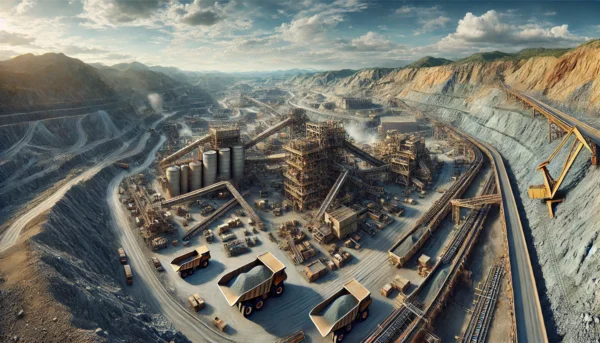



LaFleur Minerals Inc. has entered into an agreement to acquire a 100% interest in the McKenzie East Gold Project in Québec’s Val-d’Or district, positioning the asset as a potential feed source for its Beacon Gold Mill while continuing aggressive drilling at the Swanson Gold Project. The low-cost transaction highlights a broader strategic push to consolidate near-mill resources and accelerate a district-scale gold development model.
How does the McKenzie East acquisition reshape LaFleur Minerals Inc.’s district-scale gold consolidation strategy in Val-d’Or?
The acquisition of McKenzie East reflects a deliberate geographic strategy rather than a purely resource-driven one. LaFleur Minerals Inc. is assembling a cluster of gold assets within trucking distance of its Beacon Gold Mill, and McKenzie East extends that footprint into a proven mineralized corridor.
The project sits directly adjacent to the McKenzie Break deposit, an established gold resource that provides geological context for the broader system. In mining, proximity to known mineralization materially reduces exploration uncertainty compared to greenfield assets. While McKenzie East itself remains underexplored, its location increases the probability that mineralization trends could extend across claim boundaries.
This move complements LaFleur Minerals Inc.’s existing portfolio, particularly the Swanson Gold Project, which has already demonstrated scale through recent drilling. The company is effectively building a hub-and-spoke model where multiple deposits feed a central processing facility, an approach that reduces capital intensity compared to standalone mine development.
The strategy signals a transition from exploration optionality toward a more structured development pathway. Instead of relying on a single flagship discovery, LaFleur Minerals Inc. is assembling a pipeline of assets that can collectively support production.
Why does proximity to Fresnillo plc’s McKenzie Break deposit matter for valuation and exploration confidence?
The adjacency to Fresnillo plc’s McKenzie Break deposit introduces both validation and strategic complexity. The deposit’s historical resource base demonstrates that the regional geology is capable of hosting meaningful gold mineralization, strengthening the exploration case for McKenzie East.
For LaFleur Minerals Inc., this proximity supports a continuity thesis. If mineralized structures extend eastward, McKenzie East could evolve from an exploration-stage asset into a defined resource with economic relevance. That possibility underpins much of the acquisition’s strategic appeal.
However, the presence of a major operator also creates longer-term considerations. Fresnillo plc controls the core deposit, and any integrated development scenario across the broader McKenzie area would likely require coordination or consolidation. At present, LaFleur Minerals Inc. has not initiated discussions, maintaining an independent exploration pathway while preserving optionality.
From an investor perspective, this creates a dual narrative. The base case focuses on standalone development, while the upside case includes potential strategic transactions involving adjacent assets.
How does McKenzie East strengthen LaFleur Minerals Inc.’s mine-to-mill strategy centered on Beacon Gold Mill?
The Beacon Gold Mill is central to LaFleur Minerals Inc.’s strategy. Ownership of a processing facility fundamentally alters project economics by providing a direct pathway from exploration to monetization. McKenzie East is being positioned as a potential contributor to this feed strategy, reinforcing the company’s mine-to-mill model.
The logic is cumulative. Each additional deposit within trucking distance increases feed flexibility and reduces reliance on any single asset. When combined with Swanson, McKenzie East adds another layer to a growing resource pipeline that could sustain long-term mill operations.
The company’s ambition to scale mill capacity toward 3,000 to 4,000 tonnes per day over the next one to two years further elevates the importance of feed security. A larger mill requires a steady and diversified supply of ore, and that in turn depends on multiple deposits at varying stages of development.
McKenzie East therefore serves as a strategic buffer. Even if it does not immediately contribute significant volumes, it enhances optionality and supports the broader production narrative.
What do recent Swanson Gold Project drilling results signal about resource scale and future production potential?
Operational momentum remains anchored in the Swanson Gold Project, where recent drilling has confirmed the presence of a large and expanding gold system. Intercepts demonstrating broad mineralized zones and continuity at depth suggest a deposit with meaningful scale potential.
The distinction between scale and grade is important. While high-grade discoveries capture attention, large-scale systems with consistent grades often provide more predictable production profiles. Swanson appears to be trending toward the latter, with extensive mineralized halos supported by localized higher-grade zones.
These characteristics are conducive to bulk mining approaches, which align with the company’s integrated mill strategy. If Swanson continues to expand, it could serve as the primary feed source, with supplementary contributions from assets like McKenzie East.
This interplay reflects a shift in focus. LaFleur Minerals Inc. is not simply exploring for isolated deposits but is building the foundation for sustained production within a defined district.
How does capital discipline and deal structure influence investor sentiment toward LaFleur Minerals Inc.?
The financial structure of the McKenzie East acquisition underscores a cautious approach to capital allocation. The transaction involves a relatively small cash payment combined with equity issuance, limiting immediate financial strain while expanding the company’s asset base.
In a sector where dilution and cash burn are persistent concerns, such discipline can support investor confidence. However, the trade-off is that low-cost acquisitions often carry higher geological uncertainty. McKenzie East requires further exploration to validate its potential, and early results will be critical in shaping market perception.
Investor sentiment is likely to hinge on execution rather than acquisition alone. The market will look for evidence that exploration efforts translate into resource definition, reinforcing the strategic rationale behind the deal.
What role do infrastructure and regional dynamics play in accelerating LaFleur Minerals Inc.’s development timeline?
Operating in the Val-d’Or district provides structural advantages that extend beyond geology. Established infrastructure, including road access and proximity to processing facilities, reduces logistical complexity and development costs.
For LaFleur Minerals Inc., this translates into shorter timelines and improved capital efficiency. The ability to move material from nearby deposits to the Beacon Gold Mill without significant transportation challenges is a key enabler of the mine-to-mill strategy.
Québec’s mining-friendly regulatory environment also contributes to this dynamic. While permitting remains rigorous, the province’s long history of mining activity provides a framework that can support project advancement. These factors collectively increase the likelihood that exploration success can be converted into production within a reasonable timeframe.
How might gold market conditions influence LaFleur Minerals Inc.’s strategic trajectory?
The strategic moves by LaFleur Minerals Inc. are unfolding against a backdrop of renewed interest in gold. Macroeconomic uncertainty, inflation concerns, and geopolitical tensions have all contributed to sustained demand for gold as a store of value.
For junior miners, this environment can be both an opportunity and a challenge. On one hand, higher gold prices improve project economics and attract investor attention. On the other hand, capital markets remain selective, favoring companies with clear pathways to production.
LaFleur Minerals Inc.’s mine-to-mill strategy aligns with this preference. By emphasizing near-term production potential rather than distant exploration upside, the company is positioning itself within a more investable segment of the market.
However, execution remains the critical variable. Investors will likely focus on milestones such as resource updates, drilling results, and progress toward mill restart. Each of these will serve as validation points for the broader strategy.
What execution risks and strategic uncertainties could still limit LaFleur Minerals Inc.’s success in Val-d’Or?
Despite a coherent strategy, several risks remain. Exploration risk is immediate, particularly at McKenzie East, where mineralization must be confirmed through further drilling. Without that validation, its contribution to the broader strategy may remain limited.
Operational challenges will also emerge as the company transitions toward development. Managing multiple assets, scaling mill capacity, and coordinating logistics require execution capabilities that extend beyond exploration.
Capital requirements represent another variable. While initial acquisitions are low-cost, advancing projects toward production will require sustained investment. Access to capital will depend on market conditions and project performance.
LaFleur Minerals Inc. is attempting to transition from a junior explorer into a district-scale gold developer built around infrastructure it already controls. The success of that strategy will depend less on any single asset and more on whether the company can convert Swanson’s scale and McKenzie East’s proximity into a reliable, multi-source feed pipeline for the Beacon Gold Mill. If execution holds and resource growth continues within trucking distance, the Val-d’Or platform could evolve into a more durable production story rather than a collection of exploration bets.
Key takeaways on what this development means for LaFleur Minerals Inc., its competitors, and the gold mining sector
- LaFleur Minerals Inc. is shifting from pure exploration toward a district-scale, mine-to-mill production strategy anchored by Beacon Gold Mill
- The McKenzie East acquisition adds low-cost optionality and strengthens the company’s pipeline of potential mill feed sources
- Proximity to Fresnillo plc’s McKenzie Break deposit enhances geological confidence but introduces strategic complexity
- Strong drilling results at the Swanson Gold Project reinforce the potential for a scalable core asset supporting long-term production
- Capital discipline in deal structuring may support investor confidence, but execution will remain the primary valuation driver
- Existing infrastructure in Val-d’Or provides a structural advantage that could accelerate development timelines
- The strategy aligns with broader investor preference for near-term production stories in the gold sector
- Execution risk across exploration, financing, and operational scaling remains the key determinant of long-term success
Discover more from Business-News-Today.com
Subscribe to get the latest posts sent to your email.