

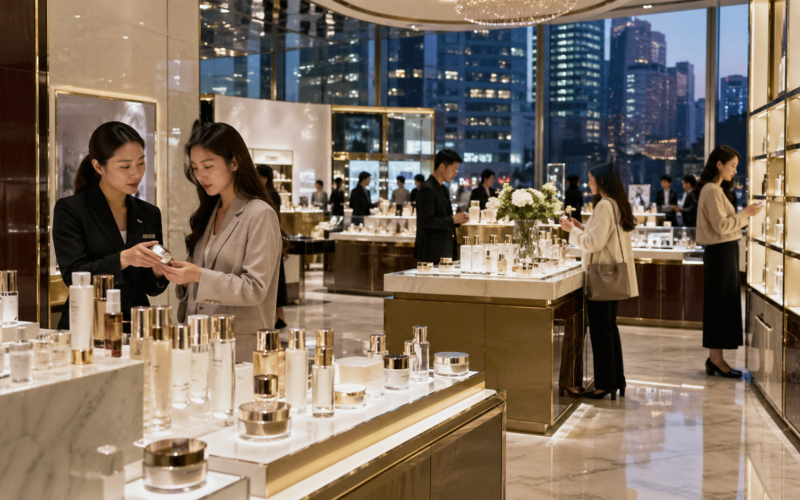
The China premium beauty cycle has turned, and the Q1 2026 reporting season has produced the cleanest evidence of a sustained rebound since the post-pandemic luxury slowdown began in 2022. L’Oréal SA (EPA: OR), the world’s largest cosmetics company, posted Q1 2026 like-for-like sales growth of 7.6 percent on Wednesday with North Asia growing 4.8 percent and Chief Executive Officer Nicolas Hieronimus quantifying the China beauty market rebound at +1 to +2 percent driven by selective premium products. The Estée Lauder Companies Inc (NYSE: EL) reports its fiscal third quarter on Friday, May 1, with Mainland China already delivering two consecutive quarters of double-digit retail sales growth in fiscal Q1 and Q2 under Chief Executive Officer Stéphane de La Faverie’s Beauty Reimagined turnaround. Shiseido Company Limited (TYO: 4911), the Japanese laggard, is targeting a 2026 sales rebound to ¥990 billion and a 55 percent surge in core operating profit to ¥69 billion under Chief Executive Officer Kentaro Fujiwara’s growth-delivery thesis. The Procter & Gamble Company’s SK-II brand grew 18 percent globally and 13 percent in China in its fiscal Q3 2026 print last Friday, the cleanest premium beauty data point of the quarter and the strongest validation that the China discretionary spending recovery is anchoring in selective premium tiers rather than broad-based consumer rebound. The cycle is real, the cycle is uneven, and the read-through into FMCG portfolios pivoting toward beauty matters more than the absolute sector numbers suggest.
How sustainable is the China premium beauty recovery that L’Oréal and Estée Lauder are seeing in their Q1 2026 prints?
The most important caveat in the L’Oréal Q1 commentary is the size of the rebound. Hieronimus described the China market recovery as “not a massive rebound” at +1 to +2 percent, attributing it to two factors: a partial recovery in the Chinese stock market that has restored some discretionary spending capacity, and selective premium positioning that has insulated luxury beauty from broader consumer caution. North Asia, which is roughly 70 percent China for L’Oréal, grew 4.8 percent like-for-like in the quarter, with the Luxe division specifically called out as having its recovery “confirmed” after several quarters of negative or flat growth. The L’Oréal Dermatological Beauty division grew 10.2 percent like-for-like, with North Asia contributing high-teens growth alongside emerging markets.
The Estée Lauder data point is stronger in narrative terms but smaller in absolute scale because the company is rebounding from a much lower base. Mainland China delivered double-digit retail sales growth in Estée Lauder’s fiscal Q1 and Q2 2026, with the company gaining share in skin care, makeup, fragrance and hair care simultaneously. The Q2 print showed Mainland China operating income increasing on the back of higher net sales and a favourable comparison to a prior-year period that was distorted by a change in local government subsidy policy. La Mer, TOM FORD and Le Labo led the brand-level growth, all consistent with the selective premiumisation thesis Hieronimus articulated.
The sustainability question hinges on whether the recovery is broad-based consumer revival or narrow trade-up by an existing premium consumer base. The current evidence points toward the latter. L’Oréal’s mass beauty Consumer Products Division grew 4.1 percent like-for-like, materially below the Luxe division’s recovery trajectory. The Chinese consumer who is buying La Mer, SK-II and Lancôme is not the same consumer who is delaying purchases of mass-market shampoo and toothpaste. That divergence has real strategic implications for Procter & Gamble’s portfolio reset toward beauty and for Unilever’s pivot toward home and personal care premiumisation.
Why does Procter & Gamble’s SK-II at +18 percent globally and +13 percent in China matter more than the headline implies for the China beauty sector?
The SK-II data point is the most important single number in the consumer staples Q1 reporting season because it bridges the FMCG and prestige beauty universes. The brand grew 18 percent globally and 13 percent specifically in China in Procter & Gamble’s fiscal Q3 2026 print on Friday, with the company explicitly flagging it as a contributor to Beauty segment net sales growth of 11 percent and organic growth of 7 percent. SK-II had been a multi-quarter drag on Procter & Gamble’s beauty narrative since 2023, with the brand caught in the broader China discretionary slowdown and exposed to localised consumer boycott pressure linked to Japan-China geopolitical friction.
The recovery sets a quantitative benchmark. If a single brand within a diversified FMCG portfolio can grow 13 percent in China during a +1 to +2 percent overall beauty market environment, it forces the question of why the pure-play beauty companies are not capturing more of the upside. L’Oréal’s North Asia at 4.8 percent like-for-like is below the SK-II benchmark, and Estée Lauder’s Mainland China double-digit retail growth, while directionally similar, is built on a depressed prior-year base that flatters the comparison. The implication is that distribution, channel mix and pricing architecture matter as much as brand equity in determining who captures the premium recovery. Procter & Gamble’s e-commerce and Tmall positioning for SK-II appears to be functioning more efficiently than legacy department store and travel retail channels that Estée Lauder has been restructuring out of.
The geopolitical layer adds nuance. Shiseido has explicitly flagged Japan-China tensions as a risk to its travel retail recovery, with travel retail remaining under pressure from cautious Chinese tourist spending into 2026. SK-II is also a Japanese-origin brand within Procter & Gamble’s portfolio, which makes its 13 percent China growth all the more striking. The competitive read is that consumer sentiment toward Japanese beauty is bifurcating between brands with strong on-the-ground China commercial execution and brands dependent on travel retail volume, with the former insulated from geopolitical drag and the latter still exposed.
What does the Estée Lauder fiscal Q3 print on May 1 need to deliver to validate the Beauty Reimagined turnaround thesis?
The Estée Lauder fiscal Q3 release this Friday is the single most important data point in the post-Procter & Gamble consumer staples and beauty reporting cycle. The company has already raised fiscal 2026 EPS guidance to $2.25, with Q2 EPS of $0.89 up 43 percent year-over-year and organic net sales growth of 4 percent on the back of 6 percent organic growth in skin care and fragrance. The two consecutive quarters of double-digit Mainland China retail growth establish a momentum baseline that the Q3 print needs to extend rather than break.
The known headwinds in the Q3 setup are operational rather than demand-driven. Management has guided fiscal Q3 operating margin to contract approximately 50 basis points year-over-year as consumer-facing investment ramps to support what de La Faverie described as the largest innovation schedule of the year. The margin contraction is signposted, but the market reaction will hinge on whether the investment is converting into top-line acceleration or whether the Q3 organic growth holds at the Q2 4 percent level without further upside. A repeat of the double-digit Mainland China retail growth would validate that the recovery is structural rather than seasonal.
The fragrance category is the operational standout that markets are likely to underweight. Estée Lauder’s fragrance segment grew 10 percent organically in fiscal first half, supported by expanded travel retail presence in European and Middle Eastern airport channels. That growth profile is materially less China-dependent than the skin care recovery and gives de La Faverie a second engine to anchor the turnaround narrative. If fragrance maintains double-digit organic growth in Q3 alongside continued Mainland China momentum, the case for a sustained re-rating of EL becomes structurally stronger than the L’Oréal comparable, where the China rebound is more central to the recovery thesis.
The risk to the thesis is the Americas. Estée Lauder’s Q2 print showed continued operational pressure in the Americas, with the broader prestige beauty channel in the United States facing softer department store traffic and aggressive trading down by mid-tier consumers. The fiscal 2026 outlook anticipates the Americas being roughly flat for the full year, which means the Q3 print needs to demonstrate that the Mainland China and fragrance momentum is sufficient to overcome the Americas drag. If the Americas weakens further, even strong China numbers may not be enough to sustain the recent share price recovery.
Why is Shiseido the structural laggard in the China beauty recovery, and what does the divergence reveal about brand strategy?
Shiseido’s position in the recovery cycle is materially weaker than its Western peers, and the divergence is instructive. The company closed 2025 with like-for-like sales down 1.8 percent and a net loss of ¥40.7 billion driven by a ¥257.4 billion goodwill impairment in the Americas. China and Travel Retail contracted 3.5 percent like-for-like for the full year, with Clé de Peau Beauté and NARS outperforming during the Double 11 shopping festival but unable to offset broader travel retail weakness. The 2026 guidance targets a 3 percent like-for-like sales rebound and a 55 percent surge in core operating profit to ¥69 billion, but the recovery is heavily back-end loaded and dependent on cost reduction rather than top-line momentum.
The structural issue for Shiseido is over-exposure to two business segments that have lagged the broader China premium recovery. Travel retail, which depends on Chinese outbound tourist consumption, has been hit by a combination of slower outbound travel volumes, a narrower price arbitrage window between Chinese mainland and travel retail prices, and bilateral Japan-China political friction that has periodically suppressed consumer enthusiasm for Japanese brands. The Americas business has been a multi-year drag, with structural restructuring expected to deliver ¥15 billion in annual cost savings but with the goodwill impairment confirming that the long-term value of acquired American brands has been written down materially.
The brand-level execution gap is the more interesting analytical point. Procter & Gamble’s SK-II growing 13 percent in China while Shiseido’s namesake brand and Clé de Peau Beauté struggled to maintain travel retail momentum demonstrates that the China premium rebound is not equally available to all Japanese-origin prestige brands. SK-II appears to have benefited from faster channel adaptation, more aggressive Tmall and Douyin investment, and a clearer in-mainland positioning that has decoupled from travel retail dependency. Shiseido’s 2026 plan to launch 20 percent more new products and concentrate investment in core brands (SHISEIDO, Clé de Peau Beauté, NARS) and next brands (ELIXIR, ANESSA) is a credible response, but the execution gap relative to SK-II is currently a multi-year deficit rather than a one-quarter blip.
How does the China premium beauty cycle change the strategic calculus for Procter & Gamble’s beauty portfolio and Unilever’s HPC pivot?
The China beauty recovery has direct strategic implications for the FMCG portfolio reshaping currently underway across consumer staples. Procter & Gamble’s beauty segment delivered Q3 2026 net sales growth of 11 percent and organic growth of 7 percent, with the China premium engine SK-II contributing materially to both. The company’s broader strategy of treating beauty as a margin and growth engine within a diversified FMCG portfolio is being validated in real time by the prestige cycle. Crucially, the SK-II margin profile is significantly higher than the company group average, which means the China rebound disproportionately supports earnings even when it represents a smaller share of revenue.
Unilever’s pivot toward beauty, wellbeing and personal care, with the McCormick foods carve-out designed to lift the beauty mix from roughly 52 percent to around 66 percent of group revenue, is anchored on a similar thesis. The company’s prestige beauty assets, including Dermalogica, Hourglass, Tatcha and Living Proof, give it an entry point into the same premium recovery cycle that L’Oréal and Estée Lauder are capturing. The risk for Unilever is that its prestige assets are smaller in absolute scale than the SK-II, La Mer and Lancôme platforms, which means even strong percentage growth contributes less in absolute earnings terms. The April 30 Q1 trading statement may give the first formal indication of whether the China premium momentum is feeding into the Unilever beauty portfolio or bypassing it.
The competitive squeeze on pure-play prestige beauty companies is the second-order effect. If Procter & Gamble can grow SK-II at 18 percent globally and Unilever can scale prestige acquisitions through global distribution networks, the structural advantage of pure-play beauty companies as the only credible owners of premium brands erodes. L’Oréal’s response has been continued bolt-on acquisition, with the €4 billion Kering Beauté transaction completing on March 31 and the Color Wow integration providing 2026 growth contribution. Estée Lauder’s response has been the Beauty Reimagined turnaround, which is essentially a forced operational reset rather than a strategic offensive. Shiseido’s response is even more defensive, with structural cost reduction substituting for growth investment.
What does the divergent China beauty recovery mean for sector valuations and the consumer staples-beauty crossover trade?
The valuation implications are significant and currently underpriced by the market. L’Oréal trades at a forward price-to-earnings multiple of around 25 times, reflecting a premium for sustained execution and the Kering Beauté integration optionality. Estée Lauder trades at a discount to its historical multiple but has rallied substantially on the Beauty Reimagined evidence. Shiseido trades at a deep discount reflecting the laggard recovery and goodwill impairment overhang. Procter & Gamble’s beauty segment is not separately valued but contributes to the company’s premium trading multiple of roughly 19 times trailing earnings.
The cleanest crossover trade in the cluster is between Procter & Gamble and Estée Lauder. Procter & Gamble offers diversified consumer staples exposure with embedded premium beauty optionality through SK-II and Olay, both of which are benefiting from the China rebound. Estée Lauder offers concentrated prestige beauty exposure with the Beauty Reimagined turnaround providing operational catalysts independent of the macro cycle. The two stocks have historically traded with low correlation, but the China beauty recovery is now a shared earnings driver that will likely tighten that relationship over the next two to four quarters.
The broader sector implication is that the consumer staples-beauty boundary is dissolving. Investors who have historically allocated separately to FMCG and to prestige beauty may need to reconsider that segmentation as the largest FMCG companies push deeper into premium beauty and as prestige companies remain dependent on cyclical China consumer recovery for their growth narratives. The next two earnings cycles will determine whether this convergence is a temporary cyclical phenomenon or a structural reshaping of how the consumer staples-beauty universe should be analysed.
Key takeaways on what the China premium beauty rebound means for Procter & Gamble, Estée Lauder, L’Oréal, Shiseido and the wider sector
- The China premium beauty rebound is real but small in absolute terms at +1 to +2 percent overall market growth, with the recovery concentrated in selective premium tiers rather than broad-based consumer revival.
- Procter & Gamble’s SK-II growth at 18 percent globally and 13 percent in China sets the highest brand-level execution benchmark in the cluster, validating the FMCG-as-premium-beauty-platform thesis.
- The Estée Lauder fiscal Q3 print on May 1 is the next critical data point, with two consecutive quarters of double-digit Mainland China retail growth establishing a momentum baseline that needs to extend.
- The 50 basis point operating margin contraction guided for Estée Lauder fiscal Q3 is signposted but the conversion of innovation investment into top-line acceleration determines whether the Beauty Reimagined turnaround re-rating sustains.
- L’Oréal’s Q1 like-for-like growth of 7.6 percent and North Asia at 4.8 percent confirm broad market share gains, but the L’Oréal mass beauty division at 4.1 percent shows the recovery is not flowing through to lower price points.
- Shiseido’s structural laggard position reflects over-exposure to travel retail and the Americas, with the 2026 turnaround dependent on cost reduction rather than top-line growth.
- The Japan-China geopolitical friction is selectively penalising travel retail exposure rather than all Japanese-origin brands, with on-the-ground China commercial execution determining brand-level outcomes.
- The Kering Beauté completion at €4 billion and the Color Wow integration give L’Oréal embedded 2026 growth contribution that consumer-staples-led beauty platforms do not have access to.
- Procter & Gamble’s beauty segment growth of 11 percent net sales and 7 percent organic validates the diversified FMCG portfolio thesis as a competitive structure for the next phase of premium beauty consolidation.
- The consumer staples-prestige beauty convergence has direct implications for the Procter & Gamble-Estée Lauder crossover trade and for Unilever’s post-McCormick beauty pivot, with the next two earnings cycles likely tightening historical correlations.
Share this:
Discover more from Business-News-Today.com
Subscribe to get the latest posts sent to your email.