




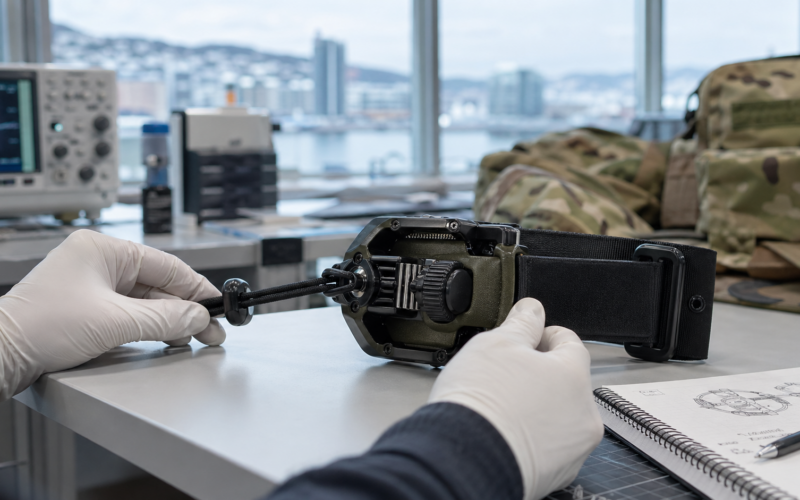
A small Norwegian medtech firm operating out of the Oslo Science Park has spent nearly a decade engineering a battlefield tourniquet that does not look, work, or fail like the two devices most NATO armies still carry as standard issue. Aristeia AS, founded in 2015 and now preparing to commercialise its eighth-generation prototype, has built its design around a pull cord and gear transmission rather than the windlass mechanism used in the Combat Application Tourniquet and the SOF Tactical Tourniquet, the two devices that have anchored Tactical Combat Casualty Care doctrine since 2004. The company’s progress matters less because of the device itself and more because of what its development pipeline reveals about a global procurement market that is being reshaped, in real time, by the Russia-Ukraine war, by a structural reassessment of NATO trauma doctrine, and by a tourniquet systems sector that public research firm Mordor Intelligence values at USD 646.48 million in 2026 and on track to reach USD 930.27 million by 2031.
The Aristeia development is the trigger event. The strategic story is the one underneath: the global tourniquet category, dominated for two decades by a handful of windlass devices recommended by the United States Committee on Tactical Combat Casualty Care, is being forced to evolve by battlefield evidence the existing doctrine was not built to handle.
Why the windlass tourniquet doctrine that defined two decades of combat medicine is now under structural strain
The Combat Application Tourniquet, manufactured by North American Rescue, and the SOF Tactical Tourniquet, manufactured by Tactical Medical Solutions, became the default extremity hemorrhage devices for United States and NATO forces during the Iraq and Afghanistan conflicts. Both rely on a windlass rod that the user twists to tighten a strap around the limb. Research published in the Wilderness Medical Society’s journal documents that these two tourniquets were the first formally recommended by the Committee on Tactical Combat Casualty Care for battlefield use, and that they performed effectively in casualty care from 2004 onward through the United States military’s experience in the Middle East. The 2019 review by the committee subsequently expanded the recommended list to include the SAM-XT, the SOFTT-Wide, the Tactical Mechanical Tourniquet, and several ratcheting and pneumatic options, with the December 2021 update of that list remaining the operative reference through 2026.
The structural problem is that the doctrine these devices support was calibrated to a battlefield that no longer exists in the form NATO planners assumed. A peer-reviewed analysis published in the Journal of Military Medicine, authored by clinicians from Rosalind Franklin University, the Ukrainian Military Medical Service, and Novant Presbyterian Hospital, found that casualty evacuation in Ukraine routinely exceeds six hours and in some cases extends beyond a full day, against the sub-60-minute evacuation windows that defined NATO operations in Iraq and Afghanistan. In the same analysis, tourniquet application was judged appropriate in only 24.6% of wounded soldiers carrying tourniquets in one Ukrainian vascular surgery case series, and the authors concluded that liberal tourniquet use under prolonged evacuation conditions has unintentionally driven up morbidity and amputation rates.
The Centre for European Policy Analysis, citing Colonel Kostiantyn Humeniuk, Chief Surgeon of the Medical Forces of Ukraine, reported that up to 85% of Ukrainian patients diagnosed with tourniquet syndrome ultimately required amputation. The Wilderness Medical Society field report from Ukrainian casualty collection units corroborated the same pattern, documenting cases where tourniquets had been left applied for eight or more hours, resulting in limb loss for injuries that did not require a tourniquet in the first place. The research published in the Chinese Journal of Traumatology, drawing on data from the National Military Medical Clinical Center of the Ministry of Defense of Ukraine, documented that vascular injury rates in modern conflicts have risen roughly fivefold compared with twentieth-century wars, with limb injuries now constituting around 65.7% of combat trauma against a historical range of 42.6% to 51.9%.
The doctrinal implication is unambiguous. The tourniquet procurement framework that NATO has relied on for two decades was optimised for short evacuation windows, embedded combat medics, and air superiority. Ukraine has none of these conditions. The product category therefore needs devices that are faster to apply correctly under stress, easier for non-specialist soldiers to operate, and more durable across long evacuation timelines.
What the Aristeia design represents in a tourniquet market structurally biased toward two incumbent products
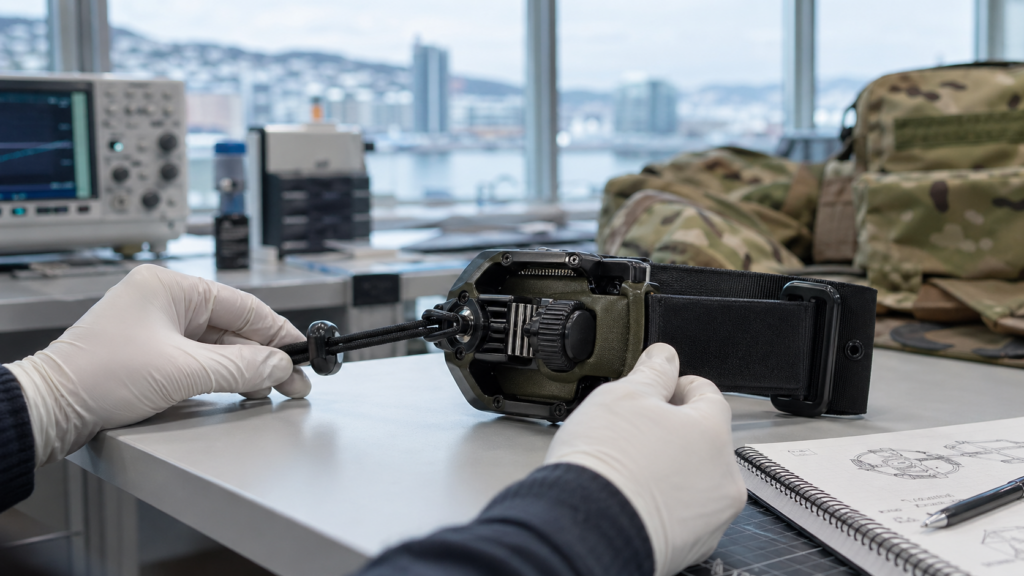
Aristeia’s mechanism, according to public technical descriptions on the company’s corporate communications and Semcon Norway’s product development announcements, is built around a pull cord and gear transmission system, conceptually similar to the starter mechanism on outboard motors and lawn mowers, intended to build occlusion pressure faster than a windlass rotation. The European Patent Office issued patent EP35124 to Aristeia in May 2021, covering a mechanical tourniquet for hemorrhage control in the extremities, with the central novelty claim resting on the transmission system that combines the pull cord with connected gears. Independent testing performed at the Naval Medical Research Unit San Antonio under a Collaborative Research and Development Agreement signed in 2020 confirmed that prototype generations four through six achieved the required 300 mmHg occlusion pressure on the HapMed Leg Tourniquet Trainer, with subsequent design iterations addressing pressure distribution refinements. Aristeia completed Phase I of its CRADA testing programme in autumn 2023.
The company has worked closely with the Norwegian Defence Research Establishment at Kjeller throughout the development cycle, with prototyping conducted at the establishment’s advanced workshop and pre-clinical trials administered by the Comprehensive Defence Division. The Royal Norwegian Ministry of Defence has supported the project under its industry development programme. Semcon Norway, a Kongsberg-based engineering firm with experience in life science and robust transmission systems, joined the development effort to address design-for-manufacturing complexity and assembly procedure simplification, an area Aristeia has flagged as critical to staying price-competitive with the incumbent windlass devices in volume procurement contracts.
Pricing is the structural constraint that determines whether the Aristeia design or any new entrant captures meaningful market share. Public commentary from Ukrainian battlefield medical sources, summarised in the open-access Chinese Journal of Traumatology research, found that Committee on Tactical Combat Casualty Care recommended tourniquets faced significant procurement and supply challenges in Ukraine during 2022 specifically because of high production costs, prompting Ukrainian domestic manufacturers SICH-Ukraine and Dnipro to develop the SICH Tourniquet and the Dnipro II as cost-engineered alternatives. The SICH design replaces plastic components with aluminium alloy for durability and modifies the windlass securing mechanism to a delta ring, with both Ukrainian devices now widely used by the Armed Forces of Ukraine on the battlefield.
A new device entering this market therefore competes against the Combat Application Tourniquet at roughly USD 35 per unit through authorised vendors, against the SOF Tactical Tourniquet Wide at a similar price point, against domestic Ukrainian alternatives priced for wartime budget realities, and against a counterfeit market that, according to authorised vendor reporting, floods Amazon and eBay with fake CAT tourniquets that have caused field failures. The competitive landscape is unforgiving on both price and authenticity.
How the global tourniquet market is being reshaped by NATO restocking and the surgical tourniquet adjacency
The tourniquet category is structurally split between two distinct demand pools that are now converging. The first is the surgical tourniquet segment, used in orthopedic and vascular procedures to create a bloodless surgical field, and the second is the field or tactical tourniquet segment, used for hemorrhage control in trauma and combat. Data from publicly available research summaries by Mordor Intelligence put the tourniquet systems market at USD 601.10 million in 2025, growing to USD 646.48 million in 2026 and forecast to reach USD 930.27 million by 2031 at a compound annual growth rate of 7.55%. North America accounted for 44.98% of 2025 revenue, with Asia-Pacific on track for a 9.95% compound annual growth rate through 2031. By material, nylon devices dominated with 41.95% market share in 2025.
Surgical tourniquet research from Straits Research valued the surgical-only sub-segment at USD 511.20 million in 2024 and forecast it to USD 960.58 million by 2033, citing the Smart Tactical Application Tourniquet and similar tactical-derived designs as evidence of crossover engineering between battlefield and operating room demand. Grand View Research data put the broader tourniquet systems market at USD 514.4 million in 2023, projecting USD 794.7 million by 2030 at an 8.0% compound annual growth rate, with pneumatic cuffs accounting for 88.3% of cuff-type revenue. The competitive landscape across these public research summaries consistently lists Delfi Medical Innovations, Zimmer Biomet, Hammarplast Medical, Stryker, AneticAid, VBM Medizintechnik, Ulrich Medical, ATMOS MedizinTechnik, and a growing tier of Asia-based manufacturers including Jiangsu Rooe Medical Technology and Ysenmed.
The convergence point is procurement volume. NATO members are restocking battlefield medical inventories under sustained Ukraine support obligations, with the Mordor Intelligence summary noting incremental European demand from defence stockpiles as alliance members recalibrate trauma care reserves. The same surgical tourniquet manufacturers whose revenue depends on hospital and ambulatory surgical centre volume are now navigating a battlefield channel that wants different form factors, different price points, and validation pathways the surgical industry has not historically prioritised. New entrants like Aristeia, alongside Ukrainian domestic manufacturers and other designers exploring ratcheting and pneumatic alternatives, are positioned in the narrow space between the incumbent windlass duopoly and the surgical-grade pneumatic systems that are too complex and too expensive for field deployment.
What this means for procurement officers, defence ministries, and trauma care policy through 2027
The investment thesis for retail and institutional readers tracking this segment is structural rather than tactical. Three forces are now operating simultaneously. NATO trauma doctrine is being rewritten under the weight of Ukrainian battlefield evidence, with pre-print and peer-reviewed publications from the International Prehospital Medicine Institute calling for revised tourniquet conversion training, increased Role 2 forward surgical team deployment, and trauma registry implementation across the Ukrainian medical service. The procurement market is restocking at scale, with Mordor Intelligence data showing sustained military demand alongside the surgical channel. And the product category is admitting new mechanical concepts for the first time since the Combat Application Tourniquet and SOF Tactical Tourniquet established the windlass standard in the early 2000s.
The Aristeia trajectory will be tested against three milestones over the next 18 to 24 months. The first is whether the Generation 8 device achieves Committee on Tactical Combat Casualty Care recommended status, which the committee itself has clarified is a recommendation rather than a certification, but which functions as the de facto procurement gatekeeper for United States and most NATO procurement. The second is whether Aristeia can solve the manufacturing economics that have constrained adoption of every non-windlass alternative to date, against incumbent CAT and SOFTT-W devices that benefit from established supply chains and high-volume contract pricing. The third is whether NATO members and the Armed Forces of Ukraine adopt new mechanical concepts at sufficient volume to validate the design beyond pilot procurement.
For sector analysts, the Aristeia case is best read as a signal rather than a single-company story. The structural opening for new tourniquet designs exists for the first time in two decades, and it exists because the existing doctrine and the existing devices were built for a war that does not match the one currently unfolding.
Key takeaways for defence procurement officers, trauma care policy advisers, and medical device investors tracking the tourniquet sector through 2027
- The global tourniquet systems market is valued at USD 646.48 million in 2026 by Mordor Intelligence and forecast to reach USD 930.27 million by 2031 at a 7.55% compound annual growth rate, driven by orthopedic procedure growth, sustained military demand, and smart limb-occlusion-pressure device transition.
- The Combat Application Tourniquet and the SOF Tactical Tourniquet have anchored Tactical Combat Casualty Care doctrine since 2004, and the Committee on Tactical Combat Casualty Care recommended list was last formally updated in December 2021, remaining stable through 2026.
- Casualty evacuation times in Ukraine routinely exceed six hours, against sub-60-minute windows in Iraq and Afghanistan, structurally invalidating key assumptions baked into the existing windlass tourniquet doctrine.
- Up to 85% of Ukrainian patients with tourniquet syndrome required amputation, according to Colonel Kostiantyn Humeniuk of the Medical Forces of Ukraine, exposing the operational cost of doctrine-misaligned tourniquet use under prolonged evacuation.
- Aristeia AS, founded in 2015 in Norway, has developed a pull cord and gear transmission tourniquet, with Generation 8 prepared for offer to military, parapublic, and civilian agencies, and European Patent Office patent EP35124 issued in May 2021.
- Aristeia completed Phase I testing under a Collaborative Research and Development Agreement with the Naval Medical Research Unit San Antonio in autumn 2023, validating 300 mmHg occlusion pressure on the HapMed Leg Tourniquet Trainer.
- Ukrainian domestic manufacturers SICH-Ukraine and Dnipro have launched the SICH Tourniquet and Dnipro II as cost-engineered alternatives to imported Committee on Tactical Combat Casualty Care recommended devices, signalling a market opening for non-windlass mechanical concepts.
- North America accounted for 44.98% of tourniquet systems revenue in 2025, with Asia-Pacific tracking a 9.95% compound annual growth rate through 2031, indicating where procurement growth and price-competitive manufacturing are concentrating.
- Counterfeit Combat Application Tourniquets remain a documented field hazard, with authorised vendor reporting confirming first responder failures from fake devices and authentic CAT Generation 7 units priced at USD 34.99.
- The strategic test for Aristeia and other new entrants over the next 18 to 24 months is achieving Committee on Tactical Combat Casualty Care recommended status, solving manufacturing economics against incumbent supply chains, and securing NATO and Ukrainian adoption volume sufficient to validate the design beyond pilot procurement.
Discover more from Business-News-Today.com
Subscribe to get the latest posts sent to your email.

