




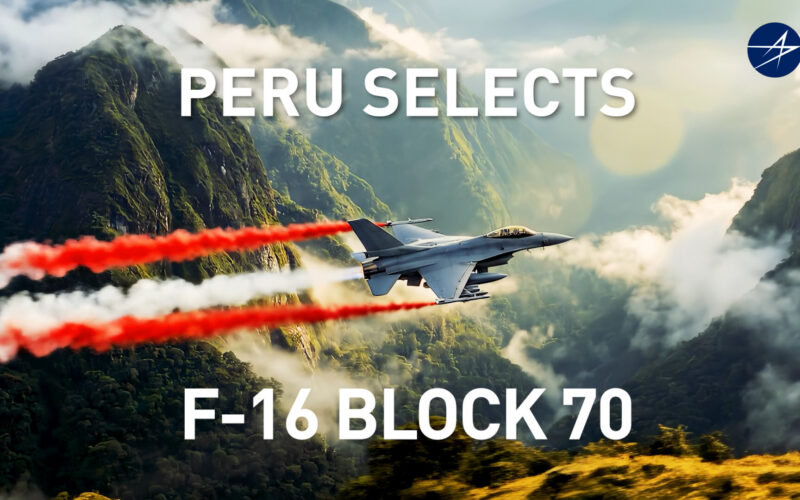
Lockheed Martin (NYSE: LMT) has confirmed the sale of F-16 Block 70 fighter aircraft to the Peruvian Air Force, with the contract formally signed on 20 April 2026 under the United States Foreign Military Sales programme. The initial agreement covers 12 aircraft, comprising 10 single-seat F-16C and two dual-seat F-16D variants, with Lockheed Martin reportedly expanding its offer to a total of 24 jets to align with Peruvian Air Force fleet requirements, at a combined programme value estimated at approximately $3.5 billion including weapons, radar systems, training, and logistical support. Peru’s Ministry of Economy and Finance has confirmed the transfer of a first instalment payment of $462 million, formally activating the procurement. The acquisition replaces an aging mixed fleet of Mirage 2000 and MiG-29 aircraft whose operational availability had deteriorated to a point where Peru’s air sovereignty calculus demanded urgent resolution.
What does Peru’s selection of the F-16 Block 70 mean for Latin American air power balance?
The decision to field the F-16 Block 70 rather than Saab’s Gripen E/F or Dassault’s Rafale carries consequences well beyond the Peruvian defence budget. Brazil and Colombia both selected the Gripen, effectively ceding their procurement influence to Sweden. Peru’s decision now gives Lockheed Martin a foothold on the continent that it previously lacked in the fighter market, and creates a geopolitically visible counterweight to the European platform cluster that had been consolidating in the region. Whether the F-16 gains further South American traction will depend partly on how the Peruvian programme executes and whether the industrial cooperation commitments translate into tangible in-country economic activity.
The Block 70 is the most advanced production configuration of the F-16 to date, equipped with Northrop Grumman’s APG-83 AESA fire control radar, which delivers fifth-generation radar capabilities in a fourth-generation airframe. Conformal fuel tanks provide a roughly 60 percent increase in operational range, expanding the aircraft’s mission radius without compromising its combat load. The integration of the Automatic Ground Collision Avoidance System, which has prevented 13 pilot fatalities and saved 12 aircraft since entering service in 2014, meaningfully improves survivability for an air force operating in the varied terrain of the Andes and Amazon basin. For Peru, which historically operated Soviet and French platforms, the switch to a predominantly American supply chain also changes its entire maintenance, training, and interoperability architecture, with long-term implications for defence industrial dependencies.
Why did Peru’s procurement process become a diplomatic flashpoint between Lima and Washington?
The path to contract signature was unusually turbulent. Lockheed Martin was formally notified of its selection on 14 April. A technical signing scheduled for 17 April at Las Palmas Air Base was postponed without advance notice to the American side, which the United States Embassy in Lima described pointedly as inconsistent with how one conducts serious business with a leading aerospace company. The interim administration of President José María Balcázar subsequently announced a suspension of negotiations, arguing the decision should be deferred to the incoming government scheduled to take office in July 2026. That position collapsed within days under a combination of contractual penalties, congressional pressure, and direct public interventions from the U.S. ambassador, with Congress President Fernando Rospigliosi confirming the first payment was made on 22 April.
The episode reveals a structural tension in procurement decisions that straddle electoral transitions. Peru’s interim government was functionally correct that a commitment of this scale carries policy weight across administrations, but the contract had already been signed by authorized officials with, as the U.S. Embassy noted, full knowledge at the highest levels of the Peruvian government. The diplomatic friction was not simply an administrative dispute. U.S. Ambassador Bernie Navarro issued an explicit public warning on 17 April that Washington would use every available tool to protect U.S. interests if the deal was undermined, a statement that registered the transaction as carrying bilateral significance beyond its defence utility. Congressional motions for a censure of President Balcázar were initiated in response to the episode, adding domestic political volatility to what should have been a routine milestone payment.
How does the F-16 Block 70 deal affect Lockheed Martin’s competitive position in foreign military sales?
Lockheed Martin’s decision to effectively double its original offer from 12 to 24 aircraft while reportedly adding only $80 million to the contract value represents a calculated market penetration move in a region where it had no existing fighter customer base. The implied per-unit effective cost of approximately $140 million, inclusive of training, armaments, spare parts, and maintenance support, is a price point designed to secure a long-term customer relationship rather than to maximise margin on the initial transaction. Peru joins a global installed base of more than 2,800 F-16s across 30 nations, which means logistics, parts, and upgrade pathways are available at scale. For Lockheed Martin, each new operator strengthens the programme’s unit economics and extends the production run for the Greenville, South Carolina facility where Peru’s aircraft will be built.
The timing coincides with a notably active period for Lockheed Martin’s foreign military sales pipeline. The company has secured a multibillion-dollar PAC-3 Missile Segment Enhancement production contract from the U.S. Army, delivered the final GPS III satellite, and is tracking elevated defence spending across NATO and Indo-Pacific partners. The F-16 Block 70 programme sits within the Aeronautics segment, which generates the majority of the company’s revenue and anchors the F-35 Joint Strike Fighter as its primary revenue driver. Peru’s acquisition is not material to Lockheed Martin’s near-term earnings, but it extends the F-16 production line’s long-term viability and adds a new node to the global support network that underpins recurring services revenue.
What is the market and financial context for Lockheed Martin at the time of the Peru announcement?
Lockheed Martin shares closed at $592.19 on 18 April, down 2.52 percent from the prior session, and have traded within a 52-week range of $410.11 to $692.00. The stock is closer to the midpoint of that range, having pulled back from a closing high of $676.70 in early March 2026. Year-to-date performance remains positive at around 20 percent. The company’s earnings report for Q1 2026, released on 23 April, is being closely tracked by analysts, with consensus expectations of $6.73 earnings per share and approximately $18.24 billion in revenue. Lockheed Martin beat Q1 2026 estimates materially, delivering $7.43 earnings per share against a $5.81 consensus, with revenue of $20.33 billion exceeding the $19.86 billion forecast. The company has guided 2026 full-year sales in the range of $77.5 billion to $80 billion.
Analyst sentiment is cautious rather than negative. The consensus rating is a Hold, with an average price target of $624.36. Jefferies raised its target to $640 and Citigroup to $675 in early April, both in anticipation of continued strong defence spending tailwinds. The Peru deal, while politically noisy, does not in itself shift the near-term earnings narrative. What it does reinforce is the durability of the F-16 programme as a revenue-generating asset well into the next decade, particularly as the Greenville production facility ramps to meet orders from Bahrain, Bulgaria, Slovakia, and now Peru.
What are the execution and geopolitical risks Peru and Lockheed Martin must navigate?
The programme faces several categories of execution risk. Delivery timelines for the Block 70 variant are not confirmed, though analysts have assessed the aircraft could begin arriving before the end of the decade given existing production queues. Peru’s military infrastructure will need meaningful upgrade to support the F-16’s logistical and maintenance requirements, a point that the competing Gripen proponents raised during the selection process. The Saab offering’s ability to operate from austere airstrips was a genuine operational advantage that Peru accepted a trade-off on by choosing the F-16.
The political transition risk is real. The incoming Peruvian administration taking office in July 2026 did not select the aircraft and is not bound by the same institutional enthusiasm. However, the first instalment has now been paid, breach-of-contract penalties would be material, and the U.S. bilateral relationship creates strong disincentives to reversal. The more credible risk is programme scope creep in the opposite direction, specifically whether Peru follows through on the expansion to 24 aircraft, which would require a further approximately $1.5 billion in budget commitments beyond the initial $2 billion allocation. Peru’s 2026 national budget has allocated $1.5 billion for the follow-on purchase, indicating that political will was at least institutionalised in the budget process before the current administration began its last months in office.
What are the key takeaways from Peru’s F-16 Block 70 acquisition from Lockheed Martin?
- Peru has formally contracted for 12 F-16 Block 70 aircraft with a total programme value estimated at $3.5 billion, with an option structure that could expand the fleet to 24 jets, making it one of the most significant Latin American defence procurements in a generation.
- The first instalment payment of $462 million was confirmed on 22 April 2026, activating the contract and reducing reversal risk for Lockheed Martin.
- Lockheed Martin’s decision to double the aircraft count for approximately $80 million in additional contract value signals a deliberate market penetration strategy in a region where the Gripen had previously held competitive momentum.
- The F-16 Block 70’s APG-83 AESA radar and conformal fuel tanks give Peru capabilities that neither the Mirage 2000 nor the MiG-29 fleet could provide, transforming the Peruvian Air Force’s operational ceiling against regional peers.
- Peru’s selection creates a new anchor customer for the Greenville production facility and extends Lockheed Martin’s F-16 production economics alongside existing Block 70 orders from Bahrain, Bulgaria, and Slovakia.
- The diplomatic friction during the procurement, including a public warning from the U.S. ambassador and a near-collapse of the April 17 signing, reflects the broader pattern of Washington treating Foreign Military Sales as a tool of strategic relationship management, not purely commercial activity.
- Lockheed Martin shares are trading near the midpoint of a $410 to $692 52-week range, with Q1 2026 earnings released today and analysts maintaining a Hold consensus ahead of confirmation that strong beat momentum continues.
- The incoming Peruvian administration taking office in July 2026 will inherit a financially committed programme, but execution of the follow-on 24-aircraft tranche is not guaranteed and represents the primary programme risk.
- For Latin American competitors considering fighter modernisation, Peru’s F-16 selection will be studied carefully, and Lockheed Martin now has a continent-level case study to deploy in future procurement competitions.
- The transaction reinforces that U.S. defence industrial exports remain a primary instrument of bilateral alliance management under the current Washington policy posture, with commercial and strategic motivations now nearly inseparable in large foreign military sales.
Discover more from Business-News-Today.com
Subscribe to get the latest posts sent to your email.

