



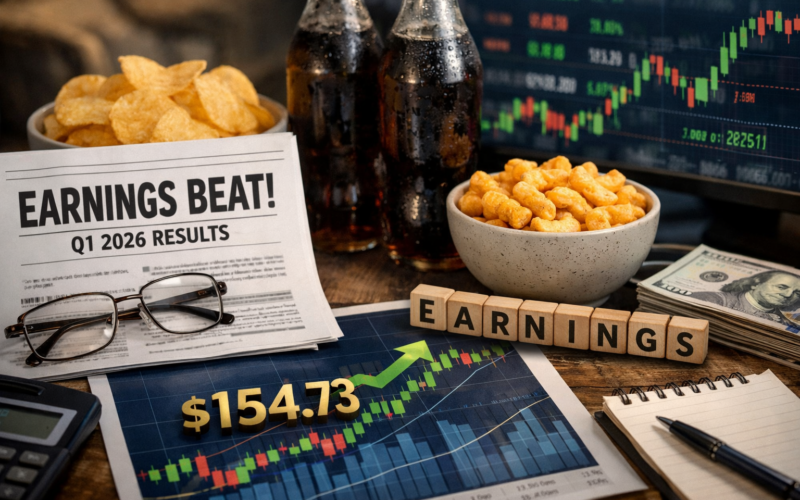
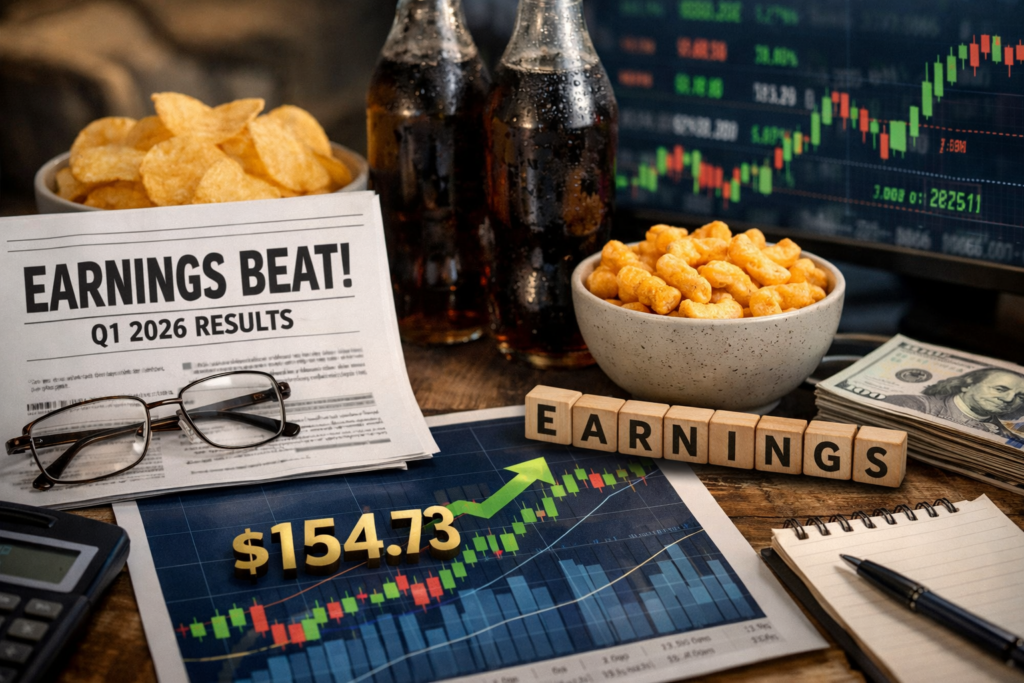
PepsiCo, Inc. (NASDAQ: PEP) reported first-quarter 2026 results on 16 April 2026 that beat analyst expectations on both earnings and revenue, with core earnings per share of $1.61 against a consensus of $1.55 and net revenue of $19.44 billion against an expected $18.94 billion. The headline number that mattered most was the 2% volume growth reported by PepsiCo Foods North America, a meaningful signal that the company’s affordability and brand-reset strategy is beginning to move the needle after quarters of erosion. Total net revenue rose 8.5% year-over-year while organic revenue grew 2.6%, with core operating profit up 9% and core EPS expanding by the same margin, and PepsiCo affirmed its full-year fiscal 2026 guidance in full. The PEP stock closed at approximately $154.80 on April 16 and was trading around $154.73 in after-hours, reflecting a roughly 2% intraday gain on strong volumes, a measured but positive reaction consistent with a beat-and-hold scenario from a market that had anticipated the recovery but wanted confirmation.
Did PepsiCo Foods North America deliver the volume inflection investors were waiting for in Q1 2026?
The most consequential story in PepsiCo’s Q1 2026 results was the performance of PepsiCo Foods North America, the segment that encompasses Frito-Lay’s US business and has been the central drag on investor sentiment over the past 18 months. The division reported 2% volume growth, a figure that belies the strategic complexity underneath it. Earlier this year, PepsiCo cut prices on Lay’s, Tostitos, Doritos, and Cheetos by as much as 15% in an effort to rebuild household penetration and pull back lapsed consumers who had stepped away from the category amid sustained inflation. That pricing adjustment is now showing up in the volume line, but the company was clear that price adjustments are only one of several levers being pulled simultaneously.
The restage of the Lay’s brand, which is being executed as a global initiative rather than a US-only program, is another component. PepsiCo added more space with retail partners, relaunched brand creative including a high-profile Super Bowl campaign, and shifted investment meaningfully toward the away-from-home channel, which is now growing at three times the company average within the foods division. The permissible and functional portfolio, covering brands including SunChips, Smartfood, and Siete, is delivering double-digit growth in several product lines, providing margin cover as the core brands absorb the pricing concessions. The overall outcome in Q1 was 300 million net new consumption occasions in the foods business compared with the same quarter a year earlier, a figure that management pointed to as one of its most important leading indicators of durable share recovery.
The more granular read from IRI data suggested PepsiCo was already gaining value share in the three weeks leading up to earnings, layered on top of volume share gains that had been accumulating for several periods. That combination, volume and value share growth simultaneously, is a more convincing proof point than volume alone. Management was explicit that shelf reset execution is roughly halfway complete and that by the end of the second quarter the process should be largely finished, with innovation deployment at around 50% of eventual all-commodity volume at the time of the earnings call. The implication is that the Q1 result represents an early-stage recovery, not a peak.
How is PepsiCo managing inflation risk from the Iran conflict across its North America and international operations?
PepsiCo’s management was direct in acknowledging that inflation will come as a consequence of the ongoing conflict in West Asia, while simultaneously declining to quantify magnitude, citing genuine uncertainty. The company’s near-term position is defensible: systemic hedging programs covering a 6 to 12-month horizon provide a meaningful buffer, and the structural cost reductions executed in 2025, including headcount reductions, plant closures, and SKU rationalisation, have already brought North America Foods operating costs down year-over-year in Q1, a rare outcome in a cost-inflationary environment.
The company’s philosophy for managing sustained inflation rests on three sequential responses: growing volume to leverage fixed infrastructure, intensifying productivity to reduce unit cost, and using price-pack architecture to adjust revenue per unit where necessary. Management indicated a preference for achieving the majority of offset through the first two levers, reserving price adjustments as a secondary tool given the sensitivity of its North America recovery to sustained affordability positioning. The productivity program, which management indicated is tracking toward a record year on the metric, encompasses global shared services, AI applications in supply chain and route optimisation, digital ordering platforms in international markets, and ongoing work on supply chain integration tests currently running in Texas that could become a wider deployment model in 2027.
Critically, international operations are not only intact but accelerating. PepsiCo’s Europe, Middle East and Africa segment delivered 9% volume growth, and Asia Pacific Foods grew volume 9% as well. Management attributed this in part to a genuine supply chain advantage over some competitors in food, particularly in geographies exposed to disruption from the conflict. The World Cup, scheduled for later in 2026, is being treated as a significant commercial event rather than a background marketing moment, with PepsiCo deploying the No Lay’s, No Game campaign at scale globally, negotiating space gains with retailers, and building personalised digital consumer engagement around the tournament. Early international market data was already showing category acceleration ahead of the event.
What is happening with PepsiCo Beverages North America and why is the 9% revenue growth figure misleading on its own?
PepsiCo Beverages North America reported 9% total revenue growth in Q1 2026, a number that looks strong in isolation but requires substantial unpacking. Approximately 7 percentage points of that growth came from acquired and newly onboarded distribution platforms, principally the poppi acquisition and an expanded energy portfolio anchored by Celsius. Organic beverage revenue grew at 2%, which is sequential improvement but still operating below the company’s long-term growth aspirations for the division.
Volume in beverages was negative 2.5% for the quarter, but management was insistent on stripping out the impact of the case pack water transition, where PepsiCo handed a low-margin commodity water business to a third party. Excluding that structural shift, which management said laps in approximately one more month, beverage volume was roughly flat. The expectation is for positive volume growth in beverages excluding case pack water in coming quarters, a baseline that is achievable given the mix of tailwinds at play: Gatorade and Propel gaining share in functional hydration, which is growing ahead of the total liquid refreshment beverage category for the first time in several years; Celsius distribution generating incremental scale; poppi beginning to accelerate into Q2; and Mountain Dew showing early signs of stabilisation through new flavour variants including Dirty Mountain Dew and regional limited-edition launches.
The Pepsi trademark itself remains a work in progress. No-sugar Pepsi continues to outperform full-calorie variants and is gaining on competitors, but the broader carbonated soft drink category requires a more sustained commercial cadence before volume trends turn decisively positive. The coffee and tea businesses, where PepsiCo holds leading positions through the Starbucks ready-to-drink partnership and Lipton Tea and Other Beverages, were flagged as areas still requiring acceleration, with Q2 innovation in the Starbucks portfolio aimed partly at addressing that gap.
How does PepsiCo’s Q1 2026 market reaction compare with what the numbers actually justify?
PEP traded at approximately $154.80 at close on 16 April 2026, representing roughly a 2% gain on the session. The 52-week range sits between $127.60 and $171.48, placing the post-earnings price in the middle third of the trailing year’s range, well off the February 2026 high but substantially recovered from the mid-2025 lows. Year to date, PEP had gained around 8 to 9% heading into the print, broadly consistent with a market that had been pricing in a modest recovery rather than either a collapse or a breakout.
The 2% intraday gain is measured and arguably conservative relative to the breadth of the beat. Core EPS of $1.61 against a $1.55 consensus is a 3.9% upside surprise on the earnings line, while revenue of $19.44 billion came in half a billion ahead of street estimates. The guidance affirmation, which some investors had feared might be quietly softened given inflation uncertainty from the conflict, instead came through unchanged, covering organic revenue growth of 2 to 4%, core constant currency EPS growth of 4 to 6%, capital spending below 5% of net revenue, and free cash flow conversion of at least 80%. Total shareholder returns of approximately $8.9 billion, including $7.9 billion in dividends, remain on track, anchored by PepsiCo’s 54th consecutive annual dividend increase.
The restrained market reaction is consistent with a stock that is being treated as a defensive repositioning trade rather than a growth story. At a forward price-to-earnings multiple of approximately 18 times, PEP trades at a modest discount to both the S&P 500 and the consumer staples sector average, which is a structural feature rather than a temporary discount given the mix of ongoing North America recovery execution risk and geopolitical cost uncertainty. The analyst consensus prior to earnings was Moderate Buy with a mean price target of approximately $173, implying meaningful upside from current levels if management executes against the second half acceleration scenario.
What does PepsiCo’s productivity programme signal about the company’s structural cost position heading into 2027?
One of the less-discussed but strategically significant disclosures from the Q1 2026 earnings call was the depth of PepsiCo’s ongoing productivity agenda. The company is tracking toward what management described as a record year of productivity savings, drawing on a multi-year programme originally announced in 2019 and since extended through 2030. The near-term drivers are well understood: reduced headcount, fewer plants, a rationalised SKU count, and supply chain efficiency metrics including cases-per-hour improvements that free up capacity without additional capital investment.
The longer-term drivers are less visible to external observers but are likely more durable. PepsiCo is deploying AI across its supply chain, route optimisation, and sales force operations at a meaningful scale. In multiple international markets, the company has shifted sales ordering to digital platforms, reducing the time cost of field sales activity and enabling better inventory positioning in real time. The supply chain integration pilot running in Texas, where PepsiCo is testing a more consolidated US operating model, could generate substantial structural savings if it validates at scale, though management was careful to frame this as an early-stage learning exercise rather than a committed programme with quantified returns.
The relevance of the productivity story for 2027 planning is significant. If inflation from the conflict proves sustained and moderate rather than severe and abrupt, PepsiCo’s cost structure may give it more runway than peers to continue investing in brand recovery without sacrificing margin. If inflation proves severe, the productivity buffer limits the ceiling on how much pricing action is required and therefore how much near-term volume is at risk. Either way, the company enters a potentially turbulent cost environment with more structural flexibility than it had entering 2025.
Key takeaways on what PepsiCo’s Q1 2026 results mean for the company, its peers, and the broader food and beverage industry
- PepsiCo Foods North America delivered 2% volume growth in Q1 2026, the clearest evidence to date that the February price cuts and brand restage programme are restoring consumer engagement rather than simply defending shelf space.
- The 300 million incremental consumption occasions added to the foods business in Q1 versus the prior year period is a more durable metric than volume alone, as it signals category re-entry from lapsed consumers rather than just pantry loading.
- Organic revenue growth of 2.6% and core EPS growth of 9% represent a beat on both lines, with the full-year guidance range of 2 to 4% organic revenue growth and 4 to 6% core constant currency EPS growth affirmed without qualification.
- PepsiCo Beverages North America’s headline 9% revenue growth conceals an organic revenue number of 2% and a volume decline of 2.5%, both of which improve materially when the structural case pack water transition is excluded.
- The Iran conflict has not yet produced observable demand destruction in international markets, and in some geographies PepsiCo’s supply chain reliability is creating a competitive advantage over less-prepared peers in the food segment.
- The World Cup activation represents the most significant single-event commercial programme in PepsiCo’s near-term international calendar, with the No Lay’s, No Game campaign, global flavour innovation, and deep retail partnerships positioned to drive occasion development across markets where per-capita consumption remains underpenetrated.
- PepsiCo’s productivity programme is tracking toward a record year of savings, drawing on headcount reductions, plant rationalisations, AI deployment in supply chain and go-to-market, and early-stage supply chain integration work in the United States.
- The poppi acquisition, energy portfolio expansion through Celsius distribution, and functional hydration growth via Gatorade and Propel are giving PepsiCo Beverages North America a structural revenue base that supplements the organic beverage business while organic volume trends recover.
- PEP’s post-earnings trading at roughly $154.80, a 2% gain, implies the market is accepting the recovery narrative without pricing in full execution, which maintains the stock’s defensive profile and dividend yield of approximately 3.6% as the primary near-term investor proposition.
- Competitors in the convenient foods category, including privately held Frito-Lay rivals and branded snack companies targeting permissible and better-for-you positioning, face a PepsiCo that is simultaneously cutting prices on core products, launching functional innovation, and defending shelf space with more resources than at any point in the recent past.
Discover more from Business-News-Today.com
Subscribe to get the latest posts sent to your email.