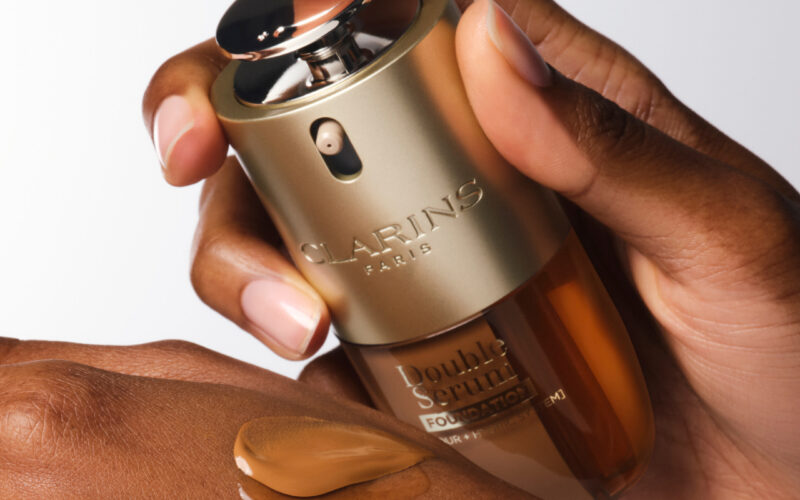
Clarins has introduced Double Serum Foundation, a new complexion product designed to extend the commercial power of its flagship Double Serum franchise into color cosmetics. The launch matters because it signals a sharper push by Clarins to compete in one of beauty’s most commercially attractive segments: skincare-infused makeup that promises both instant visible payoff and longer-term treatment benefits. Priced at $62 and launching in 37 shades, the product sits squarely in the premium tier, where brands are increasingly trying to justify higher price points through efficacy claims, ingredient storytelling, and customization. For Clarins, this is not merely another foundation launch. It is an attempt to turn skincare equity into a broader platform strategy.
Why is Clarins extending Double Serum into foundation instead of launching a standalone makeup line concept?
The logic behind the move is fairly straightforward. In prestige beauty, franchise extensions work best when consumers already trust the parent product’s efficacy, and Clarins has clearly decided that Double Serum has enough brand equity to carry that burden. Rather than asking consumers to evaluate a completely new complexion concept from scratch, Clarins is borrowing credibility from a product line that has long been positioned as high-performance skincare. That reduces educational friction, shortens the path to trial, and lets the company market the foundation as an evolution rather than a gamble.
This matters because the hybrid beauty category has become one of the few areas in makeup where premium pricing still feels defensible. Consumers may hesitate to pay luxury prices for a conventional foundation unless the finish, shade match, or brand prestige is exceptional. But when a complexion product is framed as part skincare, part makeup, the perceived value equation changes. Suddenly the consumer is not just buying coverage. They are buying hydration, glow, treatment, ingredient sophistication, and the comforting illusion that makeup is doing the work of a serum while they wear it. Beauty companies did not invent that instinct, but they have become highly skilled at monetizing it.
Clarins is also leaning into a category where its heritage gives it a legitimate narrative advantage. The company’s historical identity has been closer to plant-based skincare and treatment-led beauty than to trend-driven color cosmetics. A skincare-first foundation allows Clarins to enter a high-volume makeup category without abandoning what made the brand distinctive in the first place. In other words, this is not Clarins trying to become a makeup brand overnight. It is Clarins trying to make makeup behave more like Clarins.
How does Double Serum Foundation fit into the premium beauty industry’s shift toward hybrid complexion products?
The broader beauty market has been moving toward products that blur the line between treatment and appearance for several years, but the complexion segment remains especially important because it sits at the intersection of daily use, visible transformation, and repeat purchase behavior. Hybrid foundations, tinted serums, skin tints, and glow-enhancing complexion products all appeal to a consumer who increasingly wants fewer steps, more multifunctionality, and less guilt about wearing makeup every day.
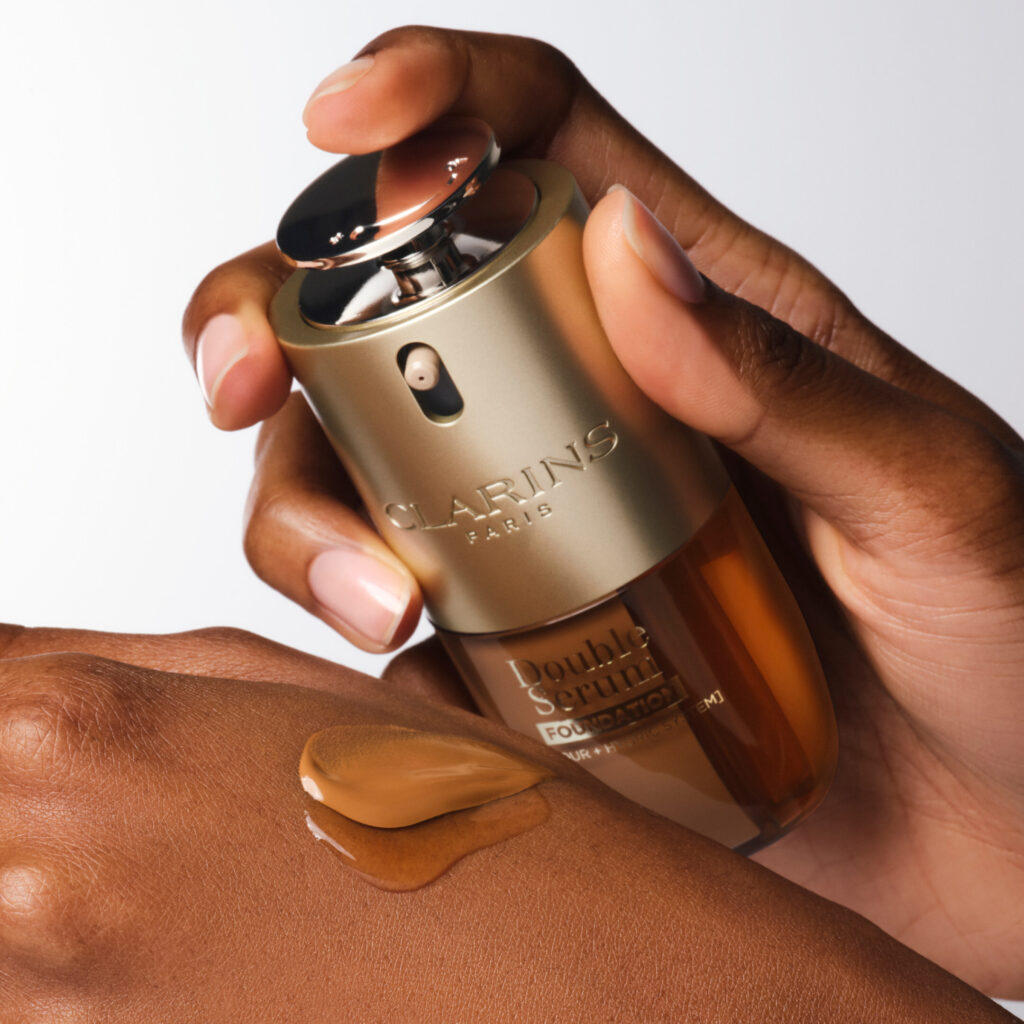
Clarins appears to be positioning Double Serum Foundation directly into that consumer mindset. The company says the product includes 2/3 makeup and 1/3 serum, combines immediate coverage with hydration and radiance claims, and uses a dual-chamber system to preserve ingredient potency. Those details are not just formulation notes. They are marketing architecture. They allow Clarins to argue that the product is not a foundation with a few skincare ingredients tossed in for label appeal, but a purpose-built hybrid designed around performance and treatment logic.
That distinction matters in premium beauty because consumers are becoming more selective about what counts as innovation. A brand can no longer slap hyaluronic acid into a standard formula and expect applause. It needs a system, a mechanism, a hero ingredient story, and preferably a device or packaging feature that implies laboratory seriousness. Clarins has tried to assemble that full stack here through its A.U.R.A. technology positioning, stabilized papain, turmeric continuity from Double Serum, and adjustable dual-chamber packaging. Whether all of that creates enduring commercial differentiation is another question, but strategically, the brand understands the assignment.
Can Clarins justify a $62 price point in a crowded market for premium serum foundations?
The $62 price tag places Double Serum Foundation in a zone where the product must do more than simply perform well. It must communicate value in a way that feels layered and rational, especially as consumers face no shortage of premium complexion options. At that price, Clarins is not competing only on finish or wear time. It is competing on trust, ingredient credibility, sensory experience, shade inclusivity, packaging quality, and brand reassurance.
The company’s answer appears to be to build a case around multifunctionality and long-term skin benefit. Clarins says the product offers 12 hours of medium-to-full coverage, 24 hours of hydration, immediate radiance improvement, and enhanced bare-skin glow after 28 days. It also emphasizes that 87% of the formula is skincare ingredients and highlights a formula built around multiple plant extracts and active molecules.
Commercially, that strategy is sensible because premium beauty consumers are often willing to pay more when a product appears to replace two or three steps in their routine. A $62 foundation sounds expensive until it is framed as part serum, part treatment, part glow enhancer, and part complexion product. Then it starts sounding like a luxury productivity hack. Beauty, after all, has always had a soft spot for products that promise to save time while charging more for the privilege.
Still, the pricing also raises execution pressure. At this level, weak shade matching, underwhelming longevity, or consumer skepticism around treatment claims can quickly undermine repeat purchase. Prestige beauty can forgive an ambitious promise once. It is less forgiving when the refill cycle does not happen.
What do the formulation claims reveal about Clarins’ strategy to differentiate beyond branding alone?
One of the more important aspects of this launch is that Clarins is trying to differentiate with a full ingredient and technology narrative rather than relying solely on franchise branding. The company highlights stabilized papain for surface renewal and radiance, turmeric extract as a continuity bridge to the Double Serum identity, peptides, hyaluronic acid, squalane, aloe vera, and an anti-pollution complex. It also frames the A.U.R.A. technology as a light-diffusion system built around ingredients such as glycerin, squalane, and illuminating microcrystals.
From a strategic perspective, this is important because premium beauty increasingly depends on layered justification. Consumers want emotional branding, but they also want the language of efficacy. They may not read every molecule name, but they notice when a product sounds specific rather than generic. Clarins is trying to create that specificity without drifting too far into inaccessible science.
The other notable part of the strategy is the explicit attempt to link short-term cosmetic performance with long-term skin outcomes. That is the holy grail for complexion marketing because it lets a brand address both immediate vanity and future skin maintenance. Instant radiance sells the first purchase. Long-term improvement sells the second. Whether those claims resonate at scale will depend on consumer experience and word of mouth, but as a commercial framework, it is strong.
Why could shade range, packaging customization, and sustainability claims matter as much as the formula itself?
In premium complexion, formula alone rarely determines success. Usability matters. Inclusivity matters. Packaging matters. Clarins says Double Serum Foundation will be available in 37 shades and includes a customizable dial that allows users to control dosage and coverage. That is more than a convenience feature. It is a strategic attempt to support personalization, minimize waste, and align the product with the consumer expectation that premium beauty should adapt to them, not the other way around.
Shade range is especially important because complexion launches can still stumble badly if inclusivity feels like an afterthought. Clarins is clearly signaling awareness of that risk by emphasizing testing across a diverse panel and undertone accuracy. In today’s prestige market, a foundation launch without credible shade breadth is not just a merchandising problem. It is a reputational problem.
Then there is sustainability. Clarins says the product uses an 87% natural-origin formula, packaging made with at least 38% recycled materials, and more than 90% recyclable components, while pointing consumers to its T.R.U.S.T. traceability platform. These claims matter because premium beauty shoppers increasingly expect sustainability messaging to accompany luxury positioning. But they also matter because they support margin defense. Environmental transparency, when integrated cleanly into product storytelling, can strengthen brand loyalty and reduce price resistance. Cynics might say it is conscience-friendly premiumization. Cynics are often annoying, but in beauty they are not always wrong.
What are the biggest commercial opportunities and execution risks in Clarins’ serum foundation rollout?
The opportunity is clear. If Double Serum Foundation lands well, Clarins could deepen customer lifetime value by extending a trusted skincare franchise into an adjacent category with high repeat potential. It could also attract makeup users who may not have considered Clarins a first-choice complexion brand before. In that sense, this launch is part acquisition tool, part retention tool, and part margin strategy.
There is also portfolio logic here. A successful hybrid foundation could create room for Clarins to build out a wider complexion ecosystem around primers, concealers, finishers, or treatment-led base products. Once a franchise proves it can travel, companies rarely stop at one boarding gate.
The risks, however, are just as real. Hybrid claims can backfire if users experience the product as neither a truly superior foundation nor a meaningful skincare upgrade. Prestige beauty buyers are willing to indulge category experimentation, but only when the product actually earns its counter space. Clarins will need strong retail education, clear sampling, excellent shade conversion, and consumer reviews that confirm the product lives up to its promise.
Another risk is that franchise extension can dilute brand icons if the new product feels opportunistic. Double Serum is a meaningful name in Clarins’ portfolio. If the foundation becomes associated with overclaiming or mediocre performance, that halo can wobble. Extending a hero product is efficient, but it is not consequence-free. Brand equity is portable until it is not.
What does the Clarins Double Serum Foundation launch signal about where premium beauty is heading next?
This launch suggests that premium beauty is moving deeper into convergence rather than category purity. The old boundaries between skincare and makeup are continuing to erode, and brands increasingly view complexion as the ideal place to monetize that overlap. Consumers want glow, treatment, convenience, and fewer product steps. Companies want premium pricing, repeat purchase, and stronger franchise ecosystems. Hybrid complexion products sit nicely in the middle of that Venn diagram.
For Clarins, Double Serum Foundation looks less like a one-off novelty and more like a statement about future growth architecture. The company is using its skincare authority to enter a more dynamic makeup battleground without abandoning its brand DNA. That is strategically smart. The question now is whether execution matches the ambition. In beauty, the launch story can sound gorgeous. The real test begins at the mirror, under bad bathroom lighting, on a tired Tuesday morning. That is where premium claims either become habit or become markdown inventory.
What do Clarins’ new serum foundation plans mean for premium beauty competition and category strategy?
- Clarins is using an established skincare franchise to lower the risk of entering a highly competitive complexion category.
- Double Serum Foundation is positioned as a platform extension, not just a product launch, which could support broader makeup portfolio expansion.
- The $62 price point signals that Clarins is targeting value through multifunctionality rather than competing on accessibility.
- Hybrid complexion remains one of the strongest premium beauty formats because it supports both efficacy messaging and premium margin defense.
- Ingredient storytelling, packaging technology, and dose customization are being used as commercial differentiation tools, not merely formulation details.
- Shade breadth and undertone credibility will be critical to whether the product earns repeat purchase and retailer support.
- Sustainability and traceability claims are increasingly part of premium beauty’s pricing logic, not just corporate reputation management.
- The biggest upside for Clarins is stronger customer lifetime value across skincare and makeup; the biggest risk is dilution of the Double Serum halo if consumer experience disappoints.
- Competitors in prestige beauty may face added pressure to make complexion products feel more treatment-led and scientifically justified.
- The launch reinforces a broader industry direction: in premium beauty, categories are blurring, and the brands best positioned for growth may be the ones that make those blurred lines feel useful rather than gimmicky.
Share this:
Discover more from Business-News-Today.com
Subscribe to get the latest posts sent to your email.