


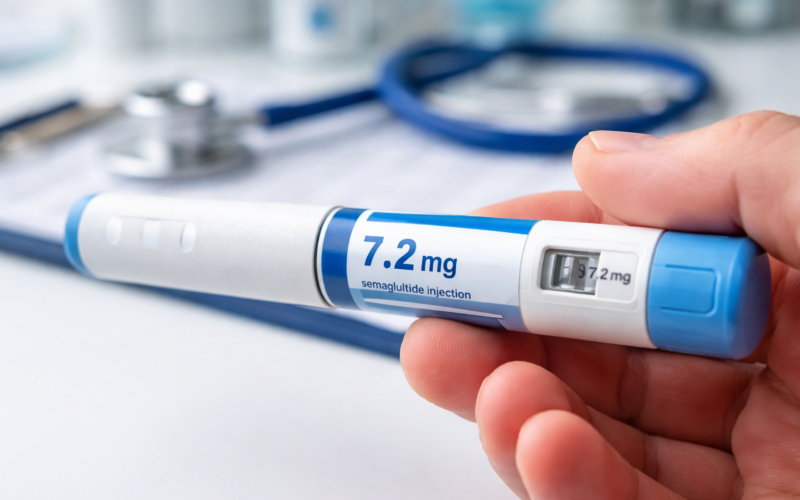
The Medicines and Healthcare products Regulatory Agency (MHRA) has approved a new single-dose 7.2mg semaglutide pen for Wegovy in adult obesity treatment, giving eligible patients in the United Kingdom a simpler way to receive the maximum weekly dose. The approval applies to adults with obesity defined as a Body Mass Index of 30kg/m² or higher and converts what had previously required three separate 2.4mg injections in one day into a single injection format. For Novo Nordisk A/S, the decision is strategically important because it improves convenience at the top end of its obesity treatment ladder just as competition in the GLP-1 market is intensifying. The company’s United States-listed shares were trading around $37.98 on April 14, 2026, while recent company materials have already positioned 7.2mg expansion as part of its 2026 obesity rollout plan.
Why does the MHRA approval of a single-dose Wegovy 7.2mg pen matter for obesity treatment in the United Kingdom?
The immediate significance of the MHRA decision is operational rather than scientific. The regulator is not introducing a new active ingredient and it is not broadening Wegovy into a fresh disease area. Instead, it is approving a more practical delivery format for the already authorised 7.2mg weekly dose. That matters because convenience is not a cosmetic feature in chronic disease treatment. In obesity care, adherence is everything, and any step that reduces friction between prescription and sustained use can have outsized commercial and clinical consequences.
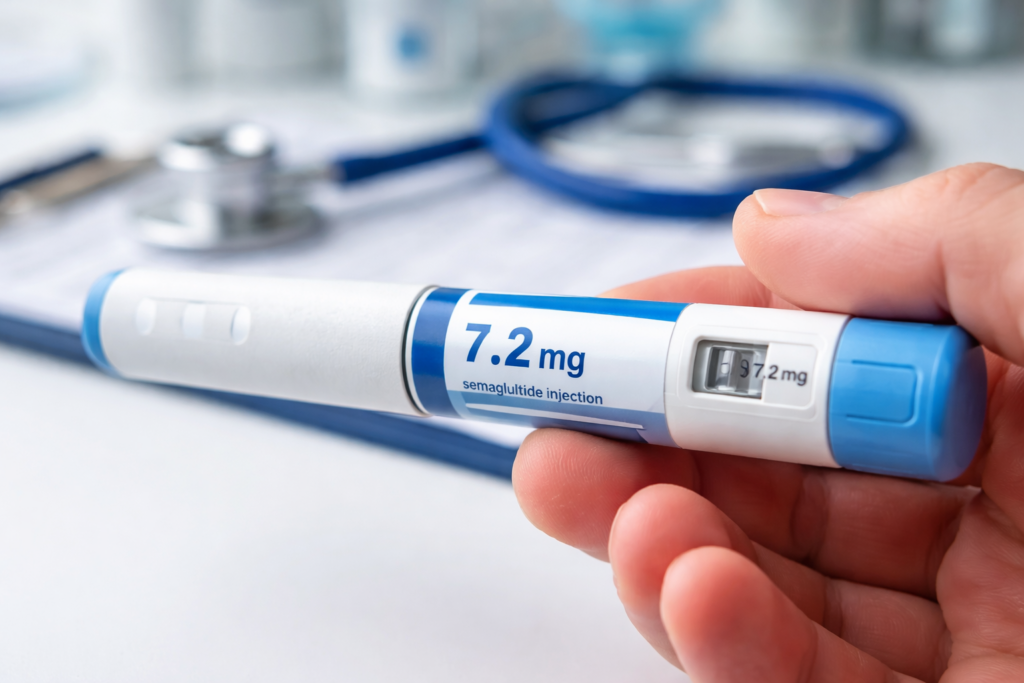
Until now, the 7.2mg maximum weekly dose authorised in January 2026 required three 2.4mg injections administered on the same day. The new pen consolidates that into one injection. In plain English, this is less hassle for patients, less room for administration error, and a cleaner value proposition for prescribers discussing long-term escalation pathways. For a medicine category where dropout rates, side-effect management, and patient expectations all influence outcomes, simplification is a serious strategic lever, not a minor packaging tweak.
The approval is also tightly framed. It covers adult patients with obesity at a Body Mass Index of 30kg/m² or higher. The MHRA explicitly said the decision does not apply to overweight patients below that threshold using Wegovy for weight management, nor to patients taking Wegovy for cardiovascular risk reduction. That narrower wording matters because it shows the regulator is keeping indication boundaries clear even as semaglutide’s uses continue to expand. In today’s GLP-1 market, where public discussion often outruns label details, regulatory precision is doing some quiet heavy lifting.
How does the new Wegovy 7.2mg pen change the patient pathway for dose escalation and long-term use?
Patients do not begin Wegovy at 7.2mg. The MHRA reiterated that treatment starts at 0.25mg weekly and is increased gradually every four weeks as clinically required and prescribed. That step-up model reflects both tolerability management and clinical discipline. The new pen therefore matters most for patients who have already advanced through the escalation ladder and are appropriate candidates for the maximum weekly dose.
This is where the format shift becomes commercially meaningful. In obesity treatment, the difference between a medicine working in trials and working in the real world often sits in the boring details: persistence, comfort, routine, and confidence. A single-injection maximum dose is easier to explain, easier to remember, and easier to integrate into normal life than a triple-injection day. Nobody builds a blockbuster around the phrase “administration burden,” but companies can absolutely lose momentum if they ignore it.
There is also a subtle signal here for healthcare delivery. The United Kingdom has been wrestling with how to expand obesity treatment access while controlling cost, managing supply, and limiting inappropriate demand. A simpler maximum-dose format may support more streamlined prescribing workflows for the right patient groups, even if overall access constraints remain a separate issue. Approval does not equal unlimited availability, and convenience does not solve commissioning pressure. But it does remove one avoidable layer of complexity from care.
What does this approval signal about Novo Nordisk A/S’s 2026 obesity strategy and competitive positioning?
For Novo Nordisk A/S, this decision fits a broader pattern: defend leadership in obesity not only through efficacy, but through line extension, access expansion, and better treatment architecture. Company materials released this year show the group expects to introduce the 7.2mg dose in a number of countries during 2026, while also pushing wider Wegovy rollout and newer obesity formats. That suggests the 7.2mg pen is part of a franchise strategy, not a one-off regulatory event.
The clinical backdrop helps explain why the company is leaning into the higher dose. Novo Nordisk’s 2025 investor presentation highlighted that semaglutide 7.2mg delivered 20.7% weight loss in the STEP UP trial, compared with 17.5% for semaglutide 2.4mg and 2.4% for placebo, with about one-third of participants achieving at least 25% weight loss. Those are strong numbers, and they help justify a higher-dose commercial pathway for patients who need greater efficacy. But trial performance alone does not win the market. The delivery format has to support adoption, and that is exactly what the new pen is trying to do.
This matters because the obesity market is no longer a one-company sprint. It is turning into a long, expensive platform war involving efficacy, tolerability, manufacturing, coverage, device convenience, and channel control. Novo Nordisk A/S has already warned investors that 2026 will include intensifying competition, pricing pressure, and changing coverage conditions, especially in the United States. In that environment, every incremental improvement that strengthens the patient experience becomes part of moat defense. The pen may not move the whole market overnight, but it reinforces the company’s effort to keep Wegovy relevant across different patient needs and competitive phases.
Why are investors likely to watch this United Kingdom Wegovy update even though it is not a major revenue event on day one?
On its face, this is not the kind of announcement that should instantly reprice Novo Nordisk A/S shares. It is a regulatory and product-format milestone, not a headline-grabbing acquisition, trial shock, or earnings reset. Even so, investors tend to care about these developments because they reveal how well a company is executing the less glamorous parts of category leadership.
The market layer around Novo Nordisk A/S is already complicated. The company’s United States-listed shares were at $37.98 on April 14, 2026, and public quote data show a wide 52-week trading band for the Copenhagen listing, underscoring how much sentiment has moved as the GLP-1 story matured from explosive growth narrative to competitive execution test. In other words, investors are no longer asking only whether obesity drugs are transformative. They are asking which company can preserve growth quality as the market gets harder.
That is where a decision like this gets noticed. It suggests Novo Nordisk A/S is still refining the franchise at a practical level while preparing for pressure from rival assets, coverage shifts, and pricing debates. It also aligns with the company’s own 2026 commentary that global GLP-1 expansion will continue, but with lower realised prices, more competition, and more scrutiny on access. The message to investors is not that one pen changes everything. It is that obesity leadership will increasingly be defended through many small, disciplined moves that make the product ecosystem harder to dislodge.
What happens next after the MHRA approval of the single-dose Wegovy 7.2mg pen in the United Kingdom?
The next step is practical implementation. The MHRA said full product information, including the Summary of Product Characteristics and patient leaflet, would be published on the MHRA Products website within seven days of approval. That documentation will matter because it gives prescribers and pharmacists the exact instructions, handling details, and formal wording that shape day-to-day use.
More broadly, the approval will be watched as a test of how higher-dose semaglutide is integrated into real-world obesity care. Regulators have done their part on the pen format. What follows now depends on prescribing behaviour, access pathways, patient persistence, and supply discipline. In obesity medicine, regulatory clearance is the opening bell, not the finish line.
The larger industry implication is that the treatment battleground is widening. Efficacy headlines still matter, but so do device simplicity, patient support, and dose architecture. This is the kind of development that looks small in a news alert and larger in hindsight. When a therapy category matures, convenience starts behaving like strategy.
What are the key takeaways from the MHRA approval of the single-dose Wegovy 7.2mg pen for obesity treatment?
- The MHRA approval turns the already authorised 7.2mg maximum weekly Wegovy dose from a three-injection routine into a one-injection format for eligible adults with obesity.
- The decision improves treatment convenience, which could support adherence and persistence in a chronic disease category where drop-off is a real commercial and clinical issue.
- The approval is limited to adult patients with obesity and does not extend to lower-BMI weight management use or cardiovascular risk reduction use cases.
- Novo Nordisk A/S is using dose expansion and delivery simplification as part of a broader 2026 strategy to defend its obesity franchise under rising competitive pressure.
- The STEP UP data cited by the company give clinical justification for the higher dose, but easier administration is what makes that option more usable in practice.
- This is not a transformational revenue catalyst by itself, but it is a useful signal that Novo Nordisk A/S is still actively refining the Wegovy platform.
- Investors are likely to read the update as a franchise-strengthening move rather than a standalone market-moving event.
- The approval highlights how the obesity market is shifting from pure efficacy competition toward ecosystem competition involving access, format, and patient experience.
- For prescribers and health systems, the simpler pen may reduce friction at the highest dose, though broader reimbursement and supply questions remain separate challenges.
- For the wider GLP-1 industry, the lesson is simple: in a crowded market, convenience can quietly become a serious competitive weapon.
Discover more from Business-News-Today.com
Subscribe to get the latest posts sent to your email.