




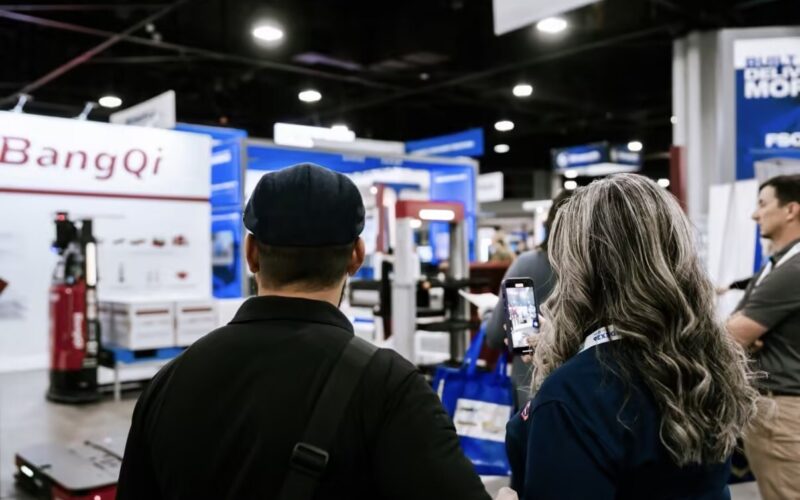
BangQi Technology used MODEX 2026 in Atlanta to introduce a new smart logistics solution aimed at overseas warehouse operations, positioning the launch as a practical answer to rising labour costs, space constraints, and volatile peak-season demand. The company said the new offer combines high-density storage, goods-to-person picking, multi-robot coordination, and AI-led warehouse management into one integrated system. That matters because overseas warehousing has become a pressure point for cross-border e-commerce, third-party logistics providers, and manufacturers trying to improve service levels without simply throwing more labour at the problem. MODEX itself is one of the industry’s biggest supply chain trade shows, running in Atlanta from April 13 to 16, 2026, and serving as a useful stage for vendors trying to convert technology claims into commercial credibility.
BangQi Technology’s announcement reads like more than a booth launch. It is really a market-entry statement directed at logistics operators outside China who increasingly want automation that can be deployed faster, supported locally, and justified with clear operating metrics. The company said it has delivered more than 2,000 projects globally and built a service network across China, North America, Europe, and Southeast Asia. Even allowing for the usual trade-show polish, that framing suggests BangQi Technology is trying to position itself not merely as a robotics supplier, but as an end-to-end warehouse transformation partner with software, hardware, AI, and services bundled into one commercial model. That is a bigger ambition, and a harder one to execute.
Why is BangQi Technology using MODEX 2026 to target overseas warehouse operators now?
The timing is not accidental. MODEX 2026 is built around supply chain resilience, logistics innovation, and hands-on demonstrations, with more than 200 education sessions and a large exhibitor base focused on manufacturing, warehousing, and transportation operations. In other words, it is exactly the kind of venue where automation vendors can pitch themselves to decision-makers already looking for ways to squeeze more productivity out of existing warehouse footprints.
For BangQi Technology, overseas warehouses are a particularly attractive wedge. These facilities sit at the intersection of global trade volatility, e-commerce service expectations, and local wage inflation. Operators are being pushed to deliver faster order cycles, better inventory accuracy, and more flexible throughput during seasonal peaks such as Black Friday and Prime Day. Yet many still operate with fragmented systems, partial automation, or labour-intensive picking models that break down when volume spikes. BangQi Technology is clearly trying to argue that its system is not just another robotics layer, but a way to redesign the operating model of the warehouse itself.
That matters because the automation market has matured beyond flashy robot demos. Buyers now want integration, uptime, local service, and proof that automation will keep working when demand becomes ugly and unpredictable. In that sense, BangQi Technology’s MODEX message is a pragmatic one. It is selling predictability, not just machines.
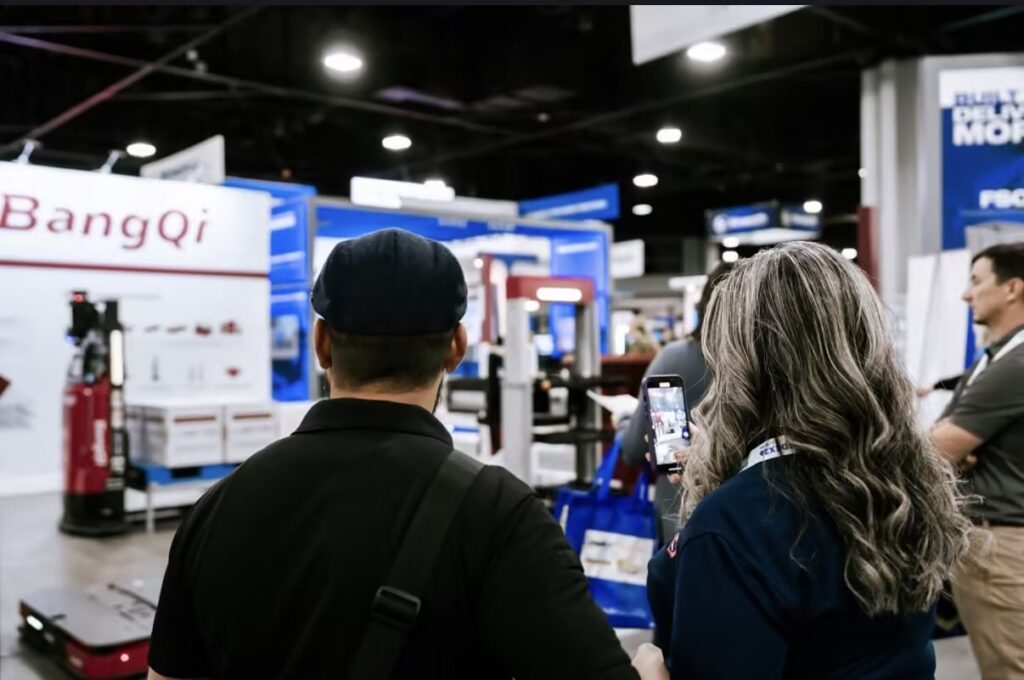
How does BangQi Technology’s new overseas warehouse solution address the biggest logistics pain points?
According to the company, the new solution is built around three recurring problems in overseas warehouse operations: rising labour costs, limited storage space, and sudden order surges during major promotional periods. Its answer combines high-density storage with goods-to-person picking and multi-robot coordination under an AI-driven control layer. The company said deployments have shown storage utilisation gains of more than 40%, picking efficiency improvements of up to 300%, and labour-cost reductions of up to 50%.
Those are ambitious numbers, and buyers will naturally want to know how transferable they are across warehouse formats, product categories, and local operating environments. Still, the direction of travel makes sense. High-density storage improves the economic yield of expensive warehouse space. Goods-to-person systems cut travel time and reduce dependence on manual picking. Multi-robot coordination is increasingly important in facilities that need to handle different workflows without turning the floor into robotic rush hour.
What BangQi Technology is really selling here is orchestration. Plenty of providers can supply mobile robots, picking systems, or warehouse software. The more difficult task is making those elements work together without creating integration headaches, bottlenecks, or maintenance complexity. If BangQi Technology can prove that its platform genuinely reduces those friction points, then its offer becomes more compelling than a standard hardware pitch.
Why could BangQi Technology’s integrated software, hardware, AI, and service model matter more than standalone robots?
Standalone robotics is no longer enough for many warehouse operators. The reason is simple: a robot that cannot communicate cleanly with warehouse management software, picking systems, replenishment logic, or human workflows becomes just another expensive object occupying floor space. The warehouse automation market increasingly rewards vendors that can integrate planning, execution, optimisation, and support into one coherent system.
BangQi Technology is leaning heavily into that logic. The company described its industrial AI foundation as a unified system combining software, hardware, AI agents, and Robots-as-a-Service. The strategic appeal of that model is obvious. It can reduce complexity for customers, create recurring service revenue for the vendor, and improve switching costs once deployed. It also lets the vendor position itself higher up the value chain, away from commodity hardware pricing.
The catch, of course, is execution. Integration-led business models are attractive on paper but demanding in practice. They require strong implementation teams, reliable after-sales support, and the ability to adapt standardised products to messy real-world customer environments. A warehouse operator does not care how elegant the architecture looks in a presentation if the picking line stalls on Cyber Monday. That is where BangQi Technology’s claim of a broad service footprint becomes commercially important. Local support is not a side note in automation. It is part of the product.
What do BangQi Technology’s customer references and global service claims suggest about its commercial strategy?
The customer roster cited by BangQi Technology includes names such as Walmart, Foxconn, Decathlon, DHL, SF Express, SHEIN, Li Auto, CATL, EVE Energy, Joyson, and Sinopharm. The company also said it supports nearly 100 top-tier clients across sectors ranging from electronics and third-party logistics to automotive, new energy, and pharmaceuticals. On its face, that suggests BangQi Technology wants to be seen as a cross-industry automation provider rather than a niche warehouse robotics specialist.
That is strategically useful for two reasons. First, it allows the company to argue that its technology is adaptable across different throughput profiles, product mixes, and operational requirements. Second, it helps de-risk the sales conversation with prospective overseas clients. Buyers are often more comfortable working with vendors that can point to deployments in demanding environments, even if those deployments are not identical to their own operations.
There is also a signalling effect here. By foregrounding global references and localised support, BangQi Technology appears to be answering a question many international buyers now ask quietly: can this vendor scale outside its home market without becoming a support headache? In warehouse automation, that question can kill deals faster than any robot malfunction. A clever demo impresses people for ten minutes. A credible service model gets procurement teams to keep talking.
How could BangQi Technology’s MODEX 2026 launch affect competition in overseas warehouse automation?
BangQi Technology is entering a crowded and increasingly sophisticated field. Warehouse automation buyers already have access to established robotics players, warehouse software vendors, systems integrators, and regional specialists that promise higher throughput and lower labour intensity. That means differentiation cannot rest on automation alone. It has to come from deployment speed, integration quality, support coverage, and measurable return on investment.
The company’s emphasis on overseas warehouse pain points suggests it understands this. Rather than selling a generic smart-factory vision, BangQi Technology has packaged a specific use case with concrete operational claims and retail-peak relevance. That is a smarter commercial move than trying to be everything to everyone. Cross-border e-commerce and overseas fulfilment are large enough problems to support specialised messaging, but broad enough to generate repeatable demand if the execution works.
Competitively, the more interesting question is whether BangQi Technology can turn project experience into a scalable international playbook. Many automation firms win impressive case studies but struggle to standardise deployment, pricing, and support across regions. If BangQi Technology can do that, its MODEX 2026 debut may look in hindsight like a meaningful step in international market building rather than a one-week trade show splash.
What should executives and logistics buyers watch next after BangQi Technology’s MODEX 2026 debut?
The next test is whether BangQi Technology can convert exhibition visibility into signed overseas projects with referenceable performance outcomes. Trade shows are useful for visibility, but the real proof comes later in implementation timelines, warehouse uptime, peak-season resilience, and customer renewal or expansion decisions. Buyers will want evidence that the promised efficiency gains are not confined to carefully selected showcase deployments.
Another thing to watch is vertical focus. BangQi Technology has cited a broad industry footprint, but international expansion often works best when a vendor narrows its go-to-market strategy around the sectors where its solution has the clearest operational edge. Third-party logistics, e-commerce fulfilment, consumer electronics, and pharmaceuticals all have different warehouse requirements. Success may depend less on how many sectors BangQi Technology can name and more on how sharply it can prioritise them.
There is also the question of commercial packaging. The inclusion of Robots-as-a-Service language hints at flexibility in how customers may buy the system. That could matter in an environment where many operators want automation benefits without the sticker shock of large upfront capital expenditure. If BangQi Technology can align technical performance with financing flexibility and local support, its addressable market becomes much broader.
What are the key takeaways on what BangQi Technology’s MODEX 2026 launch means for warehouse automation buyers and competitors?
- BangQi Technology used MODEX 2026 to present itself as an integrated automation partner, not just a robotics vendor.
- The company’s overseas warehouse focus is commercially sensible because labour costs, space pressure, and seasonal demand volatility remain major pain points.
- Its value proposition depends heavily on orchestration across software, hardware, and AI rather than on robots alone.
- Claimed gains in storage utilisation, picking efficiency, and labour savings will attract attention, but customers will want proof across more deployments.
- Localised service and implementation support could matter as much as the automation technology itself in winning overseas contracts.
- The company’s cited customer base suggests it is trying to build credibility across multiple high-demand industrial sectors.
- MODEX 2026 is a strong launch platform because it concentrates supply chain buyers actively looking for practical automation upgrades.
- Competitive pressure in warehouse automation means BangQi Technology must differentiate on execution speed, system integration, and return on investment.
- A scalable international deployment model will determine whether this launch becomes a durable growth move or just a trade-show moment.
- For buyers, the real question now is not whether automation works, but which vendors can make it work reliably at operational scale.
Discover more from Business-News-Today.com
Subscribe to get the latest posts sent to your email.
