


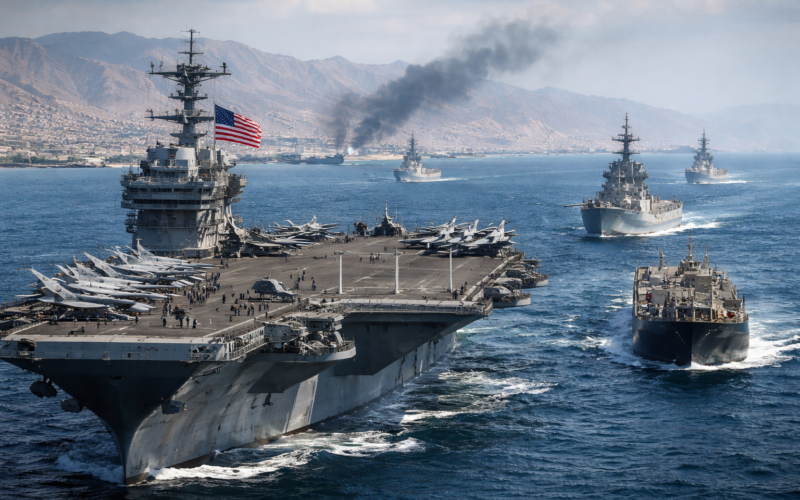
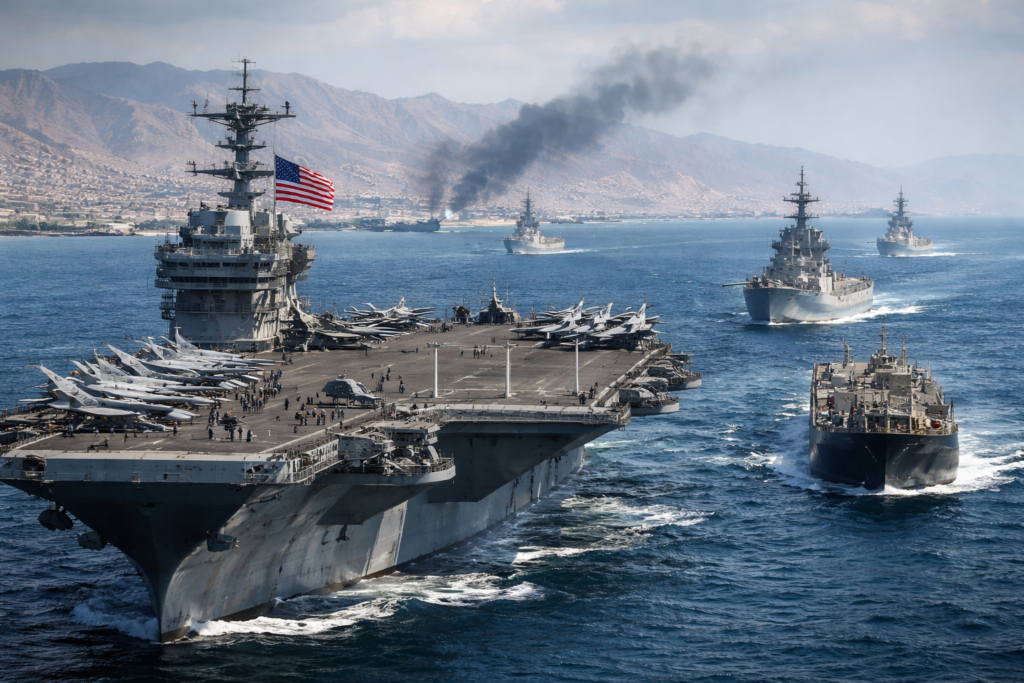
The United States naval blockade of all Iranian ports and coastal areas on the Arabian Gulf and Gulf of Oman came into effect at 10 a.m. Eastern Time on Monday, April 13, 2026, as United States Central Command began enforcing restrictions on maritime traffic entering and exiting Iranian port infrastructure. The blockade, ordered by President Donald Trump following the collapse of United States-Iran peace talks in Islamabad, Pakistan, on Sunday, applies to vessels of all nations and marks the most direct United States naval enforcement action against Iran since the conflict began on February 28, 2026.
United States Central Command confirmed that ships transiting the Strait of Hormuz to and from non-Iranian ports would not be impeded. The formulation preserves the legal distinction between a port blockade and a total strait closure, which would constitute interference with the navigation rights of non-belligerent states under international maritime law. Iran rejected both the framing and the legality of the operation, calling it an act of piracy.
Trump posted on Truth Social on Monday that any Iranian fast attack ships coming near the blockade would be immediately eliminated, describing the response as quick and brutal. He separately claimed Iran’s navy had been destroyed, saying 158 ships were at the bottom of the sea, and that fast attack vessels no longer posed a threat requiring pre-emptive strikes.
How Iran’s military responded to the blockade and what its threat to regional ports means
Iran’s armed forces called the blockade an act of piracy and declared that the country’s ports were either for everyone or for no one. The spokesperson for Iran’s joint military command at Khatam al-Anbiya Central Headquarters warned that if the security of Iranian ports in the Persian Gulf and the Sea of Oman was threatened, no port in the Persian Gulf and the Sea of Oman would be safe. The statement extended the threat to the port infrastructure of all regional states and represented a direct warning to the United Arab Emirates, Qatar, Kuwait, Bahrain, and Saudi Arabia, all of which host major commercial port operations in the affected waters.
The spokesperson declared that Iran would implement a permanent mechanism to control the Strait of Hormuz even after the war ends, signalling Tehran’s intention to retain the waterway as a long-term strategic instrument regardless of the conflict’s outcome. Iran’s navy chief Shahram Irani dismissed Trump’s blockade threat as ridiculous and funny. Iran’s Parliamentary Speaker Mohammad Bagher Ghalibaf said Iran would not give in but would respond with logic if approached with logic. Mohsen Rezaee, a member of Iran’s Expediency Council, said the United States plan was doomed to failure and that Tehran retained untapped leverage.
Why the United Kingdom and France broke from the United States blockade and what their rival initiative means
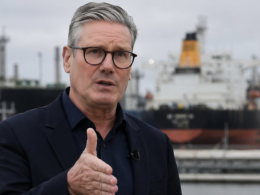
United Kingdom Prime Minister Keir Starmer formally confirmed on Monday that the United Kingdom would not participate in the United States blockade. French President Emmanuel Macron announced preparations for what he described as a peaceful multinational mission aimed at restoring freedom of navigation in the Strait of Hormuz, saying he would convene a conference on the plans in the coming days together with Britain.
The Macron-Starmer approach represents a significant diplomatic divergence from Washington, with two of the United States’ closest military allies opting for a multilateral freedom-of-navigation framework rather than endorsing a port blockade that targets the commercial shipping of non-belligerent states. Australia had already confirmed it had received no request to join the United States operation. Japan’s Chief Cabinet Secretary Minoru Kihara called for de-escalation and safe navigation through the strait on Monday without committing to any form of participation. The absence of confirmed allied support for the blockade at the point of its commencement raises questions about its operational durability in one of the world’s most contested waterways.
What the blockade has done to Brent crude prices and what it means for European and global energy costs
Brent crude surged to $102.24 a barrel on Monday morning, up from $95.20 at the close of Friday’s session, representing a gain of more than 31 percent since the conflict began at the end of February 2026. The European Commission President Ursula von der Leyen said the European Union’s fuel import bill had risen by more than 22 billion euros in 44 days of conflict, adding that the disruption of energy supplies would continue for some time to come. Von der Leyen called on European Union governments to begin coordinating the use of oil and natural gas stocks and proposed easing state aid rules to help governments manage the energy crisis.
A senior scholar at Columbia University’s Center on Global Energy Policy had warned on Sunday that oil prices could remain elevated through the end of 2026 even after the strait reopens, given a pre-existing supply shortfall of approximately seven million barrels of crude and four million barrels of refined products not reaching global markets per day. The port blockade adds Iranian barrels to that deficit, deepening the supply gap further.
Whether a second round of United States-Iran talks can happen before the ceasefire expires around April 22
Pakistan Prime Minister Shehbaz Sharif was pushing to restart United States-Iran negotiations before the ceasefire expires around April 22, according to CBS News. The effort was being pursued under direct instructions from Sharif and Pakistan Army Chief Field Marshal Asim Munir, both of whom played central roles in brokering the original ceasefire framework. Pakistan was waiting for responses from both Washington and Tehran.
Trump said the ceasefire was holding well but said he did not care whether Iran returned to the table. Vice President J.D. Vance, before departing Islamabad on Sunday, had described the United States position as a final and best offer and said it was now up to Iran to decide. Iran’s state-affiliated Fars news agency reported that Tehran had no plan for a new round of negotiations and was in no hurry to change its position on the Strait of Hormuz.
The ceasefire’s expiry around April 22 now represents the next hard deadline in the conflict. The active port blockade, the absence of a diplomatic framework to replace the collapsed Islamabad process, and the emerging Macron-Starmer freedom-of-navigation initiative create three separate and potentially conflicting tracks in a situation that has already pushed Brent crude above $100 a barrel and left global energy markets without a clear path to stabilisation.
Key takeaways on what the United States blockade of Iranian ports means for the conflict, energy markets, and the April 22 ceasefire deadline
- The United States naval blockade of Iranian ports on the Arabian Gulf and Gulf of Oman came into effect at 10 a.m. Eastern Time on April 13, 2026, with United States Central Command confirming vessels not bound for Iranian ports retain freedom of navigation through the Strait of Hormuz.
- Iran called the blockade an act of piracy, threatened that no port in the Persian Gulf or the Sea of Oman would be safe if its own ports were targeted, and announced it would implement a permanent mechanism to control the Strait of Hormuz even after the war ends.
- The United Kingdom and France broke from Washington, with Prime Minister Keir Starmer confirming the United Kingdom would not join the blockade and President Emmanuel Macron announcing a separate peaceful multinational freedom-of-navigation mission to be convened with Britain in the coming days.
- Brent crude surged to $102.24 a barrel on Monday and the European Union’s fuel import bill rose by more than 22 billion euros in 44 days of conflict, with energy analysts warning that elevated oil prices could persist through the end of 2026.
- Pakistan was actively pushing for a second round of United States-Iran talks before the ceasefire expires around April 22, but Trump said he did not care whether Iran returned to negotiations, and Iran said it had no immediate plan for a new round.
Discover more from Business-News-Today.com
Subscribe to get the latest posts sent to your email.