




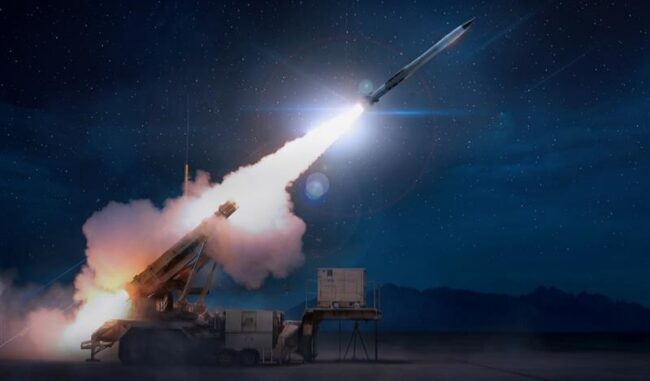
Lockheed Martin (NYSE: LMT) has secured a $4.7 billion undefinitized contract action from the U.S. government to continue accelerated production of the PAC-3 Missile Segment Enhancement interceptor, converting the January 2026 framework agreement with the Department of War into funded production authority. The contract is the first formal funding vehicle under the Department of War’s Acquisition Transformation Strategy and gives Lockheed Martin the financial runway to deliver what it describes as a record number of interceptors to American and allied forces in the current year. The announcement follows a string of escalating production commitments across Lockheed Martin’s Missiles and Fire Control portfolio, and arrives as the stock trades near the upper half of its 52-week range, up more than 26 percent year to date against a broader market struggling with tariff-driven uncertainty.
The undefinitized contract action structure is notable in its own right. A UCA allows the government to begin funding and Lockheed Martin to begin ramping expenditures before final contract terms are negotiated, reflecting the urgency with which the Department of War has approached munitions replenishment. Under normal procurement timelines, a contract of this scope would have taken months longer to reach formal award. The decision to proceed on undefinitized terms is a signal that production continuity was prioritized over administrative completeness, which is the right call when interceptors are being consumed in active operations.
What does the January 2026 PAC-3 MSE framework agreement mean for Lockheed Martin’s long-term production capacity?
The January 6 framework agreement between Lockheed Martin and the Department of War was the first of its kind under the Acquisition Transformation Strategy, and it set an ambitious ceiling. The agreement is structured as a seven-year arrangement designed to take annual PAC-3 MSE production from approximately 600 interceptors per year to 2,000 by the end of 2030. That is not a marginal capacity adjustment. It represents a more than three-fold increase in throughput for one of the most combat-proven interceptors in the U.S. inventory, and it requires parallel scaling across the entire supply chain, not just final assembly.
Lockheed Martin Chief Executive Officer Jim Taiclet acknowledged the supply chain dimension directly at the January briefing, noting that the ramp to 2,000 per year depends on getting the full supplier network up to speed in parallel with Lockheed Martin’s own facilities. The production floor at the Dallas operations cannot outrun the seeker or rocket motor suppliers, and a bottleneck anywhere in the chain constrains the whole system. The April 1 announcement of a separate seven-year framework agreement with Boeing and Lockheed Martin specifically to triple seeker production capacity addresses precisely that constraint, suggesting the government and industry have mapped the critical path with reasonable precision.
How does Operation Epic Fury and active combat deployment change the strategic calculus for PAC-3 MSE procurement?
The timing of this contract award is inseparable from the operational context. PAC-3 MSE interceptors have been used in active defense operations during Operation Epic Fury, where U.S. forces and infrastructure have been subject to ballistic missile and drone threats requiring high-end kinetic intercept capability. The consumption of interceptors in real operations, rather than in training or through Foreign Military Sales drawdowns alone, accelerates the urgency of replenishment in a way that peacetime procurement cycles simply do not reflect.
This is the key variable that separates the current production ramp from earlier incremental increases. After the War in Ukraine demonstrated how quickly even substantial stockpiles can be drawn down under sustained combat pressure, the Department of War’s calculus shifted. Active operational demand for PAC-3 MSE in the CENTCOM area of responsibility puts the inventory question in a different register altogether. The $4.7 billion contract is, in part, a response to the arithmetic of consumption rates that no framework agreement alone could resolve. Funding is what converts intent into interceptors.
Is Lockheed Martin’s $7 billion capital investment in munitions production generating credible returns for shareholders and the government?
Lockheed Martin has committed more than $7 billion since the Trump administration’s first term to expand capacity across priority systems, with approximately $2 billion specifically dedicated to munitions acceleration. The recent groundbreaking on the Munitions Acceleration Center in Camden, Arkansas, and the opening of the Rapid Fielding Center represent the physical manifestation of that commitment. Both facilities are oriented toward the workforce and manufacturing infrastructure needed to sustain high-rate production across PAC-3 MSE, THAAD interceptors, and Precision Strike Missiles simultaneously.
The Acquisition Transformation Strategy framework that governs this contract introduces a model where the government provides long-term demand certainty while industry carries the upfront capital cost of facilitization. The January framework explicitly incorporated what Lockheed Martin described as a collaborative financing approach designed to preserve initial cash neutrality, allowing the company to invest confidently against a guaranteed demand signal rather than betting on annual appropriations cycles. The $4.7 billion UCA is the first concrete validation that the government intends to follow through on its side of that arrangement. For shareholders, the critical question ahead of the April 23 first-quarter 2026 earnings call is whether the Missiles and Fire Control segment operating margins reflect the early investment costs of the ramp or are already beginning to benefit from increased throughput. Segment performance at MFC will be the number that tells investors whether the capital commitment is tracking toward the promised returns.
How does the PAC-3 MSE contract fit within Lockheed Martin’s broader munitions acceleration strategy across THAAD and PrSM programs?
The PAC-3 MSE contract is one node in what has become a coordinated acceleration across Lockheed Martin’s missile portfolio in the first quarter of 2026. In January, Lockheed Martin signed a framework agreement to quadruple THAAD interceptor production from 96 to 400 units per year, backed by more than 340,000 square feet of dedicated production space and over 2,000 employees at Camden. In March, a further framework agreement was signed to quadruple Precision Strike Missile production to 550 units per year from a baseline of roughly 45 to 152, building on the prior $4.94 billion Army contract award. PrSM achieved its operational debut in combat during Operation Epic Fury in March 2026, after receiving Milestone C full-rate production approval from the Army in July 2025.
Taken together, these three programs represent the largest single-year expansion of Lockheed Martin’s Missiles and Fire Control production capacity since the Cold War. The Acquisition Transformation Strategy is structured to cascade beyond Lockheed Martin as well, with the Department of War explicitly stating its intent to apply the same facilitization model to multiple munitions contracts across the defense industrial base. RTX has separately announced comparable scaling commitments for Tomahawk and SM-6 production. The industry-wide implication is that the defense prime contract model is evolving toward longer-term demand guarantees and shared capital risk arrangements, a structural shift with significant implications for revenue visibility, margin profiles, and capital allocation discipline across the sector.
What do LMT’s stock performance and analyst consensus suggest about how the market is pricing the munitions ramp?
Lockheed Martin shares are trading around $628 to $633 as of April 9 and 10, 2026, up more than 26 percent year to date and recovering substantially from the 52-week low of $410.11. The 52-week high of $692.00, reached in early 2026, remains about 9 to 10 percent above current levels. The stock has delivered roughly 30 percent total return over the trailing twelve months, against the S&P 500’s 3.3 percent over the same period, making it one of the clearest beneficiaries of the defense spending re-rating trade.
Analyst consensus as of early April sits at Hold from 14 analysts, with price targets ranging from $517 to $770 and a consensus around $602 to $665. The divergence between the lower consensus target and the current price reflects a market that has moved faster than the formal analyst community has revised its models. The counter-argument, made by investors who have held through the run, is that a $194 billion backlog representing roughly 2.5 times annual revenue, combined with the government’s shift toward multi-year guaranteed offtake, justifies a premium to historical multiples. The risk the bears flag is execution: supply chain bottlenecks, classified Aeronautics program integration costs, and the possibility that the fiscal year 2027 budget cycle produces appropriations uncertainty that interrupts the ramp. The April 23 earnings call will be the first opportunity to test those concerns against actual MFC segment data.
Key takeaways on what the $4.7 billion PAC-3 MSE contract means for Lockheed Martin, the defense sector, and allied air defense capacity
- The $4.7 billion undefinitized contract action is the first formal funding award under the Department of War’s Acquisition Transformation Strategy, converting the January 2026 framework agreement into live production authority.
- The target is to scale PAC-3 MSE annual production from approximately 600 interceptors to 2,000 by end of 2030, a more than three-fold increase driven by active combat consumption in Operation Epic Fury and allied restocking demand.
- A parallel April 2026 agreement with Boeing addresses the seeker supply chain specifically, indicating the government and Lockheed Martin have mapped critical path constraints beyond final assembly.
- Lockheed Martin’s portfolio-wide munitions acceleration now covers PAC-3 MSE, THAAD, and PrSM simultaneously, representing the largest single-year MFC capacity expansion in decades.
- The Acquisition Transformation Strategy introduces a structural shift toward long-term demand guarantees and shared capital risk between government and prime contractors, with implications across the entire defense industrial base.
- LMT shares are up 26 percent year to date and trade in the upper half of a 52-week range of $410.11 to $692.00, with the market pricing durable rearmament tailwinds ahead of formal analyst consensus.
- The April 23 first-quarter 2026 earnings call is the next material catalyst, with Missiles and Fire Control segment margins the key metric for assessing whether the production investment is tracking toward promised returns.
- Supply chain execution remains the primary execution risk: seeker, rocket motor, and subsystem vendors must scale in parallel with Lockheed Martin’s own facilities for production targets to be met on schedule.
- Allied demand from Europe, the Indo-Pacific, and the Middle East adds a Foreign Military Sales dimension that could accelerate the revenue recognition timeline beyond domestic procurement alone.
- The UCA structure itself signals that production continuity was prioritized over administrative completeness, a deliberate choice that reflects how seriously the Department of War is treating munitions inventory as an immediate national security variable.
Discover more from Business-News-Today.com
Subscribe to get the latest posts sent to your email.