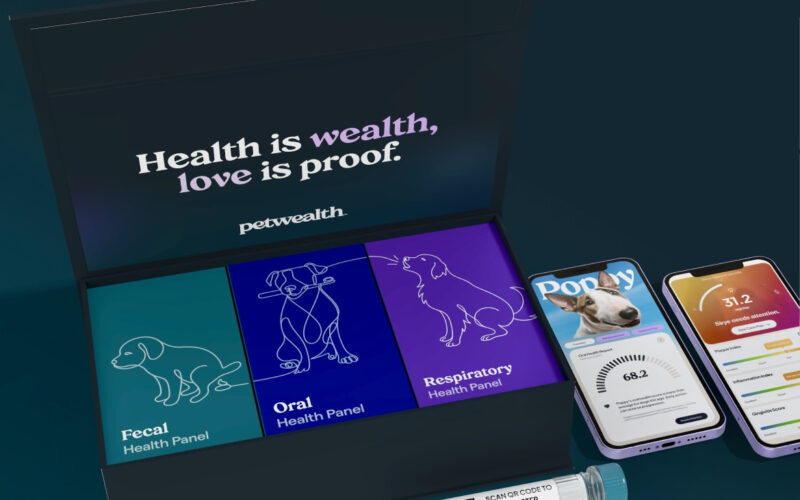
Petwealth has emerged from stealth with $1.7 million raised to date, a pre-seed round underway, and two early partnerships aimed at giving the company distribution, workflow access, and clinical credibility in preventive pet care. The Miami-based company is positioning itself not as a single test-kit seller but as a broader functional health platform for pets, built around at-home polymerase chain reaction diagnostics, artificial intelligence-driven interpretation, and access to veterinary guidance. Its public launch includes an exclusive diagnostic partnership with Kennel Connection and a telehealth integration with Pawp, two relationships that suggest Petwealth is trying to insert itself into both the operational and care-delivery sides of the pet ecosystem. In plain terms, Petwealth is not just selling a box to anxious pet owners. It is attempting to build infrastructure in a market where prevention still sounds attractive in theory but remains fragmented in practice.
That distinction matters because pet health has become a surprisingly large commercial arena. The company said Americans now spend more than $200 billion annually on their pets, and it framed that spending pattern as evidence that companion animal care is shifting from reactive treatment toward prevention and monitoring. Plenty of businesses have tried to ride that emotional and economic trend, but most sit in narrow lanes such as food, insurance, supplements, or one-off testing. Petwealth is instead making a platform play, which is usually where the real strategic ambition hides. A platform, if it works, does not merely capture a transaction. It becomes the place where data, follow-up action, customer retention, and partner economics converge.
Why is Petwealth trying to build a functional health platform for pets instead of just selling test kits?
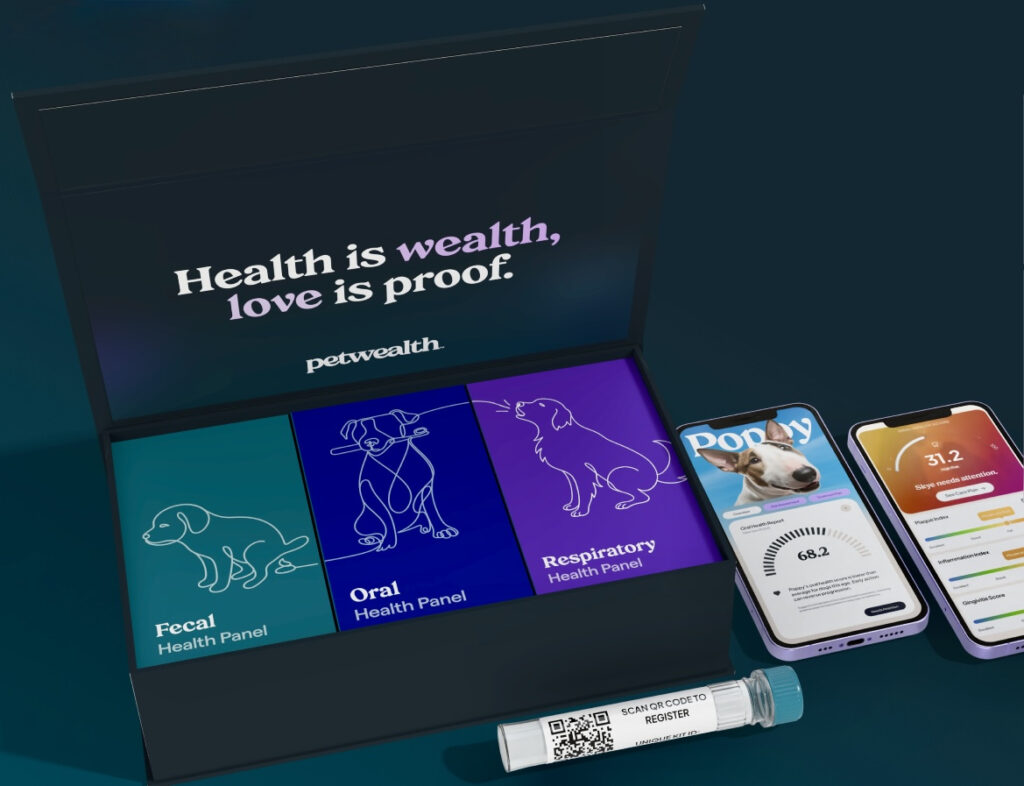
The answer is likely simple: a diagnostics product can generate revenue, but a health platform can generate recurring relevance. Petwealth’s flagship Petwealth Pack combines fecal, oral, and respiratory polymerase chain reaction panels into a single at-home offering priced at $399, while individual panels are available for $175 each. The company says results are delivered in 24 to 48 hours and supported by artificial intelligence-powered insights. On the surface, that sounds like premium direct-to-consumer diagnostics. Strategically, though, it points to something more durable. If Petwealth can become the interface through which pet owners, pet service operators, and veterinarians interpret health signals before visible symptoms appear, it moves from product vendor toward decision-making layer. That is a much stronger position in any healthcare-adjacent market.
The company’s origin story also aligns with that posture. Petwealth said founder Angelo Palivos started the business in 2025 after the sudden loss of his dog Mochi, and co-founder Zoë Barry later joined to shape commercial strategy and broader industry positioning. Founding stories do not guarantee strong economics, of course, but they often reveal how a management team intends to frame a category. Here, the framing is not about pet pampering or convenience. It is about bringing human-style clinical data logic into animal care before deterioration becomes obvious. That framing could resonate because pet spending is emotional, but purchase conversion often improves when emotion is backed by a clinical rationale. Consumers may indulge toys and treats impulsively. Diagnostic testing usually needs a stronger trust bridge.
There is also a category-creation angle here. Pet diagnostics is not new, but at-home, multi-panel, clinically framed, fast-turnaround diagnostics tied to artificial intelligence interpretation and on-demand veterinary follow-up is more ambitious than the average pet wellness product. Petwealth appears to be betting that pet owners increasingly want the language of precision health, not just the language of care. That is a clever strategic move because it shifts the conversation from discretionary spend to risk reduction. In consumer categories, “nice to have” gets cut first. “I need to know whether something is wrong” tends to survive longer.
How important are the Kennel Connection and Pawp partnerships to Petwealth’s commercial strategy?
They may be more important than the funding number itself. A $1.7 million raise is meaningful for an early company, but not enough on its own to prove market power. The partnerships are more revealing. Kennel Connection powers more than 5,500 pet care locations across the United States, according to the release, and Petwealth said it has become the exclusive diagnostic partner for that ecosystem. That gives Petwealth something many young health companies struggle to secure: embedded workflow access. Instead of waiting for every pet owner to discover and trust the brand individually, Petwealth can plug into daycares, boarding facilities, groomers, and pet hotels where disease screening and preventive checks can be operationally justified. That creates a path to business-to-business-to-consumer distribution rather than pure direct response marketing.
That model could be especially valuable because pet service operators face reputational and operational risk when infectious issues spread through shared environments. If Petwealth’s diagnostics become integrated into intake, monitoring, or outbreak prevention workflows, then testing becomes less of an optional retail add-on and more of a service-layer standard. Once that happens, pricing power and retention can improve. In other words, Kennel Connection gives Petwealth a shot at becoming part of pet care operations, not just pet owner shopping behavior. Those are very different businesses, and the second one is usually noisier and more expensive to scale.
The Pawp partnership solves a different problem. Diagnostics without interpretation can create anxiety, hesitation, or drop-off. Petwealth said every report will connect pet parents to a licensed veterinarian on demand through Pawp’s telehealth integration. That closes an important trust gap between result and action. In human healthcare, a test result without care navigation often creates confusion. In pet care, where owners may already be stressed and unsure how urgent a result is, the need for guided interpretation may be even stronger. Pawp therefore acts as a conversion bridge from information to response, which can increase perceived utility and reduce abandonment after the initial diagnostic event.
What execution risks could slow Petwealth’s attempt to scale diagnostics across pet care channels?
The first risk is that platform language is easier to market than to operationalize. Petwealth says it operates a molecular laboratory capable of processing thousands of tests per day and screens more than 100 markers across fecal, oral, and respiratory health. Those claims suggest technical ambition, but early-stage diagnostics businesses live or die on consistency, logistics, and trust. Fast turnaround is attractive, but maintaining that speed at scale while preserving analytical quality is where operations start sweating. A test that arrives late or feels unclear can damage repeat behavior much faster than a wellness brand can repair it.
The second risk is customer education. Preventive diagnostics sounds smart, but consumers do not always wake up wanting polymerase chain reaction panels for their pets. Petwealth will have to persuade buyers that proactive testing is worth paying for before a visible problem emerges. That means the company must sell not only the product but also a new habit. The Kennel Connection channel may help because facilities can normalize screening as part of care routines. Still, habit creation in health-adjacent consumer markets is expensive, especially when price points sit above impulse territory.
The third risk is channel balance. Business customers such as boarding and daycare operators may want testing that protects operations, while pet parents may want testing framed around individual peace of mind and personalized health insights. Those are related, but not identical, value propositions. Petwealth will need to avoid becoming too operational for consumers or too consumer-branded for business buyers. Early companies sometimes try to be delightfully everything to everyone and end up being memorably vague to all of them.
There is also a governance question around artificial intelligence. Petwealth is leaning on artificial intelligence-driven insights as part of its differentiation. That can help simplify complex results, but it also raises expectations around accuracy, explainability, and trust. In a category linked to health decisions, even when final interpretation is paired with telehealth access, the company will eventually need to show that its artificial intelligence layer improves usability without introducing ambiguity. Fancy dashboards are easy. Reliable decision support is hard.
Why could Petwealth’s launch signal a broader shift in how pet healthcare businesses are being built?
Because the pet economy is increasingly borrowing playbooks from human healthcare and software at the same time. Petwealth’s model blends diagnostics, data interpretation, subscription-like engagement logic, partner integration, and care escalation. That is not the architecture of a traditional pet products company. It looks more like an attempt to build a health intelligence layer in a fragmented care market. If that approach works, other companies may follow with combinations of diagnostics, telehealth, monitoring, insurance linkage, and preventive analytics.
This matters for incumbents too. Veterinary clinics, pet wellness brands, digital pet insurers, and pet service software providers could all feel pressure if diagnostics begins moving closer to the home and closer to service workflows. The company is not claiming to replace veterinarians, and its Pawp tie-up actually suggests the opposite. But it is trying to re-route the starting point of pet health engagement. That is where disruption usually begins, not with total replacement, but with control over first contact and first data.
Petwealth is also arriving at a moment when prevention has become one of the most overused words in health markets. The companies that win are usually the ones that make prevention actionable, not just aspirational. Petwealth’s early move suggests management understands that. The Kennel Connection partnership gives it operational context. The Pawp relationship gives it care follow-through. The laboratory and panel structure give it a product core. The challenge now is whether those pieces become a true system or remain a well-packaged collection of promises. Startups do not fail only because ideas are weak. They often fail because integration, trust, and distribution do not scale together.
For now, Petwealth’s stealth exit looks less like a splashy consumer launch and more like a deliberate attempt to occupy the connective tissue of pet health. That is strategically more interesting. Selling pet diagnostics is one business. Becoming the layer that organizes diagnosis, interpretation, and action across the pet care economy is a much larger one. The market opportunity is obvious. The hard part, as ever, begins after the press release behaves nicely and the operating model has to do the same.
What are the most important strategic signals from Petwealth’s funding, partnerships, and platform launch?
- Petwealth is pursuing a platform strategy, not a single-product strategy, which gives it a broader long-term opportunity if execution holds.
- The $1.7 million raised to date is modest but credible for an early-stage company whose bigger proof point is partner access rather than funding size.
- The exclusive Kennel Connection deal could give Petwealth rare workflow distribution across thousands of pet care locations.
- The Pawp integration addresses a critical post-diagnostic trust gap by connecting results to licensed veterinary interpretation.
- Petwealth is trying to shift pet diagnostics from reactive testing to routine preventive infrastructure.
- The company’s pricing suggests it is positioning itself as a premium clinical intelligence offering, not a mass-market wellness novelty.
- Artificial intelligence is part of the commercial story, but long-term differentiation will depend more on trust, turnaround, and clarity than on buzzwords.
- The business may benefit if pet service operators adopt diagnostics as an operational safeguard rather than an optional upsell.
- Execution risk remains high around lab scalability, customer education, and balancing business-to-business and consumer-facing value propositions.
- If Petwealth succeeds, it could push the pet care industry toward a more data-driven, platform-led model that blends diagnostics, telehealth, and preventive decision support.
Discover more from Business-News-Today.com
Subscribe to get the latest posts sent to your email.