





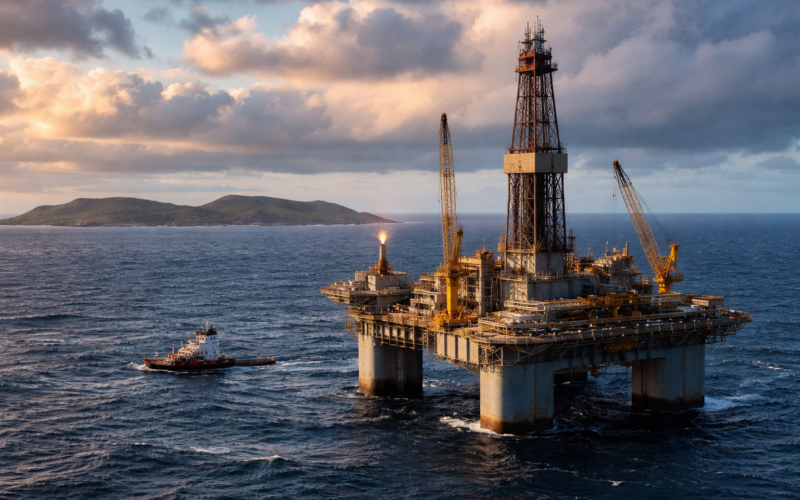
Rockhopper Exploration plc (AIM: RKH) said on 2 April 2026 that an updated independent report by Netherland, Sewell & Associates reclassified Sea Lion Northern Development Area Phases 1 and 2 from contingent resources into reserves following final investment decision in December 2025. The new report values 2P reserves at 313.8 million barrels gross, or 109.8 million barrels net to Rockhopper’s 35% working interest, with future net revenue of about $3.1 billion undiscounted and an NPV10 of roughly $965.8 million net. The immediate significance is not that Sea Lion suddenly became bigger, because the company itself said overall gross resource volumes were broadly consistent with the June 2025 independent evaluation. The significance is that a long-discussed Falklands oil project has now crossed a crucial technical and commercial threshold that markets, lenders, and strategic observers tend to treat very differently from contingent-resource stories.
For years, Sea Lion sat in that awkward category where everyone knew there was oil, everyone knew there was theoretical value, and everyone also knew that theoretical value does not pay for subsea hardware, floating production systems, or investor patience. The updated reserve booking matters because reserves carry a stronger development signal than contingent resources. In practical terms, this tells the market that the project has advanced beyond geological and conceptual confidence into a phase where capital, contracts, and staged execution are now the central issues. That is a very different conversation, and a far more investable one, even if the project still sits in a geography that tends to make political and financing nerves twitch.
Why does the Sea Lion reserve reclassification matter more than the headline barrel count suggests for Rockhopper Exploration plc?
The most important line in the announcement is arguably not the reserve total itself but the statement that Phases 1 and 2 have been moved into the reserves category after December 2025 FID, while later phases remain within contingent resources. That tells investors two things at once. First, the near- to medium-term development path is now credible enough to support reserve recognition. Second, the longer-dated optionality has not disappeared; it has simply remained in the “later” bucket, waiting for commercial and operational conditions to justify further conversion.
That layered structure is important because Sea Lion is not a one-shot project. Rockhopper’s own Sea Lion project page still frames the development as a phased build with 23 wells, around 80,000 barrels per day plateau production, about $1.3 billion pre-first-oil capex, roughly $2.2 billion total capex, and an NPV10 of about $4.3 billion for the wider project. The phased model matters because it reduces the need to solve for the entire field in one giant leap. In offshore development, “phased” is often corporate language for “we found a way to make this financeable without frightening everyone in the room.”
The new report also keeps a very large contingent base in play. Rockhopper’s update shows 2C contingent oil resources of about 603.2 million barrels gross and roughly 211.1 million barrels net to its working interest. That means Sea Lion’s strategic story is now split into two more digestible pieces: a reserve-backed core development case and a still substantial contingent upside case that could extend field life, improve infrastructure utilization, and support future capital returns if execution goes to plan.
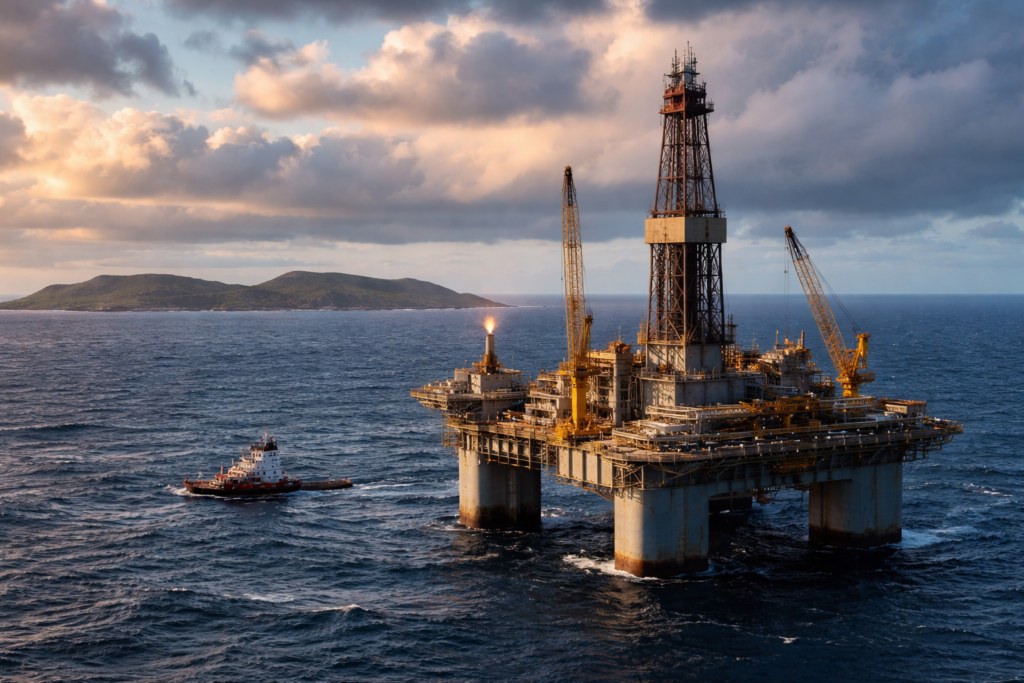
How does the Sea Lion financing structure reduce risk for Rockhopper Exploration plc while still leaving room for execution pressure?
This is where the reserve story becomes more than an engineering footnote. Rockhopper said that after the placing, it held approximately $179 million of cash at 31 December 2025, which it expects to be sufficient to fund its share of the capex required for the Phase 1 development plan. That is a strong message for a company whose biggest historical problem was never only proving hydrocarbons, but proving it could survive long enough financially to participate in development.
The December 2025 FID announcement gives additional context. Rockhopper said the post-FID funding requirement was $1.8 billion to first oil and $2.1 billion to project completion, including contingencies and financing costs. The financing structure included $1.0 billion of senior debt, of which $350 million related to Rockhopper debt, with the balance coming from joint venture equity and post-first-oil cash flows. Rockhopper also said its net equity requirement was approximately $102 million, plus roughly $10 million tied to a 5% equity overrun support exposure.
Then, at financial close in late December 2025, Rockhopper confirmed that key contracts for Phase 1 had been negotiated and entered into by operator Navitas Petroleum and Development Limited, and that budgeted costs to project completion remained at $2.1 billion. It also completed a placing that raised aggregate gross proceeds of approximately $142 million at 53 pence per share. That combination of FID, financial close, and reserve conversion is why this announcement lands differently from older Sea Lion updates. The market is no longer being asked to imagine a path to development. It is being shown one.
That said, “funded” in offshore oil rarely means “risk-free.” It means the known route to first oil is sufficiently financed under current assumptions. Schedule slippage, cost inflation, contractor bottlenecks, and changes in oil price assumptions can still erode value. Sea Lion’s development logic is materially stronger than it was before FID, but it is not magically exempt from the usual offshore tendency to remind shareholders that budgets are aspirational until steel is installed and wells behave.
What does the latest share price move say about investor sentiment toward Rockhopper Exploration plc and Falklands oil risk?
The market reaction suggests investors understood this as a threshold event. London Stock Exchange data showed Rockhopper opening at 77.20 pence, with a previous close of 89.60 pence recorded for 2 April 2026 and a 52-week range of 34.83 pence to 92.86 pence. Investing.com historical data showed the stock trading as high as 89.60 pence on 2 April, with the day range running from 77.20 pence to 89.60 pence. That one-day move was sharp, and it pushed the stock close to the top end of its 52-week band.
The broader recent trend has also been strong. Investing.com historical data shows Rockhopper at 70.20 pence on 5 March 2026 and 89.60 pence on 2 April 2026, implying a roughly 27.6% rise over that period. The same source also notes a strong one-year change and a 52-week range reaching into the low 90 pence area. In other words, investors were already rerating the stock before this reserve update, and the announcement appears to have reinforced that move rather than created it from nothing.
That matters because it suggests the equity market is increasingly willing to price Rockhopper Exploration plc less as a perpetual optionality play and more as a leveraged development vehicle tied to Sea Lion delivery. The danger, of course, is that once a market starts treating a story as real, it also becomes less forgiving about delays. Reserve conversion can narrow the “dream discount,” but it can also replace it with a harsher execution premium.
What happens next for Sea Lion, Navitas Petroleum, and the wider Falkland Islands oil development thesis?
The next phase is operational proof. FID and financial close have already established the commercial skeleton. Reserve conversion has added technical and classification validation. The next market test will revolve around development milestones, contractor performance, and clarity on the first-oil timeline. Rockhopper’s project materials and late-2025 shareholder documents point to first oil around Q1 2028. If that timetable holds, Sea Lion could become one of the most consequential offshore developments to move from long-dated stranded narrative into producing reality in the North Falkland Basin.
There is also a wider industry angle here. Sea Lion has become a case study in how difficult offshore projects can be revived when a new operator brings a different financing model and a more modular development philosophy. Rockhopper’s materials note that Navitas became operator after Harbour’s exit, and that the field benefited from re-engineering work that reduced upfront capital intensity relative to earlier visions. This matters well beyond the Falklands because the same playbook is being tested globally on assets once considered too awkward, too capital-intensive, or too politically noisy to advance.
Still, Sea Lion remains Sea Lion. Geography has not changed. Falklands-linked energy projects still attract a geopolitical overlay, however commercially mature they become. The development case now looks much stronger, but it still requires steady operator execution, stable financing conditions, and continued political tolerance. The reserve reclassification does not eliminate those risks. It simply means the project has progressed far enough that those are now the main risks worth arguing about.
What are the biggest strategic takeaways from Rockhopper Exploration plc’s Sea Lion reserve update for executives and investors?
The reserve conversion marks a shift in how Sea Lion should be analyzed. This is no longer mainly a debate about whether the resource exists or whether the development concept is plausible. It is now a debate about whether Rockhopper Exploration plc and Navitas Petroleum can deliver a phased offshore project on time and within a financing structure that still leaves equity holders with meaningful upside.
For Rockhopper, that is a huge improvement in strategic position. The company has moved from defending an asset story to defending a development story. Those are different investor audiences, different valuation frameworks, and different expectations. Resource optionality can produce exciting presentations. Reserves, funding, and financial close can produce reratings. But they also produce accountability. That, in a way, is the real graduation ceremony here.
What are the key takeaways from Rockhopper Exploration plc’s Sea Lion reserve conversion for the company, peers, and the offshore oil sector?
- Rockhopper Exploration plc has crossed from speculative resource narrative into reserve-backed development narrative, which materially changes how the market can value Sea Lion.
- The new 2P reserve base of 313.8 million barrels gross gives Sea Lion a much firmer commercial identity than its previous contingent-resource framing.
- Rockhopper’s 35% net 2P share of 109.8 million barrels and NPV10 of about $965.8 million provide a stronger asset-level valuation anchor for investors.
- The company’s reported $179 million cash balance at year-end 2025 supports the argument that Phase 1 participation is financed on current assumptions.
- December 2025 FID and financial close now look like the pivotal inflection points that unlocked reserve recognition and improved equity market confidence.
- Later-phase contingent resources remain substantial, preserving long-dated upside beyond the initial development case.
- Navitas Petroleum’s role reinforces a broader sector lesson that operator change and project redesign can revive assets once viewed as commercially stalled.
- The share price rally suggests the market is increasingly pricing execution rather than pure optionality, which can support valuation but also increase sensitivity to delays.
- Sea Lion remains exposed to standard offshore risks including cost inflation, schedule slippage, contractor performance, and oil-price-linked economics.
- For the wider industry, Sea Lion is becoming a live example of how stranded-looking offshore discoveries can re-enter the development pipeline under a phased financing model.
Share this:
Discover more from Business-News-Today.com
Subscribe to get the latest posts sent to your email.


