




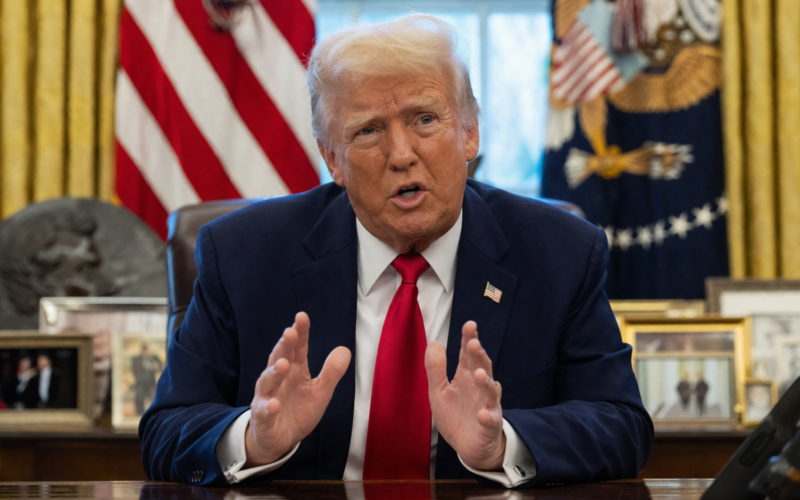
United States President Donald Trump said on Wednesday that the United States would end its military campaign against Iran fairly soon and could return for targeted strikes if necessary, hours before he was scheduled to deliver a primetime address to the nation. Trump also confirmed he would use the speech to signal that he was considering withdrawing the United States from the North Atlantic Treaty Organization, escalating tensions with European allies who have declined to participate in the conflict.
In a telephone interview with Reuters, Trump said the United States planned to leave Iran “pretty quickly” and indicated military action could conclude within two to three weeks, with or without a formal ceasefire agreement. “I can’t tell you exactly … we’re going to be out pretty quickly,” Trump told Reuters, adding that the United States could return to conduct what he described as “spot hits” if required. He said United States military operations had ensured Iran would not possess a nuclear weapon.
Trump said he was delivering a primetime address to the nation at 9 p.m. Eastern Daylight Time on Wednesday. The White House confirmed the address would provide what it described as an important update on Iran. Secretary of State Marco Rubio, appearing on Fox News Channel, said the United States could see what he called the finish line but that a formal conclusion was not imminent. Rubio said there was potential for a direct meeting between United States and Iranian officials at some point.
Why is President Trump threatening to withdraw the United States from the NATO alliance over the Iran war?
Trump intensified pressure on European governments over their refusal to support United States military objectives in Iran, saying he was going beyond merely reconsidering United States membership in the North Atlantic Treaty Organization. In an interview with The Daily Telegraph of Britain, Trump described the alliance as a paper tiger and said Russian President Vladimir Putin held a similar view. Trump said he had moved past reconsidering membership and was now actively considering attempting to withdraw the United States from the alliance.
Trump told reporters he intended to express what he described as his disgust with NATO during his address to the nation and said he was “absolutely” considering the attempt. He criticized European states for what he characterized as their lackluster military support for United States objectives in Iran and demanded that they demonstrate what he called “some delayed courage” and take action to patrol and secure the Strait of Hormuz, the closure of which has generated a global energy crisis.
European governments responded with studied restraint. France’s junior army minister Alice Rufo said any North Atlantic Treaty Organization operation in the Strait of Hormuz would constitute a breach of international law, as the strait lies outside the alliance’s geographic mandate, which covers the Euro-Atlantic area. Poland’s Defense Minister Wladyslaw Kosiniak-Kamysz urged calm and noted that there was no NATO without the United States, adding that stability was in Europe’s interest. Several NATO member states reminded Washington publicly of the alliance’s foundational purpose and the constraints on its operational scope under international law.
Under legislation passed by the United States Congress in 2023, the president cannot suspend, terminate, or withdraw the United States from the North Atlantic Treaty without either the advice and consent of the Senate with a two-thirds concurrence of senators present, or an Act of Congress. Then-Senator Marco Rubio was among the co-sponsors of that legislation. Legal analysts have noted that any attempt by Trump to withdraw unilaterally would face significant congressional and judicial obstacles.
What are the conditions in the United States ceasefire framework presented to Iran through Pakistan?
The United States had previously presented Iran with a 15-point ceasefire framework through Pakistan, which has been serving as the principal mediator between Washington and Tehran in the conflict. United States Special Envoy Steve Witkoff confirmed presenting the framework, which demands that Iran abandon its pursuit of nuclear weapons and uranium enrichment and fully reopen the Strait of Hormuz. Iran rejected the framework and presented its own five conditions in response, including demands for war reparations and recognition of Iranian rights over the Strait of Hormuz.
Trump said separately on social media that Iran had asked for a ceasefire and that he would not consider the request until Tehran ceased blocking the Strait of Hormuz. The office of Iranian President Masoud Pezeshkian issued a statement denying that any such request had been made and said Iran remained determined to defend its territorial integrity. Iran’s Islamic Revolutionary Guard Corps said the strait was fully under its control. Pakistan earlier told Reuters it had proposed a temporary ceasefire to both sides but had not received a response from either party.
Trump had previously extended a deadline for Iran to reopen the Strait of Hormuz to 6 April 2026 at 8 p.m. Eastern Time, citing ongoing talks he described as going well. He had threatened to destroy Iranian electricity plants and desalination facilities if Tehran did not comply. Iran’s parliament speaker accused the United States of conducting public diplomacy while privately plotting what he described as a ground attack.
How has the closure of the Strait of Hormuz affected global oil markets and energy security since February 2026?
The International Energy Agency said on Wednesday that global oil supplies were expected to be hit twice as hard in April as in March, underscoring the urgency of resolving the conflict. The agency’s director, Fatih Birol, described the situation as the greatest global energy security challenge in history. The conflict has generated what analysts characterize as the largest oil supply disruption since the 1970s energy crisis.
Iran declared the Strait of Hormuz closed on 4 March 2026. The strait normally carries approximately 27 percent of the world’s maritime trade in crude oil and petroleum products, and roughly 20 million barrels per day flowed through it in 2024. The closure has forced Saudi Arabia to divert oil through the East-West Crude Oil Pipeline to the Red Sea port of Yanbu, and the United Arab Emirates to route exports via the Abu Dhabi Crude Oil Pipeline to Fujairah on the Arabian Sea. The combined capacity of these alternative pipelines remains well below the volumes that ordinarily transit the strait.
Brent crude oil prices surged past $120 per barrel following the closure and reached $166 per barrel for Dubai crude on 19 March 2026, the highest price on record. Prices fell back below $100 per barrel on Wednesday following Trump’s remarks about a possible early exit from the conflict. Oil production in Kuwait, Iraq, Saudi Arabia, and the United Arab Emirates collectively declined by at least 10 million barrels per day by mid-March. The IEA estimates that close to 15 million barrels per day passed through the strait in 2025, with China and India accounting for 44 percent of those imports.
The European Union’s energy commissioner said the bloc was particularly concerned in the short term about supplies of refined petroleum products, including jet fuel and diesel, as distinct from crude oil, which Europe sources primarily from outside the Middle East. The average price of regular gasoline in Los Angeles County, California, rose to $5.99 per gallon as of 1 April 2026, up from $4.69 one month earlier.
What military operations and attacks have taken place across the Middle East as the conflict escalates in April 2026?
Iranian drone attacks hit fuel tanks at Kuwait’s international airport, causing a significant fire, and authorities in Bahrain reported a fire at a company facility following an Iranian strike. Qatar said an oil tanker leased to state-owned QatarEnergy was struck by an Iranian cruise missile in Qatari waters, though Qatar’s government said there were no casualties or environmental damage. An overnight strike struck Shahid Haghani Port, Iran’s largest passenger terminal, according to Iran’s state media.
Yemen’s Houthi forces said they conducted a missile attack on Israel alongside Iran and Iran-backed Hezbollah in Lebanon, marking the Houthis’ first direct participation in the conflict since joining in recent days. Israel’s military said air-defense systems were intercepting the threats. In Lebanon, at least seven people were killed and 24 wounded in two Israeli strikes in the Beirut area, according to Lebanon’s health ministry. Israel said the strikes targeted two senior Hezbollah figures.
The United Arab Emirates said its air defenses had intercepted 438 ballistic missiles, 19 cruise missiles, and 2,012 drones from Iran since the start of the conflict. Iran’s Islamic Revolutionary Guard Corps threatened to strike United States technology companies operating in the region, including several major corporations, from 8 p.m. Tehran time on Wednesday. Trump said he was not concerned by the threat. An airstrike in Tehran appeared to have struck inside the compound of the former United States Embassy, which has been controlled by Iran’s Revolutionary Guard since 1979.
United States rights group HRANA said 3,492 people had been killed in Iran as of 1 April, including 1,574 civilians and 236 children. Iran’s Emergency Organization reported that 24 healthcare workers had been killed and 114 injured. At least 1,200 people have been killed in Lebanon since the conflict began. Thirteen United States service members have been killed in combat, with two additional deaths from non-combat causes. Debris from Iranian missiles has struck several areas in central Israel and accounted for the majority of 19 deaths recorded in Israel.
What diplomatic initiatives have China, Pakistan, and Britain proposed to end the Iran war and reopen the Strait of Hormuz?
China and Pakistan jointly presented a five-point initiative on 31 March 2026 calling for an immediate ceasefire, a return to peace talks, the security of non-military targets and shipping routes including the Strait of Hormuz, adherence to the United Nations Charter, and the conclusion of a comprehensive peace framework based on international law. Pakistan’s Foreign Minister and Deputy Prime Minister Mohammad Ishaq Dar told Axios the initiative came together during his bilateral meeting in Beijing with China’s foreign minister Wang Yi.
Pakistan had earlier hosted talks in Islamabad on 29 March with Egypt, Saudi Arabia, and Turkey to discuss pathways to reopening the strait. China’s Foreign Ministry said Beijing commended Pakistan’s mediation efforts and supported Pakistan’s continued role as mediator. China has a strong economic interest in a resolution. Chinese imports of Iranian crude oil amounted to approximately 1.38 million barrels per day in 2025, representing roughly 12 percent of China’s total oil imports. Trump, asked about the China-Pakistan initiative, said negotiations with Iran were going well but declined to comment on the specific proposal.
United Kingdom Prime Minister Keir Starmer said on 1 April that 35 countries had signed a statement committing to work together on restoring maritime security in the Strait of Hormuz. Starmer said British Foreign Secretary Yvette Cooper would lead a virtual conference on the issue on Thursday, and that military planners were developing potential implementation plans. Starmer called for what he described as a united front of military strength and diplomatic activity to restore stability.
Trump’s planned visit to China, which had been scheduled for 31 March to 2 April 2026, was postponed because of the Iran war. A revised visit is now expected on 14 and 15 May 2026. China’s participation in mediation has been described as a significant geopolitical development given that China did not launch the conflict and has broader economic interests in a stabilized Iran-United States relationship. Iran, whose parliament speaker has accused the United States of bad faith, has so far rejected the 15-point United States framework and has insisted that any ceasefire agreement include an end to the simultaneous conflict in Lebanon.
Key takeaways on what the Trump NATO threat and Iran war exit signal means for global security and oil markets
- United States President Donald Trump told Reuters on 1 April 2026 that the United States would exit its military campaign against Iran within two to three weeks, with or without a ceasefire deal, and reserved the right to conduct subsequent targeted strikes.
- Trump has told The Daily Telegraph he is actively considering attempting to withdraw the United States from the North Atlantic Treaty Organization, citing European governments’ refusal to support United States military objectives in Iran and demanding allies take independent action to secure the Strait of Hormuz.
- Iran rejected the United States 15-point ceasefire framework presented through Pakistan and denied making any request for a ceasefire, while the office of Iranian President Masoud Pezeshkian said Iran remained determined to defend its territorial integrity.
- The International Energy Agency warned on 1 April that global oil supply disruptions in April were expected to be twice as severe as in March, underscoring the economic stakes as Iran continues to block the Strait of Hormuz, through which roughly 27 percent of global maritime crude oil trade normally passes.
- China and Pakistan jointly presented a five-point peace initiative on 31 March calling for an immediate ceasefire and the reopening of the Strait of Hormuz, while the United Kingdom confirmed a virtual maritime security conference to be convened by Foreign Secretary Yvette Cooper on 2 April 2026.
Discover more from Business-News-Today.com
Subscribe to get the latest posts sent to your email.