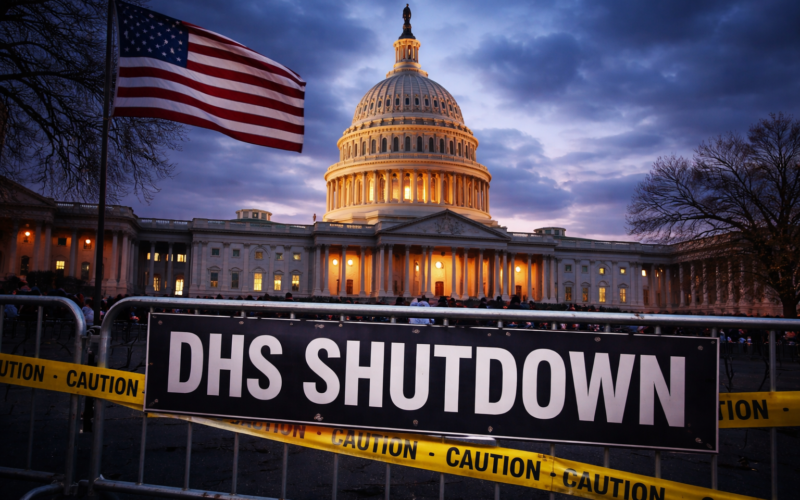
The United States House of Representatives passed a short-term spending bill late on Friday, 28 March 2026, to fund the Department of Homeland Security in its entirety for 60 days, extending appropriations through 22 May 2026. The vote was 213 to 203, with three moderate House Democrats joining all voting Republicans in favour of the measure. The bill now moves to the Senate, where Senate Minority Leader Chuck Schumer of New York has declared it dead on arrival, and where senators have departed for a two-week spring recess without plans to return early.
The House vote came hours after the Senate, in the early hours of Friday morning, passed a separate and differently structured funding bill by unanimous consent. The Senate measure would have restored funding to most components of the Department of Homeland Security, including the Transportation Security Administration, the Federal Emergency Management Agency, the Coast Guard, and the Cybersecurity and Infrastructure Security Agency, while withholding appropriations for Immigration and Customs Enforcement and parts of Customs and Border Protection. That measure did not include the immigration enforcement reforms Senate Democrats had been demanding as a condition for their support.
House Speaker Mike Johnson of Louisiana rejected the Senate-passed bill within hours of its passage, calling it a joke and placing responsibility for the impasse squarely on Senate Democrats. Johnson told reporters that Democrats have used the appropriations process to impose what he characterised as a radical agenda on the American people by blocking funding for immigration enforcement agencies. He then advanced the Republican-drafted 60-day continuing resolution through the House Rules Committee, which approved it on a procedural vote before the full chamber passed it along largely party lines.
The three House Democrats who crossed party lines to support the Republican bill were Representative Don Davis of North Carolina, Representative Marie Gluesenkamp Perez of Washington, and Representative Henry Cuellar of Texas, all representing competitive districts. Representative Jared Golden of Maine, who had previously supported earlier Department of Homeland Security funding measures, voted against the House Republican bill. The rule governing the floor procedure included a provision under which the funding legislation was automatically passed once the House adopted the rule, meaning there was no separate standalone vote on the bill itself.
Why did the Senate reject the House version of the DHS funding bill before it was even voted on?
Senate Minority Leader Chuck Schumer drew a clear boundary ahead of the House vote, stating that Senate Democrats would not provide the support needed to advance the House Republican measure. In the Senate, legislation generally requires 60 votes to overcome a procedural filibuster, meaning Republican support alone is insufficient without at least some Democratic backing. Schumer characterised the House Republican position as an attempt to fund what he described as a lawless and deadly immigration enforcement apparatus without any accompanying accountability measures. Senate Majority Leader John Thune of South Dakota, meanwhile, ruled out any possibility of revisiting immigration enforcement reforms after the Senate passed its own bill, saying Democrats had forfeited that opportunity.
House Minority Leader Hakeem Jeffries of New York backed Schumer’s position and indicated that House Democrats were prepared to vote for the Senate-passed bill had Speaker Johnson brought it to the House floor. Jeffries argued that the Senate measure represented a bipartisan path to ending the shutdown and that Johnson’s refusal to schedule a vote on it reflected the influence of a bloc of conservative House Republicans within the House Freedom Caucus, who objected to the Senate bill’s exclusion of Immigration and Customs Enforcement funding and the absence of a federal voter identification provision.
Representative Andy Harris of Maryland, chair of the House Freedom Caucus, confirmed that conservative members would only support a Department of Homeland Security funding bill that included both full immigration enforcement funding and the voter identification requirement drawn from a separate legislative initiative. That position made it arithmetically difficult for Johnson to pass the Senate bill through the House without losing a significant portion of his own caucus, effectively leaving him with the choice of relying on Democratic votes or passing a party-line measure that faced its own obstacles in the Senate.

What triggered the Department of Homeland Security funding lapse that began in February 2026?
The Department of Homeland Security funding lapse began on 14 February 2026, following the breakdown of appropriations negotiations in the weeks after federal immigration agents killed two United States citizens during Operation Metro Surge, a large-scale immigration enforcement action conducted by Immigration and Customs Enforcement and Customs and Border Protection primarily in the Minneapolis and Saint Paul metropolitan area of Minnesota beginning in December 2025. The operation, which the Department of Homeland Security described as the largest immigration enforcement operation in its history, resulted in the detention of approximately 3,000 individuals.
The two United States citizens killed during the operation were Renee Good and Alex Pretti. Their deaths, along with footage of aggressive enforcement tactics including the operation in areas near schools and hospitals, prompted widespread public protests and triggered legal challenges from the state governments of Minnesota and Illinois and the city governments of Minneapolis and Saint Paul, which filed federal lawsuits against the Department of Homeland Security and senior federal officials. Those lawsuits argued that the deployment of federal agents constituted an unconstitutional intrusion into state sovereign police powers and violated administrative procedure requirements.
Senate Democrats, led by Minority Leader Schumer, declared following the deaths of Good and Pretti that they would not support any appropriations legislation that included funding for Immigration and Customs Enforcement without significant reforms to that agency’s enforcement practices. The Democratic position centred on a set of demands that included requiring agents to wear body-worn cameras, prohibiting agents from wearing face coverings during operations, requiring judicial warrants before agents could enter private property, and establishing stricter use-of-force standards for immigration enforcement personnel. Republicans rejected most of those demands throughout the negotiations, with some characterising them as incompatible with the operational requirements of immigration enforcement.
How has the DHS partial shutdown affected the Transportation Security Administration and air travel across the United States?
The partial shutdown of the Department of Homeland Security, now well past its 40th consecutive day, has had significant operational consequences for the Transportation Security Administration, whose workforce has gone without regular paychecks for an extended period. The absence of pay has led to elevated call-out rates among Transportation Security Administration officers, with the agency recording a call-out rate of 11.83 percent on 27 March 2026, the highest single-day figure since the shutdown began. That rate translated to more than 3,450 officers absent from duty, contributing to prolonged security screening queues at major airports across the country.
President Donald Trump on Friday signed a presidential memorandum directing Homeland Security Secretary Markwayne Mullin to use funds appropriated through the One Big Beautiful Bill Act, passed by Congress in the summer of 2025, to pay Transportation Security Administration employees. The Department of Homeland Security indicated that those payments could begin arriving as early as Monday, 30 March 2026. However, officials acknowledged that the presidential memorandum addressed only the immediate pay issue and did not resolve the underlying funding lapse affecting the department as a whole.
The One Big Beautiful Bill Act, which provided the Department of Homeland Security with approximately 170 billion dollars including 75 billion dollars specifically designated for Immigration and Customs Enforcement, has enabled that agency and parts of Customs and Border Protection to continue their enforcement operations despite the shutdown. That financial cushion has diminished the immediate operational pressure on immigration enforcement while concentrating the visible effects of the funding lapse on agencies such as the Transportation Security Administration, the Coast Guard, the Federal Emergency Management Agency, and the Secret Service, whose employees have continued working without regular pay.
What were the sticking points that prevented a bipartisan DHS funding agreement before the congressional recess?
Weeks of intermittent negotiations between Senate Republican leaders, Senate Democratic leaders, and representatives of the Trump administration failed to produce an agreement that could clear both chambers before the congressional recess. Senate Majority Leader Thune described the Republican position as a final offer to Democrats in the days preceding the Senate vote, which would have funded approximately 94 percent of the Department of Homeland Security budget while withholding 5.5 billion dollars from the Immigration and Customs Enforcement Enforcement and Removal Operations unit. Senate Democrats countered that offer but did not reach agreement before the Senate procedural clock ran out.
Senate Appropriations Committee Chair Susan Collins of Maine characterised the Democratic position throughout the negotiations as intransigent and unreasonable, arguing that Democratic members had repeatedly forced government shutdowns and used funding legislation as a vehicle for policy demands that went beyond the appropriations process. Senate Budget Committee Chair Lindsey Graham of South Carolina indicated that Republicans intended to pursue additional Immigration and Customs Enforcement and Customs and Border Protection funding through the budget reconciliation procedure, which requires only a simple Senate majority, as a way of bypassing the Democratic filibuster threshold entirely.
Senate Republican leaders had signalled ahead of the Senate vote that any discussion of immigration enforcement reforms would be contingent on Democrats first agreeing to fund those agencies fully, a sequencing that Democrats rejected. Thune said after the Senate passed its bill early Friday morning that Democrats had kissed goodbye their opportunity to obtain the reforms they sought, by failing to reach a funding agreement during the negotiating window. Senate Democrats maintained that they had made multiple good-faith offers and that the Republican position had consistently excluded the accountability measures they regarded as non-negotiable following the deaths in Minneapolis.
What is the current political and institutional deadlock facing Congress over the DHS shutdown resolution?
With both chambers of Congress departing for a two-week spring recess and no confirmed plans to return early, the Department of Homeland Security shutdown is expected to continue until at least the week of 13 April 2026, when senators are scheduled to return to Washington. House members are scheduled to return on 14 April 2026. There are no current plans for either body to reconvene before those dates, though some Republican members have called publicly on the Senate to cut short its recess and return to address the funding impasse.
The House Republican 60-day continuing resolution, if it were ultimately to pass the Senate, would fund the Department of Homeland Security in full through 22 May 2026, effectively deferring the underlying policy dispute rather than resolving it. Senate Democrats have given no indication that they would support such a measure absent the immigration enforcement reforms they have demanded since January 2026. That position means the bill passed by the House on 28 March 2026 faces a procedural obstacle in the Senate that neither side appears prepared to resolve through compromise in the near term.
President Trump, speaking publicly throughout the day on 27 March 2026, characterised the Senate Democratic position as an attempt to reopen the borders and halt deportation of criminal illegal aliens, and expressed support for both Johnson’s rejection of the Senate bill and the House Republican alternative. Trump also said in a telephone interview with Fox News that the Senate deal was not good and was not appropriate, aligning himself with the House Republican bloc that demanded full immigration enforcement funding as a precondition for any agreement.
The Department of Homeland Security funding lapse, which began on 14 February 2026, has become the longest partial government shutdown focused on a single department in recent United States legislative history. The pattern of inter-chamber disagreement, with the House and Senate passing irreconcilable versions of a funding bill and both chambers then departing for recess, means that the legislative machinery for resolution is effectively suspended until mid-April 2026 at the earliest. The immediate practical pressure on Congress has been partially reduced by the Trump administration’s directive to pay Transportation Security Administration workers using existing funds, but the underlying appropriations impasse remains unresolved.
Key takeaways on what the House-Senate DHS funding deadlock means for United States institutions and governance
- The House of Representatives passed a 60-day Department of Homeland Security continuing resolution on 28 March 2026 by a vote of 213 to 203, fully funding all department components including Immigration and Customs Enforcement and Customs and Border Protection through 22 May 2026, in direct rejection of a Senate-passed bill that excluded those immigration enforcement agencies.
- Senate Minority Leader Chuck Schumer declared the House Republican measure dead on arrival in the Senate, where Democratic support is required to reach the 60-vote threshold needed to advance most legislation, and the Senate has departed for a two-week recess with no plans to reconvene early.
- The Department of Homeland Security funding lapse, which began on 14 February 2026 following Democratic opposition tied to demands for Immigration and Customs Enforcement reform after the January 2026 deaths of United States citizens Renee Good and Alex Pretti during Operation Metro Surge in Minnesota, is now the longest such partial shutdown in recent legislative history, with no resolution expected before mid-April 2026 at the earliest.
- President Trump signed a presidential memorandum directing the Department of Homeland Security to use funds from the One Big Beautiful Bill Act to pay Transportation Security Administration employees, providing short-term financial relief to unpaid federal workers but not resolving the underlying appropriations lapse affecting the broader department.
- Senate Republican leaders have indicated they intend to pursue additional Immigration and Customs Enforcement and Customs and Border Protection funding through the budget reconciliation procedure, which requires only a simple Senate majority, as a mechanism to bypass the Democratic filibuster threshold and restore full agency funding without bipartisan agreement.
Discover more from Business-News-Today.com
Subscribe to get the latest posts sent to your email.