

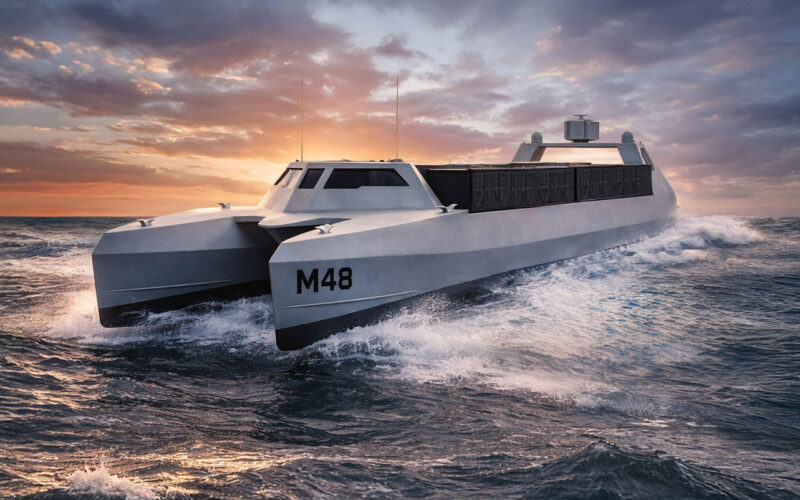
Magnet Defense LLC, a Miami-based developer of fully autonomous maritime platforms, announced on 26 March 2026 that it has begun production of its first deliverable M48 Unmanned Surface Vessel (USV), transitioning the 157-foot, $30 million platform from prototype validation to active manufacturing. The move is significant not merely as a company milestone but as a signal that the medium USV category, long dominated by paper programs and protracted experimentation cycles, is entering a production phase with at least one commercially funded entrant already in the water. Magnet Defense has invested more than $50 million in the M48 program since its inception, with the prototype accumulating over 1,000 days at sea and more than 40,000 nautical miles before a single deliverable unit was offered to market. The first production M48 is scheduled for delivery in the second quarter of calendar year 2027.
Why is Magnet Defense’s M48 a competitive option in the US Navy’s unmanned surface vessel strategy, and what separates it from rivals?
The M48 is sized at 48 metres and displaces in the medium USV category that the US Navy has identified as central to its future fleet architecture. The vessel’s headline specification is a range of 17,000 nautical miles, sufficient to self-deploy from San Diego to the Arabian Gulf without refuelling or crew support. In a market where most competitors are still refining autonomy stacks and testing hull designs in controlled conditions, Magnet Defense argues that its prototype heritage provides a rare form of credibility: real-world, uncrewed ocean crossings in Sea State 7 and brief encounters with Sea State 9 conditions, rather than sheltered harbour trials or short coastal runs.
The competitive landscape the company is navigating is crowded and accelerating rapidly. Defense One reported in February 2026 that several dozen companies are now pitching unmanned surface vessels to the Navy, ranging from established primes such as HII and Leidos through to newer entrants including HavocAI, Saildrone, Blue Water Autonomy, Anduril Industries, and Saronic. Most of the smaller players have raised significant private capital and are targeting the Navy’s Modular Attack Surface Craft programme, or MASC, which Congress funded with $2.1 billion in a reconciliation bill last year. The MASC solicitation has become the focal point for medium USV procurement, and Magnet Defense will need to position the M48 credibly within that framework to secure government offtake.
Where Magnet Defense differentiates itself is on range and prototype maturity. Blue Water Autonomy’s Liberty class, also entering production, advertises a design range of 10,000 nautical miles, well short of the M48’s 17,000-nautical-mile figure. Saronic and HavocAI are building strong autonomy software reputations but have not publicly disclosed comparable open-ocean endurance data. Saildrone, backed by a $50 million investment from Lockheed Martin, is advancing its larger Surveyor-class platforms for intelligence, surveillance, and anti-submarine roles, but operates in a different weight and mission class. Magnet Defense’s claim to a proven hull that has already lived through multi-day heavy-weather operations is a genuine differentiator at this stage of market development.
How does the DriveAI autonomy suite position the M48 for multi-domain joint operations and what mission sets does it support?
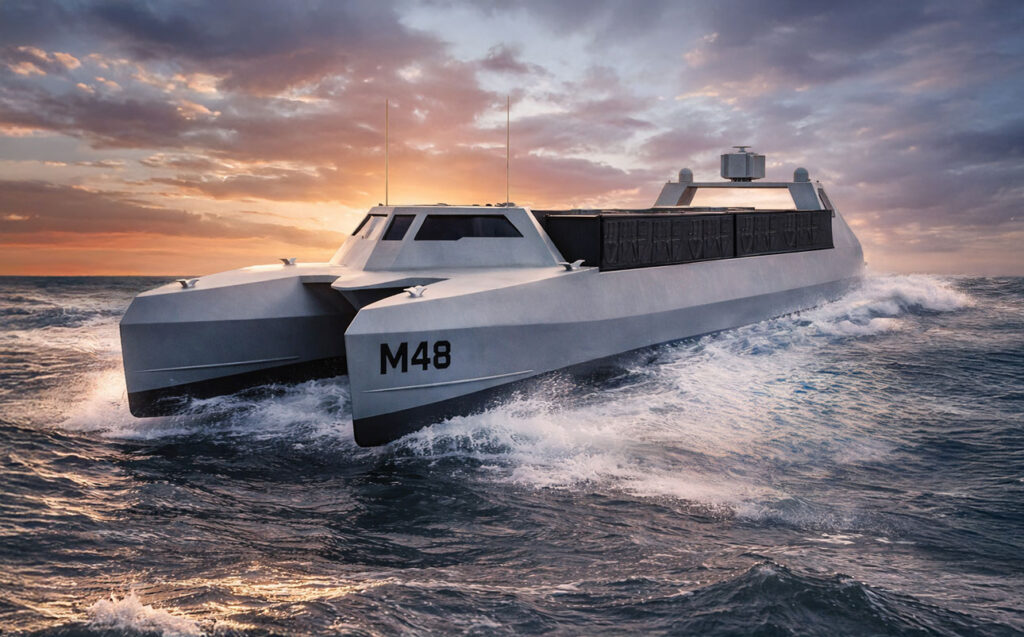
Each production M48 will be equipped with Magnet Defense’s proprietary DriveAI navigational autonomy suite. The system uses machine learning, edge processing, and multi-sensor fusion to enable the vessel to operate without human intervention in environments where satellite communications may be unreliable, degraded, or actively contested. The operational picture for DriveAI includes self-routing across long ocean passages, automated threat recognition, and what the company describes as automated weapon pairing, a capability that implies integration with combat management systems rather than purely navigational autonomy.
The mission profile the M48 is designed to support spans Integrated Air and Missile Defense, Long Range Kill Chains, Contested Logistics, Anti-Surface Warfare, Anti-Submarine Warfare, Electronic Warfare, and Search and Rescue. This breadth reflects the joint force’s desire for a modular platform that can reconfigure for different missions through containerised payloads rather than purpose-built vessels for each role. The containerised payload architecture reduces the per-unit cost of each mission configuration and allows the Navy to adjust the fleet’s capability mix without procuring entirely new hulls. For Magnet Defense, this modularity is also a commercial hedge: a vessel capable of serving multiple combatant commands and allied navies is a more resilient revenue base than a single-role platform tied to one procurement programme.
The missile defence mission set deserves particular attention. The M48’s stated ability to support Integrated Air and Missile Defense and Long Range Kill Chains places it squarely in the doctrinal space the Navy is actively developing around distributed lethality, where smaller, harder-to-target vessels carry weapons or sensor payloads that extend the strike and intercept reach of the fleet without concentrating risk on large manned ships. As the Navy moves toward Vertical Launch System integration on medium USVs under the MASC programme, a platform like the M48 with validated ocean-going endurance becomes a plausible candidate for that weapons integration, though no contract has been announced to that effect.
What does the US Navy’s $7 billion unmanned investment in fiscal year 2026 mean for companies like Magnet Defense entering the production phase now?
The macro funding environment for Magnet Defense’s production launch is as favourable as it has ever been for a medium USV developer. DefenseScoop reported in January 2026 that the Navy is investing approximately $7 billion in unmanned systems in fiscal year 2026, with $3.7 billion of that directed toward the surface force by 2027. The Navy’s inventory of small USVs grew from roughly four in 2025 to close to 400 by the end of that fiscal year. Medium USV inventory under the MASC programme is projected to reach approximately 11 vessels in 2026, with longer-term projections suggesting unmanned systems could constitute around 45 percent of the surface force by 2045.
For Magnet Defense, the timing of its production start creates a strategic window. The Navy has signalled that its MASC programme will move from prototype to procurement contract in the early phases of fiscal 2026, and companies with production-ready platforms and documented sea trial histories are better positioned than those still in design validation. The risk for Magnet Defense, as for every entrant in this space, is that the Navy’s procurement machinery moves more slowly than the market rhetoric suggests. Previous unmanned programmes, including the Sea Hunter and Seahawk medium unmanned surface vessels, spent years in experimental status before being transferred to fleet operational control. The Defence One reporting from February 2026 noted that the Navy has still not decided how many medium and large USVs it ultimately needs, and that experimentation is continuing under at least three commands simultaneously.
The company’s decision to fund the M48 primarily with private capital, without disclosing a government contract underpinning the production start, introduces a meaningful financial risk. A $30 million platform entering production on a commercial basis without a signed offtake agreement requires either strong balance sheet confidence or imminent contract visibility that has not been made public. Magnet Defense CEO Marc Bell’s statement that warfighters and mission partners can soon access the capability suggests the company is confident in near-term demand, but the gap between prototype validation and a funded production contract remains the most significant execution risk in the programme.
How does the M48’s prototype heritage with 40,000 nautical miles of sea trials address the reliability challenge that has slowed other USV programmes?
One of the persistent criticisms of the broader USV market is that many platforms have been demonstrated in controlled or benign conditions and have not been subjected to the kind of sustained, unattended ocean operations that naval missions actually require. The Magnet Research Vessel, which shares the M48’s hull, mechanical, and electrical systems, launched in 2020 and has accumulated over 40,000 nautical miles and more than 1,000 days at sea including sustained operations in multi-day Sea State 7 conditions and several hours of Sea State 9. Sea State 7 corresponds to significant wave heights of roughly 6 to 9 metres, the kind of environment that tests structural integrity, autonomy system reliability, propulsion redundancy, and sensor performance under sustained physical stress.
This heritage is not a cosmetic differentiator. The Navy’s reticence to commit large procurement budgets to unproven autonomous platforms has been a consistent theme in Congressional testimony and flag officer comments. Blue Water Autonomy’s CEO Rylan Hamilton told Defense One in February 2026 that the Navy needs to see suppliers’ vessels operating reliably every day with the fleet before major acquisition decisions are made. Magnet Defense’s position is that its prototype has already met that bar in the open ocean, independent of Navy programme supervision, which removes one significant uncertainty from the procurement conversation. Whether the Navy accepts that framing or insists on its own evaluation programme before issuing a production contract remains to be seen.
The shared hull architecture between the research vessel and the production M48 also reduces integration risk in a way that clean-sheet designs cannot replicate. The structural, propulsion, and electrical systems have already demonstrated their durability at scale over a six-year operational period. The primary production risk lies in the DriveAI autonomy software stack, which must be validated for combat-relevant mission autonomy rather than passage-making alone, and in the integration of weapons and sensor payloads that the prototype was not configured to carry.
What are the execution risks and competitive pressures Magnet Defense faces before the M48 secures a government production contract?
The medium USV market is entering a period where capital availability and prototype credibility no longer automatically translate into government contracts. The MASC programme and related procurement vehicles will force the Navy to make comparative assessments across multiple platforms simultaneously, and the evaluation criteria, including autonomy maturity, payload integration capability, classification certification, and production scalability, will matter as much as raw performance specifications. Saildrone’s Surveyor has received full classification from the American Bureau of Shipping, which the Navy has signalled it may require for future procurements. Magnet Defense has not publicly disclosed a similar classification milestone for the M48, which could be a gap in its competitive posture as formal procurement evaluations proceed.
Anduril Industries is developing its dual-use autonomous surface vessel specifically for MASC, with a stated design philosophy centred on mass production, austere-environment maintenance, and continuous software modernisation. Anduril’s integration of autonomy software with proven shipbuilding partnerships gives it a different risk profile from a smaller, less capitalised entrant. Saronic, led by Navy veterans, is pursuing ABS certification for its autonomous capabilities and has positioned itself explicitly around the Navy’s stated preference for non-exquisite, commercially built platforms. Each of these competitors is addressing a different aspect of the Navy’s acquisition framework, and Magnet Defense will need to clearly articulate where the M48 sits in that landscape, particularly on production scalability and unit economics as volumes increase.
Geopolitical urgency is a genuine tailwind for the entire sector. Heritage Foundation research fellow Brent Sadler has noted publicly that China’s accelerating shipbuilding output means the United States needs to get autonomous maritime firepower to sea quickly. Ukraine’s demonstration that small, low-cost unmanned vessels can neutralise far larger manned warships has validated the concept at operational scale. These dynamics create policy pressure for faster acquisition decisions, which in turn creates commercial opportunity for companies that can demonstrate production readiness. Magnet Defense’s March 2026 announcement is, at least in part, a deliberate signal to that policy audience that the M48 is not a concept but a manufacturing reality.
Key takeaways on what Magnet Defense’s M48 production start means for the company, autonomous maritime competitors, and the US Navy’s unmanned fleet strategy
- Magnet Defense has moved the M48 from prototype to active production, with first delivery targeted for Q2 2027, making it one of the few medium USV programmes with a published production timeline and a funded build underway.
- The M48’s 17,000-nautical-mile range is the headline specification that separates it from most competitors, including Blue Water Autonomy’s Liberty class at 10,000 nautical miles, though range alone will not determine procurement outcomes.
- Over 40,000 nautical miles and 1,000 days of sea trials on the shared-heritage Magnet Research Vessel address the Navy’s core reliability concern, but government evaluation under fleet conditions will still likely be required before a major production contract is awarded.
- The DriveAI autonomy suite supports a broad mission envelope spanning missile defence, anti-submarine warfare, electronic warfare, and contested logistics, positioning the M48 for joint force applications rather than a single-mission role.
- The Navy’s $7 billion unmanned systems investment in fiscal 2026, with $3.7 billion directed toward the surface force by 2027, represents the largest single-year funding commitment to the sector and creates genuine procurement urgency that benefits production-ready entrants.
- Magnet Defense’s privately funded production start carries balance sheet risk until a government contract is secured; the absence of a disclosed offtake agreement is the most significant near-term uncertainty in the programme.
- Competition from Anduril Industries, Saronic, Blue Water Autonomy, Saildrone, and HavocAI means the M48 enters a market where autonomy software maturity, ABS classification, and production scalability are increasingly the decisive evaluation criteria alongside hull performance.
- The MASC programme, backed by $2.1 billion in Congressional reconciliation funding, is the primary procurement vehicle the M48 must address; Navy awards for MASC variants are expected to be announced in the near term, making 2026 a defining year for medium USV market structure.
- Magnet Defense’s positioning as a private, commercially funded developer rather than a prime contractor offshoot gives it procurement agility but limits its access to the long-term programme relationships and classified integration work that larger defence companies can leverage.
- The broader strategic signal from the production start is that the medium USV market has moved past the prototype and demonstration phase; investors, policymakers, and allied navies should expect procurement decisions, not further experimentation, to dominate the sector narrative through 2027.
Discover more from Business-News-Today.com
Subscribe to get the latest posts sent to your email.