


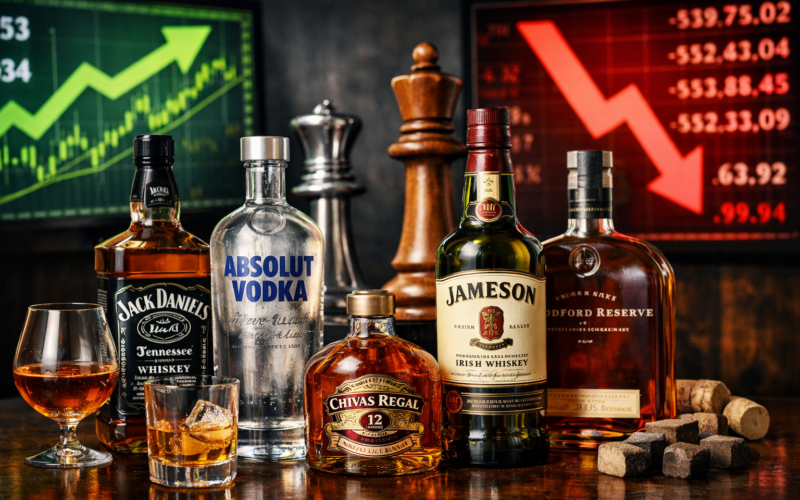
Pernod Ricard SA (Euronext Paris: RI) and Brown-Forman Corporation (NYSE: BF/A, BF/B) confirmed on 26 March 2026 that they are in formal discussions regarding a potential business combination, with both companies describing the contemplated structure as akin to a merger of equals. The disclosure follows Bloomberg and Reuters reports that broke the story hours earlier, sending Brown-Forman shares surging more than 20 percent intraday before closing up approximately 9 percent, while Pernod Ricard’s Paris-listed shares fell roughly 7 percent on the day. The combination, if concluded, would create a spirits group commanding an unrivalled portfolio stretching from Jack Daniel’s Tennessee whiskey to Absolut vodka, Jameson Irish whiskey, Chivas Regal, Martell cognac, and Woodford Reserve, among dozens of other premium and ultra-premium labels. Both companies have acknowledged no assurance that any agreement will be reached and have indicated they will not comment further until a deal is struck or talks end.
Why are Pernod Ricard and Brown-Forman exploring a merger of equals now, and what strategic logic drives the timing?
The timing is inseparable from the industrywide volume contraction that has been pressuring premium spirits producers since 2023. Pernod Ricard reported a 6 percent organic net sales decline and an 8 percent fall in recurring operating profit for the first half of fiscal year 2026, with the United States market among the most challenged regions. Brown-Forman has similarly navigated a difficult period, posting falling domestic sales as shifting consumer preferences, post-pandemic destocking, and macroeconomic pressure weighed on volumes. Both companies’ shares have reflected that pain: Pernod Ricard’s Paris-listed stock was trading around 60 euros in late March 2026, well within striking distance of its 52-week low of 58.60 euros and roughly 44 percent below its 52-week high of 107.45 euros. Brown-Forman’s Class B shares (BF/B) were hovering near 29 dollars, also near multi-year lows, with a 52-week range spanning 22.61 to 36.18 dollars.
At these valuation levels, the strategic arithmetic becomes compelling. Brown-Forman’s market capitalisation sat at roughly 11 billion dollars going into the discussions, while Pernod Ricard’s market value stood at approximately 18.7 billion euros. For Pernod Ricard, a combination while Brown-Forman is at depressed valuations offers an opportunity to secure one of the most recognised whiskey brands on the planet without the premium that might have been demanded in 2021 or 2022. For Brown-Forman, the rationale is different: access to Pernod Ricard’s global distribution infrastructure, its deep footprint in high-growth emerging markets including India, and the scale necessary to compete in an environment where the cost of building premium brand equity globally has never been higher.
The broader context is one of accelerating industry consolidation. Alcoholic beverage producers across beer, wine, and spirits have been rationalising portfolios, exiting underperforming categories, and chasing scale as volume growth evaporates in developed markets. Spirits players have faced the added burden of generational shifts in drinking behaviour, with younger consumers in major Western markets reducing alcohol consumption at a rate that is beginning to show up materially in volume figures. Consolidation at scale is no longer a growth strategy so much as a defensive necessity.
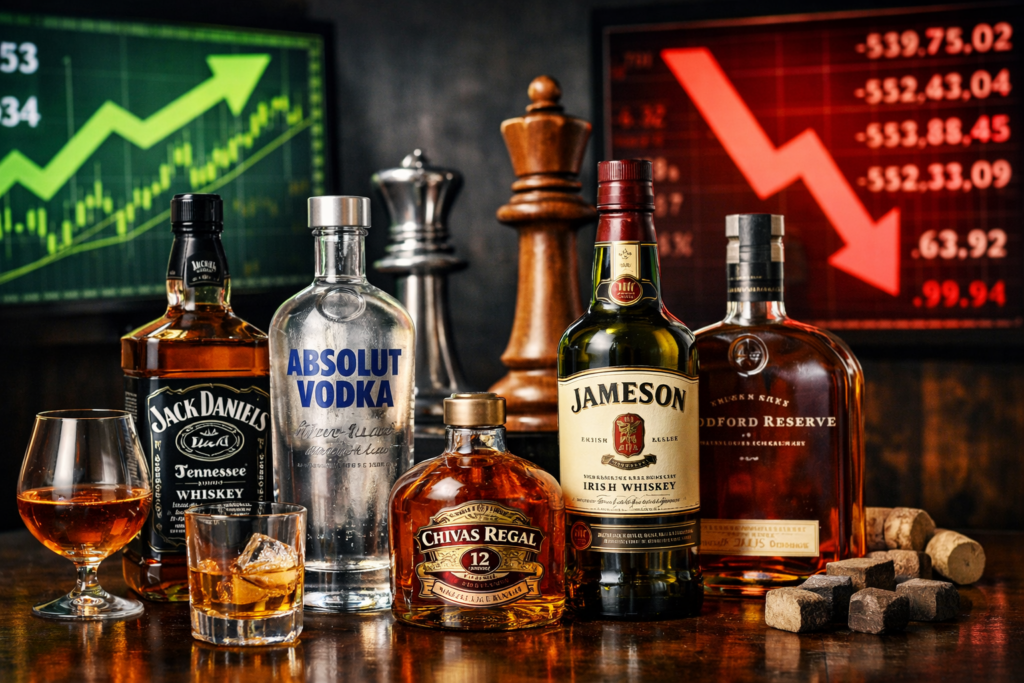
What does a combined Pernod Ricard and Brown-Forman portfolio look like, and where does the brand overlap risk lie?
A combined entity would hold an extraordinary concentration of globally recognised spirits brands. Pernod Ricard brings Absolut vodka, Jameson Irish whiskey, Chivas Regal and Royal Salute Scotch whiskies, Martell cognac, Beefeater gin, Malibu liqueur, Havana Club rum, The Glenlivet single malt, and Mumm and Perrier-Jouet champagnes, among a roster of over 240 labels distributed across 160 countries. Brown-Forman’s contribution anchors around Jack Daniel’s, the world’s best-selling American whiskey, complemented by Woodford Reserve, Old Forester, Herradura and el Jimador tequilas, Fords Gin, and a growing portfolio of Scotch single malts including The Glendronach, Benriach, and Glenglassaugh.
Portfolio overlap in whiskey is the most obvious area where antitrust scrutiny would focus. A merged group would control competing premium Scotch whisky brands, Irish whiskey positions, and American whiskey at scale simultaneously, giving it dominant shelf presence across virtually every major whiskey subcategory. Regulators in the United States, European Union, and United Kingdom would almost certainly require divestitures as a condition of approval. The more delicate question is which brands and at what price. Labels like Clan Campbell, Long John, or certain territorial Scotch positions could be candidates for disposal, but any divestiture process involving a recognisable name carries brand value risk that negotiations would need to price carefully.
The geographic complement is arguably more interesting than the brand overlap. Pernod Ricard has invested heavily in distribution infrastructure across India, which is now among the fastest-growing premium spirits markets globally, as well as across Southeast Asia and Africa. Brown-Forman’s distribution strength is concentrated in the United States and Western Europe, with particularly strong on-trade and retail relationships built around the Jack Daniel’s franchise. For Pernod Ricard, acquiring that American on-premise depth would address a structural gap that has cost it in its most important single market.
How would a Pernod Ricard and Brown-Forman combination affect Diageo’s competitive position in the premium spirits market?
Diageo plc (LSE: DGE), the world’s largest spirits company by volume, would feel the competitive pressure most acutely. Diageo’s current dominance across Scotch whisky, premium gin, luxury vodka, and tequila has been built on the breadth of its portfolio and the depth of its global distribution. A merged Pernod Ricard and Brown-Forman would challenge that position directly, assembling a group with comparable global reach, a stronger position in American whiskey where Diageo has historically been weaker, and significantly greater scale in Irish whiskey. Jameson’s continued growth in the United States, combined with a materially improved distribution platform for the Brown-Forman portfolio, would sharpen competition in bars and retail outlets across key markets.
For smaller premium spirits producers, including Remy Cointreau, Davide Campari-Milano, and Beam Suntory, the implications are more existential. A world in which two super-scale spirits platforms, Diageo and a merged Pernod-Brown-Forman entity, command disproportionate shelf space, distributor attention, and marketing budgets would compress the room available for mid-tier players to build premium positioning. Distribution consolidation tends to follow corporate consolidation, and smaller brands could find their access to the best distributors squeezed as exclusivity and priority arrangements are renegotiated at scale.
What are the key execution risks in combining two global spirits businesses of this scale and complexity?
The operational complexity of a merger of this magnitude should not be underestimated. Both companies operate across dozens of production facilities, ageing warehouses, and bottling sites globally, each tied to brand-specific production requirements, geographic appellations, and regulatory specifications. Integrating supply chains that include Scottish distilleries, Irish blending operations, a Tennessee distillery, and multiple international production facilities involves not only physical logistics but the management of appellation rules, aged stock accounting, and quality control frameworks that have been developed independently over decades.
Cultural integration represents a separate but equally material risk. Pernod Ricard operates as a decentralised federation of brand companies, with significant autonomy sitting with regional affiliates and brand custodians. Brown-Forman, a company that has been majority-controlled by the Brown family since its founding in 1870, has a distinct identity rooted in Louisville, Kentucky, and a culture built around long-term thinking and brand stewardship. The merger of equals framing both companies have used is strategically significant, since it signals an attempt to preserve Brown-Forman’s identity rather than absorb it into a French corporate structure. Execution against that promise, particularly in the early post-close period, will be a critical determinant of talent retention and brand momentum.
Financing structure and balance sheet impact also warrant scrutiny. Pernod Ricard’s own share price has fallen sharply in recent years, limiting its currency for an equity-heavy deal. If the transaction involves a significant cash component, the leverage implications for the combined group would need to be assessed against a backdrop of still-elevated interest rates and uncertain volume recovery timelines. Pernod Ricard’s consolidated sales for fiscal year 2025 were approximately 10.96 billion euros. Adding Brown-Forman’s revenue base would create a group approaching Diageo’s revenue scale, but the debt load required to consummate the deal could constrain strategic flexibility at precisely the moment the combined entity needs resources for brand investment and geographic expansion.
How have Pernod Ricard and Brown-Forman shares reacted to the merger confirmation, and what does the market divergence signal?
The market’s initial reaction told two different stories. Brown-Forman’s Class B shares (BF/B) surged more than 20 percent in the immediate aftermath of the Bloomberg report before settling up around 9 percent on the session, with trading briefly halted for volatility. The move was a sharp departure from the stock’s recent trajectory: Brown-Forman had been trading near multi-year lows, with its Class A shares (BF/A) touching 23.01 dollars at the 52-week low against a high of 35.96 dollars. The deal speculation effectively delivered in a single session what organic recovery would have taken quarters to achieve.
Pernod Ricard’s response was the mirror image. The Paris-listed shares fell approximately 7 percent, consistent with the market’s conventional pricing of an acquirer in a major deal: a combination premium being funded partly at the expense of the buyer’s shareholders. Pernod Ricard was already trading near its 52-week low of 58.60 euros, having declined more than 31 percent over the prior 12 months. The market’s scepticism likely reflects concerns about deal financing, execution complexity, and whether the combined entity can generate enough synergy to justify the transaction costs in an environment where both businesses remain under volume pressure.
The divergence is a classic deal dynamic, but it carries a pointed message: shareholders in Brown-Forman see value in being acquired at this point in the cycle, while Pernod Ricard investors are not yet convinced the price or structure represents compelling capital allocation. If and when deal terms become public, the financing breakdown and implied transaction multiple will determine whether that market response reverses or hardens.
What regulatory and antitrust hurdles would a Pernod Ricard and Brown-Forman merger face across major markets?
Regulatory approval would be required across multiple jurisdictions, with the United States, European Union, and United Kingdom representing the most consequential hurdles. The combined entity would hold significant market share across American whiskey, Irish whiskey, Scotch whisky, premium vodka, and gin simultaneously. In each of those subcategories, regulators would need to assess whether the combined group’s market position creates pricing power or distribution leverage that could harm competition. The whiskey concentration is particularly pronounced: Jack Daniel’s, Jameson, Chivas Regal, The Glenlivet, Woodford Reserve, and a suite of other labels under one corporate umbrella would represent a degree of category concentration that would almost certainly trigger conditional approval requirements.
The U.S. Department of Justice and Federal Trade Commission would likely scrutinise the deal closely given the American whiskey market dynamics. Jack Daniel’s alone commands a dominant share of the Tennessee whiskey category, and Brown-Forman’s broader bourbon portfolio adds further concentration. Pernod Ricard’s existing U.S. whiskey presence, while less significant than its European or emerging market scale, would compound the regulatory analysis. Precedent from past spirits mergers suggests divestitures in the two-to-four brand range are common in deals of this scale, though the specific portfolio in question here involves more globally recognised assets than most prior transactions.
What role does Brown-Forman’s family ownership structure play in the feasibility of a deal with Pernod Ricard?
Brown-Forman’s dual-class share structure, in which the Brown family retains majority voting control through Class A shares, is the single most consequential variable in whether any deal ultimately gets done. Unlike a widely held public company where a sufficiently attractive premium can secure shareholder approval, Brown-Forman cannot be acquired without the family’s active support. The Brown family’s willingness to engage in discussions is itself a significant signal: it suggests that at least some family members believe the long-term case for combining with Pernod Ricard is stronger than continuing on an independent path through the current industry downturn.
That does not mean internal alignment is complete or guaranteed. Founding family businesses with multi-generational ownership rarely move in lockstep on transformational decisions. The merger of equals language both companies have used publicly is almost certainly calibrated to address family sensitivities about legacy, brand stewardship, and Louisville’s continued role in any combined organisation. If negotiations progress, the governance structure of the merged entity, including board representation, executive appointments, and the preservation of Brown-Forman’s operating identity, will be at least as important to the family as transaction price.
Key takeaways: What the Pernod Ricard and Brown-Forman merger discussions mean for investors, competitors, and the spirits industry
- Pernod Ricard and Brown-Forman have formally confirmed merger discussions, framing the potential transaction as a merger of equals, though no agreement has been reached and either party may walk away.
- The deal logic is driven by a prolonged industrywide volume downturn that has pushed both companies’ share prices to multi-year lows, creating valuation conditions that make large-scale consolidation more attractive than at any point in the past decade.
- A combined entity would hold an unprecedented global spirits portfolio, spanning Jack Daniel’s, Woodford Reserve, Jameson, Absolut, Chivas Regal, Martell, The Glenlivet, Beefeater, and Herradura, with coverage across virtually every premium and ultra-premium category.
- Brown-Forman shares rose approximately 9 percent on deal confirmation while Pernod Ricard fell roughly 7 percent, a classic acquirer-target divergence signalling market scepticism about deal economics and financing for the French group.
- Pernod Ricard’s Paris-listed stock (RI) was trading near its 52-week low of 58.60 euros; Brown-Forman’s Class B shares (BF/B) were similarly depressed, with a 52-week range of 22.61 to 36.18 dollars before the deal news.
- Diageo plc faces the most direct competitive threat from a merged group, which would close the scale gap in global spirits and deliver materially stronger American whiskey and Irish whiskey positions against which Diageo currently has limited direct competition.
- Antitrust approval across the United States, European Union, and United Kingdom is likely to require brand divestitures, given the combined entity’s market share concentration across multiple whiskey subcategories.
- Brown-Forman’s family-controlled dual-class ownership structure means no deal proceeds without the Brown family’s active support, making governance terms, legacy preservation, and leadership continuity as important as headline price in negotiations.
- The merger of equals framing adopted by both companies reflects a deliberate attempt to address Brown-Forman’s cultural and family ownership sensitivities, though integrating a decentralised French spirits federation with a founder-culture American distiller carries significant organisational execution risk.
- If completed, the transaction would accelerate competitive consolidation pressure across mid-tier spirits producers including Remy Cointreau, Campari, and Beam Suntory, for whom distribution access and shelf presence in a two-platform global market would become materially harder to secure.
Discover more from Business-News-Today.com
Subscribe to get the latest posts sent to your email.