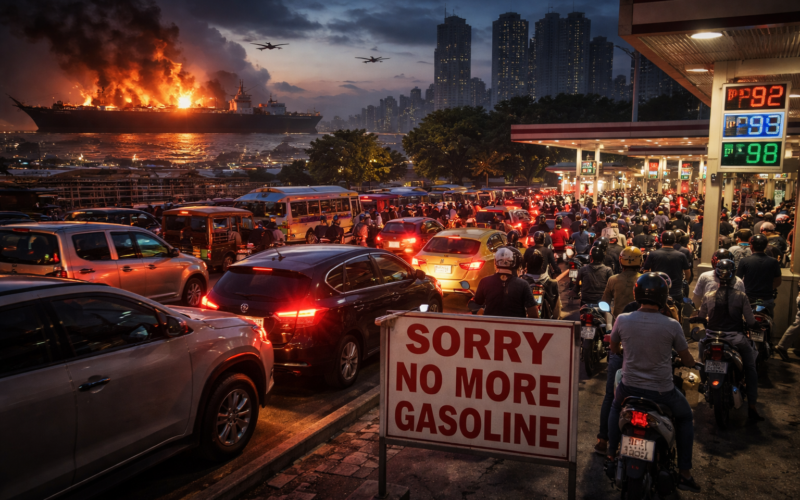
Philippine President Ferdinand Marcos Jr. signed Executive Order No. 110 on Tuesday, March 24, 2026, declaring a state of national energy emergency in light of the ongoing conflict in the Middle East and the resulting imminent danger posed upon the availability and stability of the country’s energy supply. The declaration takes effect immediately upon publication in the Official Gazette or a newspaper of general circulation and will remain in force for one year unless otherwise extended or lifted by the President. It is the first time a Philippine president has exercised emergency authority under Republic Act 7638 in response to oil supply disruptions.
The declaration followed coordinated United States and Israeli military strikes on Iran that began on February 28, 2026, under an operation that targeted military facilities, nuclear sites, and Iranian leadership, resulting in the death of Supreme Leader Ali Khamenei. In response, Iran’s Islamic Revolutionary Guard Corps issued warnings prohibiting vessel passage through the Strait of Hormuz and launched retaliatory missile and drone attacks on United States military bases in the Gulf, Israeli territory, and other Gulf states. The Strait of Hormuz, a narrow sea passage between Iran and Oman that serves as the principal conduit for approximately 20 percent of global oil and liquefied natural gas trade, has been effectively closed to most international shipping since February 28, with tanker traffic falling by approximately 70 percent at its lowest point.
Executive Order No. 110 cites a determination by Energy Secretary Sharon Garin that circumstances arising from the Middle East conflict pose an imminent danger of a critically low energy supply in the Philippines and that urgent measures are necessary to ensure the stability and adequacy of the country’s energy supply. The order explicitly references the closure of the Strait of Hormuz as disrupting the flow of petroleum products to international markets and constraining global fuel supply, with corresponding implications for the stability and adequacy of domestic energy supply in the Philippines.
Why does the Strait of Hormuz closure pose such a severe threat to Asian energy markets and import-dependent economies?
The Strait of Hormuz is the world’s most critical maritime energy chokepoint, facilitating the transit of approximately 20 million barrels of oil per day in 2025, representing roughly 20 percent of global seaborne oil trade, primarily from producers including Saudi Arabia, the United Arab Emirates, Iraq, and Qatar. In 2024, an estimated 84 percent of crude oil and condensate shipments through the strait were destined for Asian markets, with China receiving approximately a third of its oil via this route. Approximately 80 percent of Asia’s oil imports pass through the Strait of Hormuz, making the closure a structural disruption to regional energy supply rather than a marginal market event.
Beyond crude oil, the closure has disrupted liquefied natural gas flows from Qatar, one of the world’s largest liquefied natural gas producers. QatarEnergy, the Bahrain Petroleum Company, and the Kuwait Petroleum Corporation were among the major energy companies that declared force majeure following the outbreak of conflict. Qatar’s liquefied natural gas production at the Ras Laffan and Mesaieed industrial facilities was halted following Iranian drone strikes on these facilities. Approximately 80 percent of Qatar’s liquefied natural gas exports are shipped to Asia, including to China, India, Japan, and South Korea, through the Strait of Hormuz. The Japan-Korea Marker, Asia’s liquefied natural gas spot benchmark, spiked 50 percent between February 27 and March 9, 2026.

How exposed is the Philippines to the Iran war energy shock compared with other Asian economies?
The Philippines is among Asia’s most exposed economies to the current energy shock. Pakistan, Japan, and the Philippines each sourced over 90 percent of their crude oil supplies from the Persian Gulf in 2025, according to data from the Institute for Energy Economics and Financial Analysis. The Philippines imports approximately 98 percent of its oil from Gulf nations. In terms of available buffer, Vietnam has the thinnest energy reserves in Asia at less than 20 days; Pakistan and Indonesia maintain reserves of approximately 20 days; the Philippines holds approximately two months of supply; and Japan holds reserves equivalent to 254 days of demand. Fuel prices in the Philippines have nearly tripled since February 28, with diesel reportedly reaching 130 pesos per liter and liquefied petroleum gas reserves estimated at less than 24 days of supply.
The Philippines, Thailand, India, and South Korea are identified among the economies most vulnerable to higher oil prices in Asia due to their high import dependence, according to analysis by Nomura. Brent crude oil prices jumped approximately 15 percent in the opening days of the conflict and subsequently surged to 120 United States dollars per barrel as the disruption deepened and global markets began pricing in the risk of sustained supply constraints. The Asian Development Bank has warned that a prolonged disruption to the Strait of Hormuz could push oil prices substantially higher, weaken global trade, and slow economic growth across the region.
What emergency measures has the Philippine government enacted under Executive Order No. 110 and Republic Act No. 12316?
Executive Order No. 110 adopts the Unified Package for Livelihoods, Industry, Food and Transport framework as a coordinated, whole-of-government response, with President Marcos chairing the UPLIFT committee alongside the secretaries of energy, transportation, social welfare, agriculture, finance, budget and management, and economy, planning and development. Under the emergency declaration, the government is authorised to procure fuel and petroleum products to ensure timely and sufficient supply, including by paying part of any contract amount in advance. Authorities are empowered to act against hoarding, profiteering, and manipulation of petroleum product supplies. A dedicated committee has been established to ensure the orderly movement, supply, distribution, and availability of fuel, food, medicine, agricultural products, and other essential goods. The Philippine government has approved the release of a 20 billion peso emergency fund to the Department of Energy for emergency procurement.
On March 25, President Marcos signed Republic Act No. 12316, which authorises the President to suspend or reduce excise tax on petroleum products when the average Dubai crude oil price reaches or exceeds 80 United States dollars per barrel for one month. Any suspension or reduction shall be effective for a period not exceeding three months, with an aggregate duration cap of one calendar year and an overall authority expiry of December 31, 2028. The Department of Finance has estimated that a full excise tax suspension would reduce government revenues by approximately 136 billion pesos in 2026, of which 121.4 billion pesos would come from excise tax reductions and 14.6 billion pesos from lower value-added tax collections. The Department of Economy, Planning and Development estimates the suspension would lower pump prices by 6 pesos per liter for diesel and 10 pesos per liter for gasoline.
As immediate relief measures, the government has begun providing a 5,000 peso subsidy to motorcycle taxi drivers and other public transport workers nationwide. Students and workers in select cities are receiving free bus rides. Energy Secretary Garin stated on March 24 that the Philippines still held approximately 45 days of fuel supply based on current consumption levels and that the government was working to procure one million barrels of oil from countries within and outside Southeast Asia. Philippine Ambassador to the United States Jose Manuel Romualdez confirmed that Manila is working with Washington to explore exemptions that would allow the Philippines to purchase oil from countries under United States sanctions, including whether Iranian and Venezuelan oil is part of those discussions. The Philippines has also turned to Russian oil as an alternative procurement source.
How are China, Japan, India, and South Korea managing the energy disruption caused by the closure of the Strait of Hormuz?
China, India, Japan, and South Korea together account for nearly 69 percent of the crude oil and condensate that normally transits the Strait of Hormuz. China is better positioned than most Asian economies because it had stockpiled crude before the conflict, holds approximately one billion barrels in strategic storage, and continues to import pipeline natural gas overland from Russia via routes that bypass maritime chokepoints. China also benefits from long-standing commercial relationships with Iran; Iran announced on March 5 that the Hormuz closure applies only to vessels from the United States, Israel, and their Western allies. Iran is also reported to be considering allowing cargoes traded in Chinese yuan to transit through Hormuz, a development that would tilt energy flows toward China and challenge United States dollar dominance in global energy markets.
Japan, which imports more than 90 percent of its oil from the Middle East, activated the largest-ever release from its strategic petroleum reserves, releasing approximately 80 million barrels equivalent to about 45 days of supply, according to Nikkei Asia. Japanese Prime Minister Sanae Takaichi ruled out sending Japanese navy ships to help escort oil tankers through the Strait of Hormuz. South Korea, which sources approximately 70 percent of its crude from the Middle East and routes more than 95 percent of that through Hormuz, activated a 100 trillion won market-stabilisation programme and is weighing further reserve releases and emergency support measures. India, the world’s third-biggest oil importer, has over 40 percent of its crude oil imports routed through the Strait of Hormuz. Indian Prime Minister Narendra Modi stated that ensuring the Strait of Hormuz remains open, secure and accessible is essential for the whole world. Russia’s Deputy Prime Minister Alexander Novak stated publicly that Moscow is ready to increase oil supplies to both India and China.
What are the broader economic and geopolitical implications of the Middle East energy crisis for Southeast Asia and global markets?
The World Economic Forum has described the economic fallout from the United States and Israel’s conflict with Iran as a structural shock to the world economy delivered at a moment of geoeconomic fragility. The disruption first hits oil, gas, shipping, and aviation; then spreads to inflation, industrial costs, and food security; and eventually reshapes trade routes, investment decisions, and political stability. Because the United States imports relatively little oil through the Strait of Hormuz, its Asian trading and strategic partners bear an overwhelming share of the economic burden created by the conflict.
For the Philippines specifically, the National Economic and Development Authority head warned that gross domestic product growth could slow to 3.5 to 4 percent in 2026 under a worst-case scenario of 200 United States dollars per barrel of oil sustained for six months. President Marcos acknowledged in an interview with Bloomberg News that the government’s ability to defend the peso is limited as the United States dollar continues to be perceived as a safe-haven asset during periods of global uncertainty. The Institute for Energy Economics and Financial Analysis has warned that as energy prices rise and local currencies depreciate, energy imports become even more expensive in local currency terms, creating a potentially vicious feedback loop that compounds the impact of the global energy shock on emerging Asian economies.
The Middle East Council on Global Affairs has argued that the current conflict exposes a fundamental asymmetry: Asian economies are deeply exposed to Middle Eastern energy markets, yet Asian states wield minimal influence over de-escalation dynamics and wider regional instability. East Asian powers import roughly 60 percent of their oil from the Middle East. A coordinated position among Asian powers, the council has argued, could enhance diplomatic leverage and allow these states to exert greater influence over de-escalation efforts. The potential emergence of a Chinese preferential arrangement for Strait of Hormuz transit represents a structural disadvantage for allied democracies including Japan, South Korea, and Australia that reserve-building alone cannot offset, according to analysis from the Diplomat.
Within the Philippines, the declaration of a state of national energy emergency has drawn criticism from transport unions and civil society groups who argue that the measures enacted fall short of addressing the structural roots of the fuel price crisis. Piston, a federation of public transport associations, described the emergency declaration as a superficial measure that ignores the structural roots of the fuel crisis and called for the immediate suspension of both the excise tax and value-added tax on petroleum products as a more direct form of relief. The two-day transport strike planned from Thursday by transport workers, commuters, and consumer groups reflects the scale of public pressure on the Marcos administration to deliver more substantive and immediate interventions.
Key takeaways on what the Philippines energy emergency means for the country, the region, and the global energy order
- Philippine President Ferdinand Marcos Jr. signed Executive Order No. 110 on March 24, 2026, declaring a state of national energy emergency under Republic Act 7638, the first such invocation in Philippine history in response to oil supply disruptions, citing the imminent danger posed to the country’s energy supply by the closure of the Strait of Hormuz following United States and Israeli military operations against Iran.
- The emergency response framework, designated UPLIFT, authorises emergency fuel procurement, anti-profiteering enforcement, and financial subsidies for transport workers, while the simultaneously enacted Republic Act No. 12316 grants the President authority to suspend or reduce fuel excise taxes when Dubai crude oil prices reach or exceed 80 United States dollars per barrel, subject to a maximum suspension of three months per activation and a total aggregate cap of one calendar year.
- The Strait of Hormuz, through which approximately 20 percent of global oil and liquefied natural gas trade transits, has been effectively closed to most international shipping since February 28, 2026, with tanker traffic falling approximately 70 percent; around 80 percent of Asia’s oil imports depend on this route, making Asian economies the most exposed globally to the supply disruption.
- Asian economies face sharply differentiated levels of resilience: Japan, with 254 days of strategic petroleum reserves, has activated its largest-ever reserve release; South Korea has enacted a 100 trillion won market-stabilisation programme; China benefits from strategic stockpiles and potential preferential transit arrangements with Iran; while smaller Southeast Asian economies including the Philippines, Vietnam, Pakistan, and Indonesia hold far shorter reserve buffers and face more acute supply and price risks.
- The Philippine government faces mounting fiscal and economic pressure, with the Department of Finance estimating a revenue loss of approximately 136 billion pesos from a full fuel excise tax suspension, the National Economic and Development Authority warning that gross domestic product growth could slow to 3.5 to 4 percent under a worst-case oil price scenario, and public protest planned over the adequacy of government relief measures, reflecting the breadth of economic strain on Filipino households, transport workers, and businesses.
Discover more from Business-News-Today.com
Subscribe to get the latest posts sent to your email.