




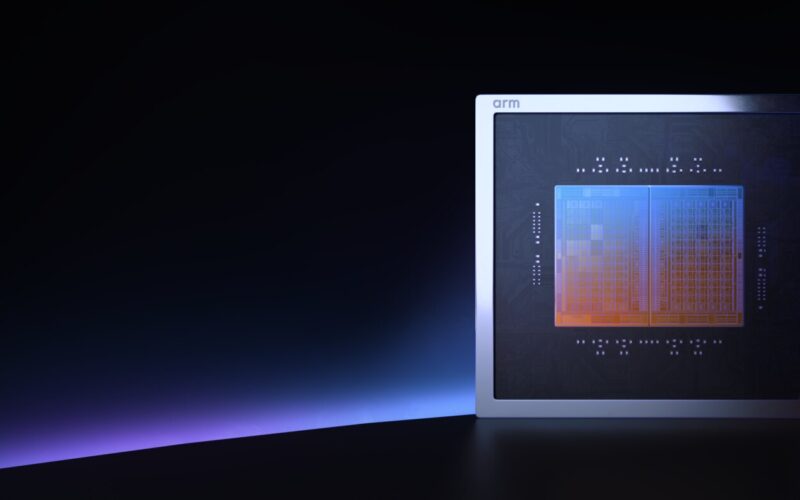
Arm Holdings plc (NASDAQ: ARM) has announced the most consequential shift in its 35-year history, moving beyond intellectual property licensing to produce its own production silicon for the first time with the launch of the Arm AGI CPU, a data center processor built specifically for agentic AI workloads. The announcement, made at the company’s annual Arm Everywhere event in San Francisco, positions Arm as a direct competitor in the AI compute stack rather than simply the underlying architecture provider. Arm Holdings stock surged approximately 14 percent intraday on March 25 to trade around $154, after closing at $134.96 the prior session, with the 52-week range spanning $80 to $183.16. The market reaction reflects investor recognition that this move fundamentally restructures the Arm revenue model and its long-term earnings potential.
Why is Arm Holdings launching its own data center CPU instead of continuing to license its architecture to chip partners?
For three decades, Arm’s business model was elegant in its simplicity: design CPU architectures, license those designs to semiconductor companies such as Apple, Qualcomm, and NVIDIA, and collect royalties on every chip shipped. That model generated consistent and growing cash flows, particularly as Arm’s Armv9 architecture gained adoption across data center workloads. However, the model has an inherent ceiling. Royalty rates, even at premium AI-tier pricing, represent a fraction of the value captured by the companies that fabricate and sell the chips. By stepping into silicon production itself, Arm is seeking to capture a larger portion of the value chain at precisely the moment when AI data center investment is accelerating globally.
The move also reflects a competitive reality. Custom silicon is now a strategic priority for every major hyperscaler. Amazon Web Services builds its own Graviton processors on Arm architecture. Google Cloud runs its Axion CPU family, also Arm-based. Microsoft Azure has deployed its Cobalt CPU line. Each of these platforms was built using Arm’s compute subsystem designs, generating royalties for Arm but scale economics and differentiation for the hyperscaler. The Arm AGI CPU allows Arm to offer a production-ready silicon option for customers who lack the engineering resources or capital to build their own custom designs, opening a new segment of the addressable market entirely.
What are the technical specifications of the Arm AGI CPU and how does it compare with x86 server processors for AI workloads?
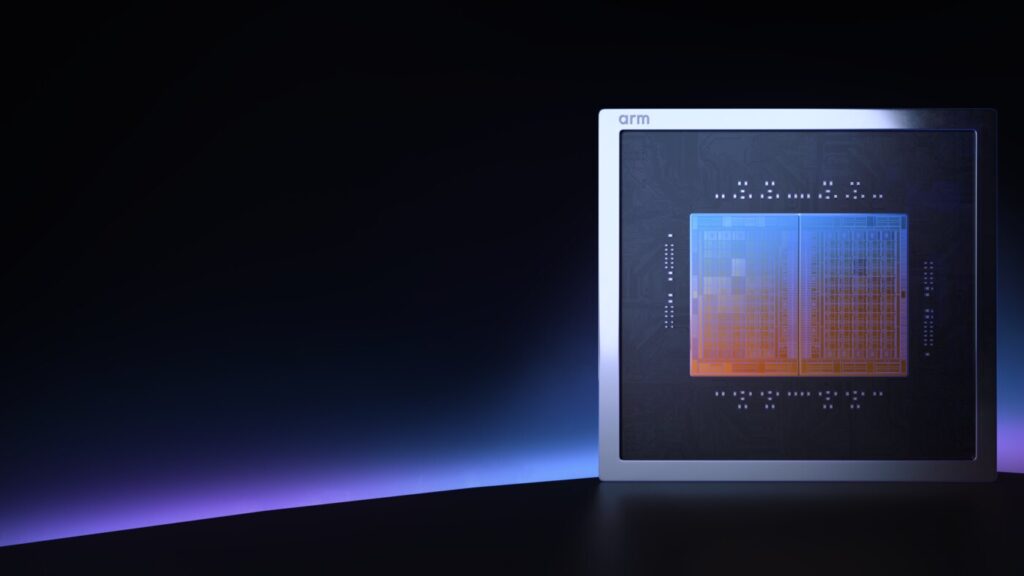
The Arm AGI CPU is built on TSMC’s 3-nanometer process node and packs up to 136 Arm Neoverse V3 cores per processor. The chip delivers 6 gigabytes per second of memory bandwidth per core at sub-100-nanosecond latency and operates at a 300-watt thermal design power envelope. Arm’s own benchmarks claim the AGI CPU delivers more than double the performance per rack compared with equivalent x86 server platforms, a claim that will require independent third-party validation before procurement teams at enterprise scale will accept it as a purchasing rationale. The chip is designed for air-cooled deployments at up to 8,160 cores per rack and liquid-cooled systems scaling to over 45,000 cores per rack.
The architecture is deliberately built without the backward-compatibility overhead that characterizes x86 designs from Intel and AMD. x86 processors carry decades of legacy instruction set baggage that consumes silicon area and power budget without contributing to modern AI workload performance. Arm’s architecture has always avoided this constraint, and the Arm AGI CPU is optimized specifically for the token throughput demands of large language model inference, agent orchestration, and control plane processing rather than the general-purpose workloads that shaped x86 server design. Arm projects these characteristics translate into up to $10 billion in capital expenditure savings per gigawatt of AI data center capacity compared with x86 deployments, though as with any vendor-supplied projection, real-world results will vary significantly by workload type and deployment configuration.
How does the partnership with Meta on the Arm AGI CPU shape the competitive landscape for AI data center infrastructure investment?
Meta Platforms serves as the lead partner and co-developer for the Arm AGI CPU, a relationship that provides the chip with immediate credibility at hyperscaler scale. Meta has committed to deploy the Arm AGI CPU alongside its own Meta Training and Inference Accelerator custom silicon, using the Arm processor for orchestration, memory management, and AI agent coordination tasks where purpose-built CPUs outperform general server chips. The partnership also extends across multiple generations of the Arm AGI CPU roadmap, which is significant because it signals a multi-year capital commitment rather than a speculative evaluation engagement. For Arm, having Meta as the anchor customer removes the most acute adoption risk that typically accompanies a first-generation enterprise chip.
Beyond Meta, the announced customer list includes OpenAI, Cloudflare, Cerebras, F5, Positron, Rebellions, SAP, and SK Telecom. These customers span accelerator management, cloud API hosting, task orchestration, and enterprise application workloads, meaning the Arm AGI CPU is being positioned across the full stack of agentic AI infrastructure rather than targeting a narrow use case. The breadth of committed customers across hyperscale, enterprise software, and telecommunications reduces the concentration risk that would otherwise make this a high-variance bet for Arm.
What does the shift to agentic AI workloads mean for CPU demand in global data centers and why does this benefit Arm’s new strategy?
The transition from AI model training to continuous agentic AI deployment changes the compute profile of data centers in a way that strongly favors CPU expansion. Training runs are GPU-intensive events that occur in discrete bursts. Agent-driven applications, by contrast, run continuously, handling inference requests, tool calls, memory retrieval, planning cycles, and inter-agent communication around the clock. This sustained throughput requirement places substantially greater demand on the CPUs that coordinate those tasks, manage data movement, and handle the control logic between accelerators.
Arm’s own analysis suggests that agentic AI deployments will require more than four times the current CPU capacity per gigawatt of data center power consumption. If that projection is directionally accurate, it represents a secular demand driver that extends well beyond the current GPU-centric capital expenditure cycle. The timing of the Arm AGI CPU launch is therefore strategically calibrated: it arrives precisely as hyperscalers are beginning to plan their next round of AI infrastructure build-out, giving Arm a window to shape procurement decisions before incumbent x86 suppliers lock in commitments.
How does the Arm AGI CPU affect the existing licensing business and what are the revenue model implications for Arm Holdings investors?
The most important structural question for Arm Holdings investors is whether the move into silicon cannibalizes the existing licensing and royalty revenue stream or expands total addressable market without meaningful substitution. The answer depends largely on which customers adopt the Arm AGI CPU. Hyperscalers with the engineering scale to build custom silicon on Arm architecture, such as Amazon Web Services with Graviton or Google Cloud with Axion, are unlikely to switch to an Arm-designed chip; they continue to license Arm’s compute subsystems and capture the differentiation themselves. The Arm AGI CPU is more likely to attract mid-market cloud providers, enterprise software companies, and infrastructure operators who need Arm-class performance without the custom silicon investment.
On that basis, the silicon business is genuinely additive rather than cannibalistic for the near term. Arm has projected its silicon business could contribute $15 billion in annual sales within five years and $25 billion by fiscal 2031, a figure that would dwarf its current approximately $4 billion annual revenue base. Those projections carry obvious uncertainty, but they frame the potential magnitude of the revenue opportunity if execution is disciplined. The gross margin profile will almost certainly be lower than the software-like margins of IP licensing, but the absolute revenue and earnings per share contribution at scale could more than compensate for the dilution. HSBC analyst Frank Lee, who upgraded Arm to buy and lifted his price target to $205, noted that Arm’s newest technology commands approximately double the royalty rate of prior generations, suggesting the underlying IP business is also repricing upward concurrent with the silicon expansion.
What execution and competitive risks does Arm Holdings face in scaling its first self-designed silicon product to commercial volume?
Moving from IP licensor to silicon vendor is not a straightforward transition. Arm must now build and sustain capabilities it has historically outsourced: chip validation at production scale, supply chain management, OEM partnership logistics, firmware and software ecosystem support at the silicon layer, and customer engineering teams capable of supporting enterprise deployment. Arm is working with lead OEM and ODM partners including ASRock Rack, Lenovo, Quanta Computer, and Supermicro, with early systems available now and broader commercial availability expected in the second half of 2026. The partnership model limits direct supply chain exposure, but it also means Arm’s customer experience is partly dependent on the execution quality of its hardware partners.
Competitive pressure from Intel and AMD will intensify as soon as those companies identify the Arm AGI CPU as a material threat to their data center revenue. Both companies have been investing heavily in next-generation server processor architectures, and neither will cede the AI infrastructure market without aggressive pricing and platform responses. Additionally, the hyperscalers who are Arm’s most important ecosystem supporters are also potential adversaries in this new market segment: if Amazon Web Services, Google Cloud, and Microsoft Azure perceive Arm-designed silicon as competing with their own custom chip businesses, they have the leverage to cool their enthusiasm for Arm ecosystem investments. Managing those relationships carefully will require strategic precision from Arm’s leadership.
How did Arm Holdings stock react to the AGI CPU announcement and what does the market pricing imply about long-term revenue expectations?
Arm Holdings stock (NASDAQ: ARM) surged approximately 14 percent on March 25, 2026, trading around $154 after the prior session’s close of $134.96, with the intraday range running from $148.25 to $157.10. The stock had already rallied more than 14 percent in the prior week following bullish analyst commentary, meaning the market began pricing in the possibility of a major product announcement ahead of the Arm Everywhere event. The 52-week trading range of $80 to $183.16 illustrates the valuation volatility that has characterized Arm’s journey from mobile chip licensor to AI infrastructure play. The stock’s current position around $154 places it well off the 52-week high but substantially above its lows, suggesting the market is pricing meaningful but not certain execution on the silicon strategy.
Analyst coverage following the announcement reflects cautious optimism rather than uncritical enthusiasm. The consensus rating sits at buy across 26 of 28 analysts tracked, with the average 12-month price target at approximately $152 and a high estimate of $205. HSBC’s double upgrade to buy with a $205 target represents the most aggressive institutional rerating and is premised on the view that Wall Street has consistently underestimated how rapidly Arm’s royalty mix is shifting toward higher-value AI workloads, and that the silicon business could represent an entirely new earnings driver by fiscal 2029. The more conservative read is that Arm’s current market capitalization of approximately $143 billion already prices in a substantial portion of the long-term silicon revenue opportunity, leaving limited room for error on execution.
Key takeaways: What Arm Holdings’ first silicon product means for AI infrastructure, competitors, and semiconductor investors
- Arm Holdings has crossed a fundamental strategic threshold by moving from IP licensor to production silicon vendor, a shift that redefines its competitive positioning and revenue model for the AI era.
- The Arm AGI CPU, built on TSMC’s 3nm process with up to 136 Neoverse V3 cores, targets the rapidly expanding agentic AI infrastructure market where sustained CPU throughput is becoming as critical as GPU compute.
- Meta Platforms as lead partner and co-developer provides immediate hyperscaler-scale validation and a multi-generation roadmap commitment, reducing the adoption risk typical of a first-generation enterprise chip.
- The committed customer base spanning OpenAI, Cloudflare, Cerebras, SAP, SK Telecom, and others demonstrates broad deployment intent across accelerator management, cloud API hosting, and enterprise application workloads.
- Arm projects the silicon business could contribute $15 billion in annual revenue within five years, dwarfing its current circa $4 billion annual revenue base, though margin compression versus the IP licensing model is a structural consideration.
- The move does not materially threaten Arm’s existing licensing revenue in the near term, as hyperscalers building custom Arm-based silicon are unlikely to substitute, making the silicon business genuinely additive for mid-market and enterprise customers.
- Intel and AMD face a credible new competitor in AI data center CPUs for the first time, backed by the entire Arm ecosystem including NVIDIA, Broadcom, Micron, Samsung, and TSMC.
- Execution risks are real: Arm must scale capabilities in chip validation, supply chain management, OEM logistics, and enterprise support that it has historically outsourced, creating operational complexity with no comparable precedent in the company’s history.
- Arm Holdings stock surged approximately 14 percent to around $154 on announcement day, reflecting investor conviction that the silicon expansion is strategically sound, though the stock remains well inside its 52-week high of $183.16, suggesting upside contingent on delivery.
- The broader semiconductor industry implication is significant: if Arm can successfully commercialise its own silicon at scale, it creates a template for other IP-centric firms to explore vertical integration as AI demand sustains premium pricing across the compute stack.
Discover more from Business-News-Today.com
Subscribe to get the latest posts sent to your email.

