



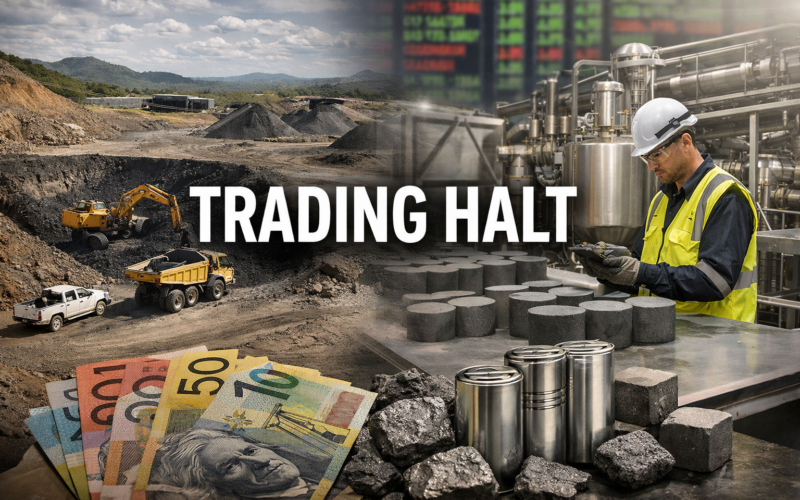
Syrah Resources Limited (ASX: SYR), the Melbourne-headquartered graphite miner and battery anode material producer, has entered a trading halt while it works through a proposed funding arrangement with its United States government lenders and assesses a potential equity raising. The halt, which follows months of active negotiation with the US International Development Finance Corporation and the US Department of Energy under a Macquarie-advised strategic review process, arrives at a pivotal moment for the company as it attempts to resolve outstanding loan conditions and shore up liquidity across its two core assets. Syrah operates the Balama Graphite Operation in Mozambique and the Vidalia Active Anode Material facility in Louisiana, the only vertically integrated, large-scale active anode material manufacturing operation outside China. The stock closed at A$0.145 on 24 March 2026, deep below the 52-week high of A$0.53, leaving the company with a market capitalisation of approximately A$200 million against an enterprise value exceeding A$520 million, a gap that reflects both the weight of its US government debt and the uncertainty investors have assigned to near-term resolution.
Why has Syrah Resources entered a trading halt and what does the proposed funding package involve?
The trading halt has been sought pending an announcement covering both a proposed funding package with lenders and a potential equity raising. This dual structure is significant: it signals that neither the lender negotiations nor any standalone capital raise is yet finalised, and that the company needs trading to be suspended while terms are confirmed and disclosure is prepared. The lenders in question are the US International Development Finance Corporation, which provided a US$150 million loan primarily directed at Syrah’s Balama operation in Mozambique, and the US Department of Energy, which has extended US$102 million in loan funding toward the initial expansion of the Vidalia facility.
Both loan facilities have been the subject of ongoing forbearance and deferral arrangements. As Syrah’s CFO Steve Wells disclosed during the Q4 2025 earnings call in late January 2026, interest payments on the DFC loan were deferred to May 2026, while debt service obligations under the DOE facility had been pushed out to 2027 under a separate forbearance agreement. Wells also confirmed at that call that the loan covenants included a specific requirement for further funding by 1 March 2026, a deadline that has now passed, adding a degree of urgency to the trading halt announcement. That March 1 requirement forms part of the broader strategic advisory process Syrah has been running with Macquarie Capital to evaluate partnering and funding options across both assets.
The trading halt announcement, timed before the ASX open, is consistent with standard market practice when a company is finalising a material capital raise or restructured financing that would be price-sensitive if disclosed in an incomplete form. For Syrah, the stakes are unusually high given that any new equity issuance would be layered on top of an already diluted share base following the approximately A$70 million institutional placement and entitlement offer completed in August 2025, which funded Vidalia operating costs and reserves for the DOE loan.

How do Syrah’s DFC and DOE loan obligations shape the structure of any new funding deal?
The architecture of Syrah’s US government debt has created a constrained funding environment that any new package must navigate carefully. The DFC facility, secured in late 2024, was structured to support both Balama’s tailings storage expansion and operating costs, with disbursements continuing through late 2025. An additional US$8.5 million disbursement was made in the December 2025 quarter to fund working and sustaining capital at Balama. However, the facility also triggered events of default earlier in the company’s history, first in December 2024 when protest actions in Mozambique disrupted Balama operations and halted shipments, forcing Syrah to pause production and engage both lenders on remediation.
At the close of the December 2025 quarter, Syrah held total cash of US$77 million, comprising US$18 million in unrestricted cash and US$59 million in restricted cash held under the two loan facilities. Of the restricted cash, US$10 million was available to fund Balama operating and capital costs, and US$17 million was earmarked for Vidalia expenses. An additional US$7 million remained drawable under the DFC facility for tailings storage purposes, subject to meeting loan conditions. With unrestricted cash of only US$18 million and operational cash outflows running at approximately US$18 million per quarter, Syrah’s liquidity window without new capital is narrow, making the proposed funding package a matter of near-term operational necessity rather than opportunistic balance sheet management.
The DOE forbearance, which defers debt service to 2027, provides a degree of medium-term breathing room, but any resolution that satisfies the lender requirements while minimising dilution to existing shareholders will need to thread a complex needle. The involvement of Macquarie Capital as strategic adviser suggests Syrah has been pursuing options that could include a strategic partnership, a significant cornerstone investor, a restructured government loan covenant, or some combination of all three alongside fresh equity.
What strategic and operational context does Syrah bring to its lender negotiations in early 2026?
The timing of this halt coincides with a meaningful shift in the external environment that works in Syrah’s favour, even if financial pressure has not eased. The US Department of Commerce finalised aggregate anti-dumping and countervailing duty rates on Chinese graphite active anode material imports at a minimum of 160%, comprising a final dumping margin of approximately 103% and a countervailing duty rate of approximately 67%. If affirmed by the International Trade Commission in the first quarter of 2026, these duties will apply for a minimum five-year period, materially restructuring the economics of supplying battery-grade anode material to US manufacturers outside Chinese supply chains. Vidalia, as the only vertically integrated, large-scale domestic active anode material producer, is structurally positioned to benefit from this shift.
On the operational side, Balama recommenced production in June 2025 following a forced outage that had lasted the better part of the preceding six months. By the December 2025 quarter, Balama was producing 34,000 tonnes of graphite at a 76% recovery rate, with the December production campaign achieving 83% recovery, a result described by management as in line with prior peak operational performance. Natural graphite sales of 29,000 tonnes in the quarter were up 21% on the prior period, with a weighted average CIF sales price of US$577 per tonne. The operation was targeting production of no less than 30,000 tonnes in the March 2026 quarter, with sales expected to match production as demand-driven campaign scheduling continues.
At Vidalia, the qualification process with US customers including Tesla remains the critical variable. Tesla issued a default notice in July 2025 citing conformity issues with active anode material samples, and the final qualification deadline under the cure process was extended to 16 March 2026, subject to consent from the DOE. Syrah maintained that its product quality and electrochemical performance were not in question, attributing the complexity to evolving customer specifications and process requirements in nascent US battery manufacturing operations. The Tesla offtake agreement, and the commercial sales from Vidalia that would flow from its resolution, remains the most consequential near-term catalyst for the stock.
How does a potential equity raising at these prices affect existing shareholders and the capital structure?
Any equity raising conducted at or around the current trading levels will be materially dilutive. At A$0.145 per share, Syrah’s 1.31 billion shares on issue imply a market capitalisation of approximately A$190 million, well below the enterprise value of over A$520 million that reflects the quantum of US government debt sitting on the balance sheet. The August 2025 A$70 million raise was conducted at a time when the stock was trading considerably higher, around A$0.35 to A$0.40, and even then was described as required to fund Vidalia operating costs and DOE loan reserves through the low-revenue qualification period.
The willingness of investors to participate in a fresh raising at or near the current depressed price will depend heavily on the terms and credibility of the lender funding package being announced simultaneously. If the proposed arrangement involves a restructured government loan with revised covenants, extended deferrals, or a converted equity stake from a strategic partner, the dilution calculus for retail and institutional shareholders changes significantly. A raising that comes accompanied by clear resolution of the DFC and DOE loan events of default, confirmation of the Vidalia qualification outcome, and a pathway to commercial sales would be a fundamentally different proposition from a standalone capital call issued under duress.
Macquarie and Jarden have both maintained buy ratings on Syrah Resources heading into this announcement, with consensus price targets in the range of A$0.43 to A$0.52, representing significant upside from the last traded price. That analyst conviction reflects a view that the assets are strategically sound and that the current discount is a function of financing uncertainty rather than fundamental impairment. Whether that view is sustained will depend on what emerges from the trading halt.
What does Syrah’s trading halt reveal about the broader critical minerals financing challenge in Australia?
Syrah’s situation is a case study in the structural difficulty facing ASX-listed critical minerals companies that have built large-scale, capital-intensive supply chains premised on US government policy support. The company deployed hundreds of millions of dollars building Balama into the world’s largest graphite mine and constructing Vidalia as a US-domestic active anode material facility. Both decisions were rational at the time of inception and remain strategically valid given the geopolitical direction of travel. The challenge is that the revenue ramp, particularly at Vidalia, has been slower than initially modelled, and the interim financing bridge required to hold the position through a protracted qualification and policy crystallisation process has placed enormous strain on the balance sheet.
The situation also highlights a tension inherent in US government development finance as a vehicle for funding ex-China critical mineral supply chains. The DFC and DOE are simultaneously lenders with financial covenants and geopolitical actors with a strategic interest in seeing Syrah succeed. That dual role has produced an unusual dynamic in which forbearance has been extended and deferrals granted even as events of default were technically triggered, because calling the loans and forcing an asset sale would be counterproductive to the very supply chain diversification objectives those facilities were designed to support. The question is whether that implicit government backing will translate into a formal restructuring that gives Syrah the runway it needs to reach commercial scale.
For Australian investors, the lesson runs deeper than Syrah alone. A number of ASX-listed battery materials companies have pursued a similar playbook of securing US government financing to anchor domestically produced critical minerals supply chains for the US EV sector. The common thread among those that are struggling is the mismatch between the long lead times of industrial qualification and policy implementation on one side, and the short patience of listed equity markets and fixed covenant loan structures on the other. Syrah is the largest and most advanced of that cohort, and how it resolves this particular funding episode will be watched closely across the sector.
Market and stock context: how does the SYR price reflect the announcement risk heading into the halt?
Syrah Resources shares closed at A$0.145 on 24 March 2026, the session before the trading halt was sought. The stock has declined approximately 68% from its 52-week high of A$0.53, touched in the months following the August 2025 equity raise and before the combination of Tesla’s default notice and ongoing Vidalia qualification uncertainty weighed on sentiment through the second half of the year. The 52-week low sits at A$0.18, and the current price is below even that range based on the most recent data, suggesting the market has been pricing in a capital raise at distressed levels ahead of the announcement.
The price-to-book ratio of approximately 0.44 times, combined with an enterprise value to revenue multiple that has expanded well above 20 times on depressed near-term revenues, reflects a market that is not valuing the underlying assets at replacement cost but is instead applying a deep financing risk discount. The stock’s beta of approximately 2.4 underscores its sensitivity to macro sentiment around EVs, China trade policy, and critical minerals, meaning any resolution that removes the balance sheet uncertainty could produce an outsized re-rating. Both Macquarie and Jarden held buy ratings as of late January 2026, with Jarden’s reaffirmed buy and Macquarie’s unchanged positive stance pointing to conviction that the discount is temporary and resolution-linked. The next earnings release, due 31 March 2026, may now be deferred or superseded by whatever announcement follows the lifting of the trading halt.
Key takeaways: What Syrah Resources’ trading halt means for the company, lenders, and the critical minerals sector
- Syrah Resources has entered a trading halt pending simultaneous announcements on a proposed lender funding package and potential equity raising, a pairing that signals the two elements are structurally linked and neither is yet final.
- The company’s US government loan covenants with the DFC and DOE included a requirement for further funding by 1 March 2026, a deadline that has passed without public resolution, making this announcement a response to an active covenant obligation rather than an opportunistic capital management exercise.
- With only US$18 million in unrestricted cash at the end of December 2025 and quarterly cash outflows of approximately US$18 million, the liquidity position makes new capital structurally necessary, not discretionary.
- The finalisation of US anti-dumping and countervailing duties on Chinese graphite active anode material at a minimum 160% aggregate rate, if confirmed by the International Trade Commission, materially improves the commercial case for Vidalia and could attract strategic investors or improved lender terms.
- Any equity raise at current prices near A$0.145 will be significantly dilutive to existing shareholders; the terms of the concurrent lender package will determine whether participation in a new raising represents distressed capital absorption or a re-rating opportunity.
- The Tesla offtake cure process, with a final qualification deadline that was extended to 16 March 2026, may factor directly into what is announced, as Vidalia commercial sales are the most consequential single variable in the longer-term cash flow outlook.
- The Macquarie Capital strategic advisory mandate, running alongside the lender negotiations, raises the possibility that any announcement could include a cornerstone strategic investor, a joint venture structure, or a restructured government debt arrangement rather than a plain vanilla equity raise.
- Analyst consensus buy ratings from Macquarie and Jarden with price targets of A$0.43 to A$0.52 imply the current discount is financing-driven rather than asset-driven, but those targets are contingent on successful resolution of precisely the uncertainties this halt is intended to address.
- Balama’s operational recovery, with 34,000 tonnes of production in the December 2025 quarter at 83% recovery in the most recent campaign, provides a credible revenue foundation if the lender and equity resolution removes the near-term cash pressure.
- Syrah’s situation is the highest-profile stress test for the model of using US government development finance to anchor ex-China critical mineral supply chains listed on the ASX; its resolution will set a reference point for how that model performs under commercial pressure.
Share this:
Discover more from Business-News-Today.com
Subscribe to get the latest posts sent to your email.