




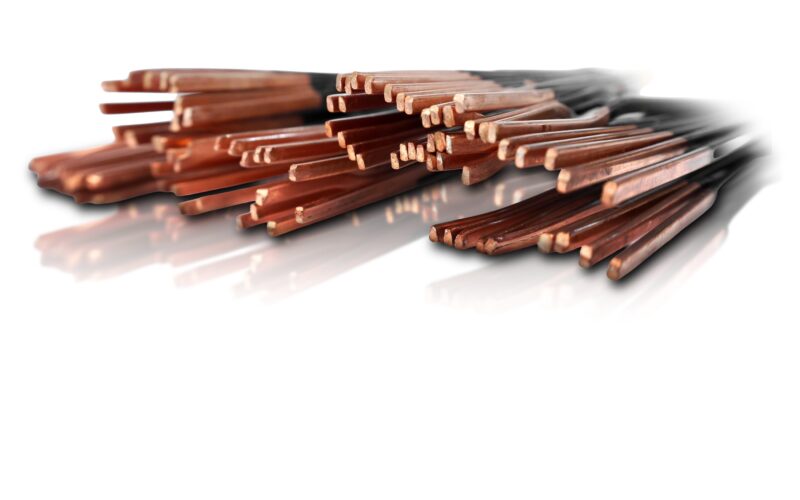
Hind Rectifiers Limited (NSE: HIRECT), the Mumbai-headquartered power electronics and railway traction equipment manufacturer, announced on March 23, 2026 the commercial availability of its advanced copper conductors to external buyers, marking the company’s formal entry into the third-party transformer supply chain. The product line, manufactured at the recently commissioned Sinnar facility in Nashik, Maharashtra, comprises Continuously Transposed Conductors (CTC), Paper Insulated Copper Conductors (PICC), and Enameled Paper Insulated Copper Conductors (EPICC), with global export as an explicit objective. The announcement signals that what began as a Rs 56 crore backward integration project to secure Hind Rectifiers’ own transformer production has been deliberately scaled to address a broader supply gap in the Indian CTC market. HIRECT shares have traded between a 52-week low of Rs 799 and a 52-week high of Rs 2,108.50, with a bonus share issue (1:1) approaching record date on March 27, 2026 adding near-term corporate action interest to an already eventful quarter.
What is the strategic case for Hind Rectifiers selling CTC conductors to external transformer manufacturers in India and overseas?
The Sinnar copper facility was never conceived purely as a cost-reduction exercise. During Hind Rectifiers’ Q2 FY26 earnings call, management was explicit that the CTC capacity installed in Phase 1 exceeds the company’s own internal consumption requirements, and that third-party sales to transformer manufacturers outside the railways segment were always part of the commercial rationale. The logic is straightforward: CTC production is a process-intensive conversion of copper, where value lies not in raw material cost but in precision manufacturing, insulation quality, and dimensional tolerance. By building that process capability in-house, Hind Rectifiers has created a tradeable product with margin characteristics different from its core equipment business.
The addressable market extends well beyond what Hind Rectifiers itself needs. India’s transformer manufacturing sector, which feeds power grid expansion, industrial electrification, and renewable energy infrastructure, depends on CTC imports or a small domestic supplier base that has historically been a bottleneck for transformer deliveries. The company’s own experience confirms this: prior to the Sinnar facility coming online, CTC shortages contributed to supply chain disruptions and delayed transformer deliveries to Indian Railways, reportedly resulting in financial penalties. The March 2026 announcement of export-ready CTC from an ISO 9001:2015 certified facility positions Hind Rectifiers as a potential supplier to international transformer manufacturers, particularly in markets where EU Conflict Minerals Regulations and Responsible Minerals Initiative compliance are procurement prerequisites.

How does the Sinnar CTC plant resolve the raw material and margin pressure that constrained Hind Rectifiers through the first three quarters of FY26?
The nine-month FY26 period was a study in revenue momentum against margin compression. Hind Rectifiers reported Q3 FY26 revenue from operations of approximately Rs 277 crore, a 64 percent year-on-year increase, while net profit grew around 30 percent to Rs 13 crore over the same quarter in FY25. However, gross margins contracted from roughly 28 percent in H1 FY25 to approximately 25 percent in H1 FY26, a deterioration management attributed in part to the absence of in-house CTC supply and the resulting dependence on external vendors at elevated prices. With the Sinnar facility now generating production throughput, the structural cost of this dependency diminishes. Management has indicated that full-scale ramp-up, with meaningful margin impact, is expected from Q2 FY27 onwards.
The capital deployment, at Rs 56 crore funded through a combination of term loans and internal accruals, is modest relative to the operational exposure the company was carrying on open-market CTC procurement. More importantly, the payback is now bifurcated: internal savings from substituting external CTC purchases, and external revenue from third-party sales to other transformer manufacturers. The company has guided for 30 percent year-on-year revenue growth through FY29, and the CTC commercial launch is a necessary input to that trajectory, not a supplementary aspiration.
What technical specifications make Hind Rectifiers’ copper conductors competitive against established domestic and global CTC suppliers?
The Sinnar facility’s production parameters are engineered for flexibility rather than a single product configuration, which is a deliberate commercial choice. The CTC line handles between 5 and 63 strands per conductor, with strand widths from 2.5 mm to 12.0 mm and thicknesses from 1.0 mm to 5.0 mm. Transposition pitches are adjustable between 25 mm and 200 mm, giving transformer design teams meaningful latitude in specifying conductors for different winding geometries. The PICC and EPICC lines extend to copper widths of 20 mm and thicknesses of 8 mm.
The insulation capability is technically differentiated. The enameling lines can apply four distinct coating types, covering multiple thermal and electrical classes, while paper insulation machinery can wrap up to 32 layers in a single pass for CTC and 8 layers for PICC. Insulation thickness is controllable between 0.25 mm and 5 mm. Maintaining dimensional accuracy at these tolerances requires process discipline: the company has integrated 100 percent in-line optical testing across all enameling lines, with pinhole and blister detectors and measuring equipment rated to tolerances of plus or minus 5 microns in the drawing and rolling process. The entire CTC production area is housed in a dust-free, air-conditioned environment, which is standard practice for premium conductor manufacturing but notable for a facility that only recently came online.
The testing infrastructure underpinning quality assurance covers dielectric dissipation (Tan Delta), high voltage breakdown, interstrand shorts, and proof stress across all three conductor types. For an international buyer evaluating Hind Rectifiers as a new CTC source, the combination of dimensional range, in-line detection, and in-house testing reduces qualification risk compared to suppliers without vertically integrated quality controls.
How does the export push for CTC and PICC fit within Hind Rectifiers’ broader diversification strategy beyond Indian Railways revenue concentration?
Indian Railways has historically accounted for close to 90 percent of Hind Rectifiers’ revenue, a concentration that creates order timing risk despite the structural strength of railway electrification and rolling stock spending. The Q3 FY26 earnings period itself illustrated this vulnerability: management noted that railway transformer tenders expected to close in Q3 slipped by a quarter, which pressured near-term revenue visibility even as the full-year trajectory remained intact.
The CTC external sales program directly addresses this concentration. Transformer manufacturers serving industrial power networks, renewable energy integration, and export markets represent a customer base entirely separate from Indian Railways procurement cycles. Hind Rectifiers’ acquisition of BeLink Solutions in France, announced in September 2024, already extended the company’s geographic and sectoral footprint into robotics, defense, and aerospace electronics. The copper conductor business operates on a different logic: it monetises process capability built for internal use and deploys it against an independently sourced demand pool. Together, these moves suggest a management team deliberately constructing revenue diversification layers rather than relying on railway capex tailwinds alone.
The compliance positioning embedded in the announcement is also worth noting. The explicit reference to EU Conflict Minerals Regulations and Responsible Minerals Initiative compliance in the supply chain is not incidental boilerplate. It is a deliberate signal to European transformer manufacturers, particularly those subject to increasingly stringent mineral sourcing requirements, that Hind Rectifiers’ CTC can pass procurement due diligence at the front end rather than at audit.
What execution risks should investors monitor as Hind Rectifiers scales the Sinnar copper facility and pursues third-party CTC sales beyond internal needs?
The announcement of commercial availability is an early-stage milestone, not a demonstrated revenue run rate. Management has been appropriately cautious about the timeline to full margin impact, targeting meaningful contribution from Q2 FY27 rather than the current quarter. Several execution variables determine whether that timeline holds. First, customer qualification cycles for CTC in the transformer industry are not short. Transformer manufacturers typically run conductor qualification trials before committing to a new supplier, particularly for traction-grade or power grid applications where conductor performance failure has downstream consequences. The pace at which Hind Rectifiers converts commercial availability into signed customer agreements and repeat orders will be the real measure of the launch’s success.
Second, copper price volatility remains a structural risk. CTC manufacturing is effectively a copper conversion business, and the bill of materials is overwhelmingly raw copper cost. During FY26, the company noted that gross margin compression was partly attributable to adverse copper pricing while still sourcing externally. In-house production improves supply chain control, but it does not hedge copper commodity exposure. If copper prices remain elevated or spike, the margin improvement narrative from the Sinnar facility will be diluted regardless of throughput.
Third, the capacity installed in Phase 1 has been sized to serve internal requirements first, with external sales as an incremental layer. If Hind Rectifiers’ own transformer order book grows faster than anticipated, particularly as railway tenders that slipped from Q3 arrive in Q4 and beyond, capacity available for third-party CTC sales could be constrained in the short term. Investors should watch the order book composition and capacity utilisation disclosures in the Q4 FY26 results for early signals on how that balance is being managed.
How should investors read the HIRECT stock position and upcoming bonus issue against the copper conductor commercial launch announced in March 2026?
HIRECT shares have had a volatile FY26. The stock touched a 52-week high of Rs 2,108.50, roughly 160 percent above the 52-week low of Rs 799, before correcting to around Rs 1,394 by late February 2026. At that level, one valuation source noted the stock trading at approximately 36 percent above its assessed intrinsic value under a base case scenario, implying that execution must meet management’s 30 percent CAGR guidance to justify current pricing. The P/E ratio at recent prices was approximately 65 times trailing earnings, which leaves limited room for delivery shortfalls.
The 1:1 bonus share issue, with a record date of March 27, 2026 and trading in bonus shares from March 31, adds a near-term corporate action dimension that can distort price signals in either direction. A bonus issue does not alter fundamental value, but it does double the share count and halve the per-share price on ex-date, which often attracts short-term speculative interest in Indian mid-cap and small-cap names. The copper conductor announcement arriving days before the bonus record date creates a confluence of catalysts that may amplify price movement relative to the fundamental news content. Institutional investors and analysts with a longer horizon should assess the March 23 announcement primarily on its contribution to the medium-term margin and revenue diversification story, rather than through the lens of the bonus-related price action.
Key takeaways: what the Hind Rectifiers copper conductor launch means for the company, its competitors, and the transformer supply chain
- Hind Rectifiers has converted a defensive backward integration project into an offensive revenue stream, with the Sinnar CTC facility now serving external transformer manufacturers and global export markets in addition to internal needs.
- The Rs 56 crore capex to build the Sinnar facility generates a dual payback: internal cost savings on CTC procurement and external revenue from third-party sales, with margin benefit expected at full scale from Q2 FY27.
- The wide CTC specification range (5 to 63 strands, customisable dimensions, four insulation coating types) and in-line optical inspection at 5-micron tolerance positions the facility competitively for both domestic and premium international transformer customers.
- EU conflict minerals compliance embedded in the supply chain is a deliberate differentiator for European transformer manufacturer procurement, removing a common qualification obstacle for Indian-origin copper conductors.
- The CTC commercial launch is a structural response to Hind Rectifiers’ single-customer concentration risk, with approximately 90 percent of revenue historically from Indian Railways. External CTC sales diversify both the customer base and demand cycle exposure.
- Copper price volatility remains an unhedged risk: in-house CTC production improves supply control but does not eliminate commodity exposure, and margin performance will remain sensitive to copper pricing in both raw material input and finished product pricing.
- Customer qualification timelines in the transformer industry are typically measured in quarters, not weeks; the conversion of commercial availability into firm order flow will be the critical variable to track in H1 FY27 reporting.
- The 1:1 bonus issue (record date March 27, 2026) arriving days after this announcement creates near-term price noise that should be separated from the longer-term fundamental assessment of the copper conductor business.
- At a trailing P/E of approximately 65 and a recent market cap above Rs 2,400 crore, HIRECT is priced for continued execution on its 30 percent revenue CAGR guidance through FY29, leaving little margin for order slippage or margin recovery delays.
- For domestic transformer peers sourcing CTC externally, the emergence of a quality-certified Indian supplier with export credentials represents both a procurement opportunity and a competitive signal: supply chain concentration in CTC is a vulnerability that at least one integrated competitor has now resolved.
Share this:
Discover more from Business-News-Today.com
Subscribe to get the latest posts sent to your email.