


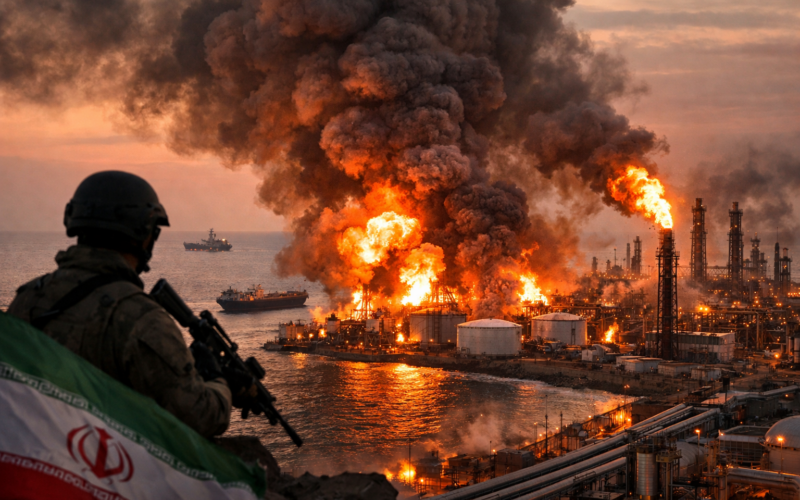
Iran’s Parliament Speaker Mohammad Bagher Qalibaf issued a direct warning on Sunday, 22 March 2026, declaring that all energy and oil infrastructure across the Gulf region would be treated as legitimate military targets and irreversibly destroyed if the United States and Israel targeted Iranian power plants. The warning was posted on the social media platform X and constituted the most explicit Iranian threat to regional energy assets since the United States and Israel launched joint military operations against Iran on 28 February 2026.
The statement by Qalibaf followed a late-night ultimatum issued by United States President Donald Trump on Saturday, 21 March 2026, through his Truth Social platform. Trump threatened to obliterate Iran’s power plants, beginning with the largest, if the Strait of Hormuz was not fully reopened to commercial shipping within 48 hours. The 48-hour window is set to expire around late Monday, 23 March 2026, local time. Trump did not specify which power plant he considered the largest, though Iran’s Bushehr Nuclear Power Plant, located on the Persian Gulf coast in southwest Iran, is the country’s only commercial nuclear facility and the most prominent energy installation in the region.
Qalibaf stated that immediately after Iranian power plants or infrastructure are targeted, vital infrastructure encompassing energy and oil facilities across the entire region would become legitimate targets and would be irreversibly destroyed. He further warned that such a scenario would cause the price of oil to rise for a long time. The Iranian parliamentary speaker’s remarks were consistent with broader Iranian military statements issued the same day. According to Fars News Agency, a semi-official news outlet affiliated with Iran’s Islamic Revolutionary Guard Corps, the Iranian military confirmed that Tehran would seek to retaliate against United States energy sites and infrastructure in the Gulf region if Washington moved to strike Iranian power plants.
What did Iran’s Parliament Speaker Qalibaf say about attacking Gulf energy infrastructure in March 2026?
Iran’s semi-official Mehr News Agency published a map of power plants located along the Persian Gulf coastline alongside a warning that read, in substance, that should Trump carry out his threat, the entire region would be plunged into darkness. The publication noted that between 70 and 80 percent of major power plants in the Gulf region are positioned along the Persian Gulf coast, placing them within what Iran described as its deterrence range. The Iranian military’s warning extended beyond power generation facilities to encompass information technology infrastructure, water desalination facilities, and other critical assets associated with the United States and its regional partners.
Saudi Arabia and the United Arab Emirates both confirmed on Sunday that Iranian missiles and drones had been intercepted overnight. Saudi Arabia said it had stopped one of three Iranian missiles fired at the kingdom. The United Arab Emirates also reported responding to Iranian drone and missile activity. In response to the continued Iranian strikes on Gulf neighbors, Saudi Arabia’s foreign ministry declared Iran’s military attache in Riyadh, his deputy, and three embassy staff members persona non grata and ordered them to leave the kingdom within 24 hours.
How has the Strait of Hormuz closure affected global oil markets and shipping traffic since February 2026?
The Strait of Hormuz, through which approximately 20 percent of all global oil transited during peacetime, has been effectively closed to most commercial shipping since the early days of the United States-Israel-Iran conflict. Iran’s position is that the strait remains open to all nations except those it designates as enemies. Iran’s representative to the International Maritime Organization, Ali Mousavi, stated on Sunday that passage through the Strait of Hormuz was possible with coordination for security and safety arrangements and that Iran was ready to cooperate with the International Maritime Organization and individual countries to improve maritime safety. Iranian Foreign Minister Abbas Araghchi separately confirmed that Tehran was ready to facilitate the passage of Japanese vessels through the strait and that negotiations with Japan on the matter were ongoing.
Crude oil prices have surged above 100 United States dollars per barrel since the conflict began, creating significant domestic political pressure on the Trump administration. The United States Treasury took the extraordinary step of authorizing the sale of Iranian oil and petrochemical products already loaded onto tankers despite existing sanctions, in an effort to moderate price spikes. The energy price surge has intensified ahead of United States midterm elections scheduled for November 2026, which analysts widely expect to hinge substantially on economic and consumer cost conditions. The European Commission separately urged member states of the European Union to lower gas storage targets in response to the impact of the conflict on critical energy supplies.
Why did Trump escalate with an ultimatum on Iran’s power plants one day after signaling the war was winding down?
Trump’s 48-hour ultimatum represented a significant reversal from the tone he struck barely a day earlier. On Friday, 20 March 2026, Trump posted on Truth Social that the United States was getting very close to meeting its objectives and was considering winding down military efforts in the Middle East. The dramatic shift in messaging occurred against a backdrop of mounting pressure from soaring oil prices and plunging stock markets, combined with reported failure to secure multilateral naval support from European allies for a coordinated operation to force open the Strait of Hormuz. After European partners declined to participate in such an effort, Trump stated that Washington was not heavily reliant on the waterway for its own energy requirements.
Admiral Brad Cooper, the head of United States Central Command, stated on Saturday that Iran’s ability to threaten vessels in the Strait of Hormuz had been degraded. Cooper reported that United States forces had dropped multiple 5,000-pound bombs on an underground Iranian coastal facility used to store anti-ship cruise missiles and mobile missile launchers. The strike also destroyed intelligence support sites and missile radar relays used to monitor ship movements. However, reporting from Washington noted a visible gap between the White House’s escalatory posture and the United States military’s assertions that significant damage had already been inflicted on Iran’s maritime threat capabilities.
What is the background to the United States and Israel military campaign against Iran that began in February 2026?
President Trump announced major combat operations against Iran on 28 February 2026, with the United States and Israel conducting massive joint strikes targeting Iranian military and government sites. Ayatollah Ali Khamenei, Iran’s Supreme Leader, was among those killed in Tehran on the first day of strikes. His son, Mojtaba Khamenei, was subsequently chosen to succeed him. Despite the loss of senior leadership and the targeting of key infrastructure, Iran has maintained an active military posture, conducting successive waves of missile and drone attacks against Israel, United States regional bases, and multiple Gulf nations, while also attempting to restrict shipping traffic through the Strait of Hormuz.
As the conflict entered its fourth week, Iran demonstrated a strike range that surprised United States military planners. Tehran launched missiles toward the Diego Garcia joint United Kingdom and United States military base located approximately 4,000 kilometres from Iran in the Indian Ocean, signaling ballistic missile capabilities previously assessed to be significantly reduced by earlier strikes. Iran’s Islamic Revolutionary Guard Corps disputed Israeli Prime Minister Benjamin Netanyahu’s assertion that Iran’s navy had been sunk and its air force neutralised. Iran also confirmed it was continuing to build ballistic missiles.
How have Gulf Arab nations and the Arab League responded to the escalating Iran conflict in March 2026?
Gulf Arab states have so far stopped short of direct military intervention in the conflict, though several have expelled Iranian diplomats in response to continued strikes on their territory. Egypt’s President Abdel-Fattah el-Sissi and Jordan’s King Abdullah II conducted visits to multiple Gulf states in the days leading up to 22 March 2026. Arab League Secretary-General Ahmed Aboul Gheit described these visits as reflecting full Arab solidarity. El-Sissi also held talks with Saudi Crown Prince Mohammed bin Salman, with Saudi Arabia’s state-run Saudi Press Agency reporting that both leaders stressed that Iranian escalation against Gulf states endangered the safety and stability of the region.
Turkey’s foreign minister, speaking from Saudi Arabia where leaders from Arab and Muslim-majority nations were gathered, warned that Gulf states may be compelled to retaliate against Iran if strikes on their territory continued. The Turkish minister stated that Iran had the capacity to reach deep into Europe, had already struck Cyprus, and was attempting to blockade a global maritime energy corridor, calling for the Iranian government to be stopped. Iran’s top military spokesman, General Abolfazl Shekarchi, warned separately that parks, recreational areas, and tourist destinations worldwide would not be safe for nations Tehran considers its enemies, raising concerns about a potential expansion of the conflict to non-military targets.
What attacks on Israeli and Iranian nuclear facilities occurred in the fourth week of the conflict in March 2026?
The fourth week of the conflict saw the first Iranian strikes targeting a site in proximity to Israel’s main nuclear research center. Iranian missiles struck the southern Israeli cities of Arad and Dimona on Saturday night, 21 March 2026. The Israeli Ministry of Health reported approximately 116 people injured in Arad and 64 in Dimona. Among the seriously injured was a four-year-old child. Israeli air defense systems were unable to intercept the missiles, with footage from Arad showing large craters and substantial structural damage to buildings. The International Atomic Energy Agency stated it had not received any indication of damage to the Negev nuclear research center in Dimona following the strikes.
Israel’s Defense Forces responded in the early hours of Sunday, 22 March 2026, announcing a wave of strikes targeting infrastructure of what Israel described as the Iranian terror regime in Tehran. Earlier in the week, United States and Israeli forces had struck the Shahid Ahmadi-Roshan uranium enrichment complex at Natanz in Iran, prompting the International Atomic Energy Agency to note that Iran had reported the site was hit and that the agency was investigating. The trading of strikes on or near nuclear facilities on both sides marked a dangerous new phase of the conflict and generated concern among international nonproliferation bodies and governments.
The energy dimension of the conflict also widened during the same period, with Israel having struck the South Pars gas field in Iran the previous Wednesday. Iran retaliated with missile strikes against what was described as the world’s largest liquefied natural gas facility in Qatar. Six personnel aboard a Qatari military helicopter, including three Turkish nationals, were killed when the aircraft crashed in regional waters on Sunday, 22 March 2026, in what Qatar’s Defence Ministry described as a technical malfunction during a routine flight. Among the deceased were one Turkish Armed Forces personnel and two personnel from Turkish defence manufacturer Aselsan.
Key takeaways on what Iran’s threat to destroy Gulf energy infrastructure means for global oil markets, regional security, and the United States-Iran conflict
- Iran’s Parliament Speaker Mohammad Bagher Qalibaf declared on 22 March 2026 that all energy and oil infrastructure across the Gulf region would be treated as legitimate targets and irreversibly destroyed if the United States or Israel struck Iranian power plants, in direct response to a 48-hour ultimatum issued by United States President Donald Trump on Truth Social.
- Trump’s ultimatum, threatening to obliterate Iran’s power plants starting with the largest if the Strait of Hormuz was not fully reopened, contradicted his own statement from the previous day suggesting the United States was considering winding down military operations, adding to market uncertainty and extending the crude oil price surge above 100 United States dollars per barrel.
- Saudi Arabia ordered the expulsion of Iran’s military attache and four other embassy personnel from Riyadh within 24 hours following continued Iranian missile and drone strikes on Gulf Arab states, while Saudi Arabia and the United Arab Emirates confirmed they had intercepted Iranian projectiles overnight on 22 March 2026.
- Iranian missiles struck the southern Israeli cities of Arad and Dimona, injuring approximately 180 people, in what marked the first time in the conflict that Iranian strikes targeted the vicinity of Israel’s Negev nuclear research center; the International Atomic Energy Agency stated it found no evidence of damage to the nuclear facility itself.
- The conflict entered a broader regional dimension with strikes on Qatar’s liquefied natural gas infrastructure, Iran’s Diego Garcia missile attack revealing longer-range ballistic capabilities, the United States Treasury authorising sanctions-era Iranian oil sales to suppress fuel prices, and the European Commission directing European Union member states to reduce gas storage targets in response to supply disruption.
Discover more from Business-News-Today.com
Subscribe to get the latest posts sent to your email.