



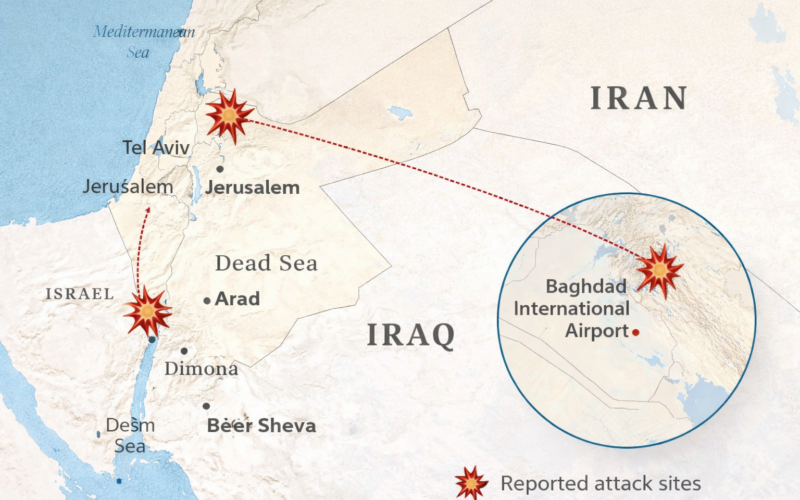
Iran launched renewed ballistic missile strikes at central and southern Israel and directed drone attacks at a United States military compound near Baghdad International Airport on Sunday, March 22, 2026, the 23rd consecutive day of an active armed conflict that began on February 28 when the United States and Israel launched coordinated strikes across Iran.
Several blasts were heard across Jerusalem on Sunday, AFP journalists reported, after the Israeli military issued warnings of incoming missile fire from Iran directed at central Israel. Israel’s Magen David Adom emergency medical service said there were no immediate reports of casualties from that particular salvo.
An impact, possibly a cluster munition from an Iranian ballistic missile, was reported in a central Israeli city. Magen David Adom confirmed no injuries from the impact. Damage was caused to a street by the apparent bomblet. The attack, described as the first in approximately eight hours, triggered missile warning sirens across a wide stretch of central Israel.
In an earlier overnight attack, a total of 175 people were wounded in Iranian ballistic missile strikes on the southern Israeli cities of Dimona and Arad, according to Soroka Medical Center. From the Dimona strike alone, 60 people were evacuated to hospital, including a 12-year-old boy in serious condition who required surgery, and a man in his 20s in moderate condition.
At least 84 people were wounded in Arad on Saturday evening from a direct missile hit, with ten in serious condition including a five-year-old girl. Following the Arad and Dimona strikes, the Israeli Home Front Command announced stricter restrictions across southern Israel. Schools in the Lachish, West Lachish, West Negev, Central Negev, South Negev, and Dead Sea regions were ordered closed, with public gatherings capped at 50 people who could reach a reinforced shelter in time.
The strikes on Dimona carry particular significance given the city’s location near Israel’s Negev Nuclear Research Center. Israeli and United States officials have not publicly confirmed whether that facility was a direct target of the Iranian salvo, though Iran has previously threatened to strike Israeli nuclear infrastructure throughout the conflict.

How did Iran’s drone strikes on the United States military compound near Baghdad International Airport unfold on March 22, 2026?
At least three drone attacks targeted a United States diplomatic and logistics hub housing United States military personnel at Baghdad International Airport, according to two security officials. One official stated that a fire broke out near the compound following the third attack.
AFP cited three security sources confirming that multiple drones and rockets targeted the Victory military base at the airport complex, which also houses a United States diplomatic facility. A security official stated that nine attacks with drones and rockets struck the Victory military base. At least three drones were downed, according to a separate source. It remained unclear at the time of reporting whether the base was directly hit by any of the projectiles.
The pro-Iran militant group Guardians of the Blood Brigade had previously claimed responsibility for attacks on the United States Victory Base near Baghdad International Airport, as well as attacks on the Erbil area in the Kurdistan Region of Iraq. The Islamic Resistance in Iraq separately claimed responsibility for more than 23 drone strikes on United States assets in Erbil since the war began on February 28.
Iraq has been placed in an increasingly exposed position throughout the conflict. Iran-backed militias operating under the Popular Mobilisation Forces have been active across Iraqi territory, while United States and Israeli forces have conducted repeated strikes targeting those militia positions. Between January 28 and March 3, 2026, the United States-Israeli coalition carried out targeted airstrikes on sites belonging to Iran-backed brigades of the Popular Mobilisation Forces, killing at least ten.
Why are Iranian cluster munition strikes on Israeli cities a focal point of international concern in the 2026 conflict?
The use of cluster munitions in populated areas has been among the most internationally condemned aspects of Iran’s missile campaign against Israel since February 28. By the tenth day of the war, nearly half of the 300 missiles Iran had fired at Israel carried cluster submunitions capable of spreading dozens of explosive warheads over a radius of ten kilometres. The Convention on Cluster Munitions, signed by more than 100 nations, prohibits such weapons. Iran has not signed the convention.
The March 22 impact in central Israel, assessed as a possible cluster munition strike, followed a pattern of Iranian attacks across the Tel Aviv metropolitan area and southern Israel throughout the conflict. Iranian cluster bombs smashed into an empty daycare and several other sites in Rishon Lezion in a prior attack, while two children were left in serious condition after air defences failed to intercept missile fire apparently aimed at the nuclear research facility near Dimona.
How has the confrontation between Iran and the United States over the Strait of Hormuz shaped the conflict on day 23?
Iran’s armed forces responded to a 48-hour ultimatum issued by United States President Donald Trump over the Strait of Hormuz. The Iranian military stated that if Iran’s fuel and energy infrastructure were struck, all energy infrastructure belonging to the United States in the region would be targeted. The statement came after Trump publicly threatened to destroy Iranian power plants if the Strait of Hormuz was not fully reopened within the specified timeframe.
Iran’s armed forces announced their 70th wave of attacks on day 22, launching missiles and drones towards Israel and United States bases across the Gulf. The escalation coincided with Iranian strikes on energy infrastructure across Gulf Arab states, described as retaliation for an Israeli strike on Iran’s South Pars natural gasfield.
Saudi Arabia ordered the Iranian military attache at the Embassy of the Islamic Republic of Iran in Riyadh, along with three members of the embassy’s military mission, to leave the country within 24 hours, citing repeated Iranian attacks against Saudi Arabia. The United Arab Emirates Ministry of Defence confirmed its air defences were actively responding to incoming missile and drone threats from Iran.
The United States military has confirmed 13 fatalities from Iranian attacks across the region since February 28. Iranian missiles have repeatedly targeted the headquarters of the United States Navy’s 5th Fleet in Bahrain’s Juffair area. The Qatari Ministry of Defence confirmed that two ballistic missiles struck the Al Udeid Air Base, where United States forces are stationed, while a drone targeted an early warning radar installation at the base.
What is the humanitarian and economic toll of the 2026 Iran-Israel-United States war entering its fourth week?
The conflict has generated a severe and widening humanitarian and economic toll across the Middle East and global markets. Iran’s state broadcaster IRIB reported that more than 1,500 people had been killed in Iran since the war began three weeks earlier, with over 21,000 wounded. Iranian broadcaster IRIB separately noted that more than 200 people under the age of 18 were among those killed.
At least 61 people had been killed in Iraq, according to Iraqi health authorities, with most casualties among members of the Popular Mobilisation Forces paramilitary group.
The number of people killed in Lebanon since Israel renewed widespread attacks stood at 1,001, according to Lebanon’s Ministry of Public Health, including at least 118 children, with more than 2,584 wounded.
The world’s 20 largest publicly listed airlines had lost approximately USD 53 billion in market value since the war began on February 28. Jet fuel costs doubled during the conflict, raising the prospect of airline fuel shortages and sharp increases in ticket prices entering the war’s fourth week.
Iran’s military announced that it had intercepted and destroyed a United States-Israeli armed drone in the airspace above Tehran before it could carry out any combat operations, stating that 127 advanced drones belonging to enemy forces had been destroyed by Iranian air defence systems since the start of the conflict.
The Israeli army confirmed it was conducting strikes on Iranian regime targets in the heart of Tehran. Airstrikes also targeted positions of Iraq’s Popular Mobilisation Forces in Mosul, in northern Iraq.
Key takeaways on what the March 22, 2026 Iran missile strikes on Israel and Baghdad mean for the conflict, regional security, and international diplomacy
- Iran fired multiple waves of ballistic missiles at central and southern Israel on March 22, triggering sirens across the country and injuring at least 175 people in Dimona and Arad, with a 12-year-old boy requiring surgery and a five-year-old girl among the critically wounded in Arad.
- At least three drone attacks struck a United States diplomatic and logistics compound housing United States military personnel near Baghdad International Airport, with a fire reported near the base following the third attack and at least three drones downed.
- Iran’s armed forces warned that all United States energy infrastructure across the region would be targeted if Iran’s own fuel and energy facilities were struck, a direct response to United States President Donald Trump’s 48-hour ultimatum over the Strait of Hormuz.
- Iran’s continued use of cluster munition warheads in strikes across central and southern Israel remains a focal point of international condemnation, given that the Convention on Cluster Munitions prohibits the weapons and has been signed by over 100 states, though not by Iran.
- Saudi Arabia expelled the Iranian military attache and three embassy military mission members from Riyadh within 24 hours, reflecting the deepening diplomatic rupture between Iran and Gulf Arab states as the conflict enters its fourth week.
Discover more from Business-News-Today.com
Subscribe to get the latest posts sent to your email.