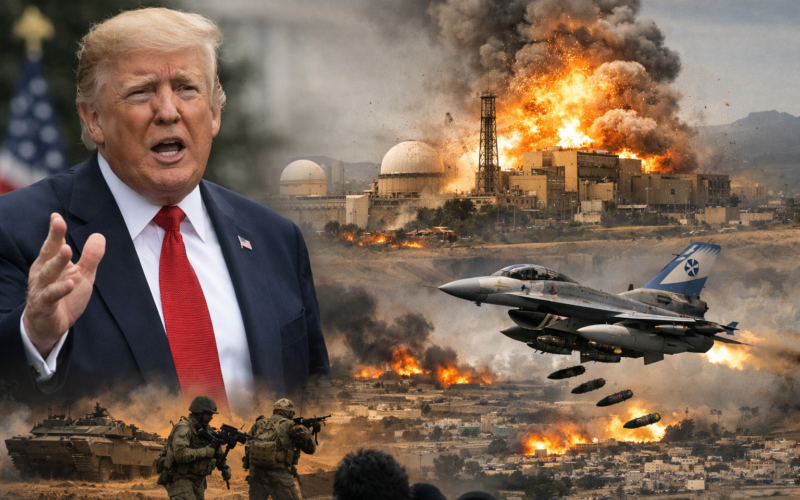
United States President Donald Trump stated on Friday, March 20, 2026, that the United States was considering ending its military operations against Iran, marking the strongest public signal yet of a potential conclusion to the conflict. The remarks came as the United States-Israel war with Iran entered its fourth week and arrived against a backdrop of contradictory statements from the Trump administration about the campaign’s objectives, duration, and endgame.
In a post on his Truth Social platform, Trump wrote that the United States was “getting very close to meeting our objectives as we consider winding down our great Military efforts in the Middle East with respect to the Terrorist Regime of Iran.” Trump listed the stated objectives of the campaign as completely degrading Iran’s missile capability and industrial base, eliminating the Iranian navy and air force, preventing Iran from obtaining a nuclear weapon, and protecting United States allies in the Middle East, most of which he said had been attacked during the conflict.
The same Friday, Trump told reporters at the White House South Lawn that he was not interested in a ceasefire. “We could have dialogue, but I don’t want to do a ceasefire,” he said. “You know you don’t do a ceasefire when you’re literally obliterating the other side.” Trump added that Iran had no navy, no air force, and no equipment, framing the situation in terms of a decisive military advantage held by the United States and Israel.
The conflict, codenamed Operation Epic Fury by the United States, began on February 28, 2026, when the United States and Israel launched coordinated airstrikes on Iran targeting military facilities, nuclear sites, and leadership. The strikes killed Iran’s Supreme Leader, Ayatollah Ali Khamenei, and prompted Iranian counterstrikes against Israel, United States military bases across the region, and Gulf Arab states. The operation began two days after United States and Iranian negotiators met in Geneva for what Omani mediators described as productive negotiations on a nuclear agreement.
What does Trump’s winding down statement mean for the trajectory of the United States-Iran conflict?
Despite the wind-down signal, the United States military continued to expand its regional presence. The United States deployed three additional amphibious assault ships and approximately 2,500 Marines to the Middle East, joining more than 50,000 United States troops already in the region. The Trump administration also submitted a request to Congress for an additional $200 billion to fund the war. A senior United States official stated that Trump’s post did not signal an imminent end to hostilities, noting that the military was striking hard and continuously and that a pause was still weeks away.
White House Press Secretary Karoline Leavitt confirmed the administration’s original timetable, stating that “the President and the Pentagon predicted it would take approximately 4-6 weeks to achieve this mission.” The simultaneity of a wind-down signal and a substantial troop deployment left traditional United States allies struggling to calibrate their positions in the conflict. Israeli Defence Minister Israel Katz appeared to contradict Trump’s statement directly on Saturday, March 21, saying that Israeli and United States forces would “significantly” increase the intensity of strikes against Iran in the coming week.
The United States and Israel have offered shifting rationales for the conflict since its inception, moving between aims that include toppling Iran’s leadership through a popular uprising, eliminating Iran’s nuclear programme, and neutralising its ballistic missile capabilities. There have been no public signs of any such uprising. Iran’s new Supreme Leader, Ayatollah Mojtaba Khamenei, issued a message of defiance on Friday marking Nowruz, the Persian New Year, which coincided with the end of the holy month of Ramadan. Khamenei has not been seen in public since he assumed the role of supreme leader following Israeli strikes that killed his father and predecessor. In his statement, Khamenei said Iranians had responded with unity and resistance.

How has the closure of the Strait of Hormuz reshaped global energy markets since the conflict began on February 28?
The Strait of Hormuz is one of the world’s most strategically consequential maritime waterways. At its narrowest, the strait is 21 miles wide, forming a passage between Iran and Oman. Its two unidirectional sea lanes facilitate the transit of approximately 20 million barrels of oil per day, representing roughly 20 percent of global seaborne oil trade, primarily from Saudi Arabia, the United Arab Emirates, Iraq, and Qatar.
Iranian forces declared the strait closed on March 4, 2026, and began attacking ships that attempted to transit the waterway. Tanker traffic dropped by approximately 70 percent, and more than 150 ships anchored outside the strait to avoid attack. Brent crude oil prices surpassed $100 per barrel on March 8 for the first time in four years. The head of the International Energy Agency described the crisis as the greatest global energy security challenge in history. The war cut the global supply of oil by approximately 8 million barrels per day in March, according to International Energy Agency estimates.
Brent crude settled at $112.19 per barrel on Friday, March 20, the highest level recorded during the conflict, before easing to approximately $108 per barrel following Trump’s social media post. Global equities markets extended their losses, with the United States equity benchmark falling steeply to end the week nearly 2 percent lower. Goldman Sachs indicated that higher prices could persist through 2027.
Why did the United States Treasury Department lift sanctions on Iranian oil while the war with Iran remained active?
The United States Treasury Department took the extraordinary step of lifting sanctions on approximately 140 million barrels of Iranian oil already loaded on ships, a measure valid until April 19, 2026. The Trump administration also lifted some United States sanctions on Russian crude to ease broader supply constraints. United States Ambassador to the United Nations Mike Waltz described the Iranian oil sanctions relief as very temporary, stating it was designed to prevent Iran’s strategy of driving energy prices higher from succeeding, and that it would allow allies including India and Japan to access Iranian oil on a temporary basis.
The optics of the move drew immediate attention: the United States was simultaneously pursuing a military campaign against Iran while allowing the Iranian government to benefit financially from oil revenues on existing cargo. The Trump administration stated that all standard go-to policy levers for alleviating the supply shock had been exhausted, and that officials privately estimated higher prices could linger for months as fighting intensified and passage through the Strait of Hormuz remained nearly impossible.
What is the Trump administration’s position on responsibility for policing the Strait of Hormuz going forward?
Trump indicated in his Truth Social post that the United States would not assume primary responsibility for securing the Strait of Hormuz. “The Hormuz Strait will have to be guarded and policed, as necessary, by other Nations who use it,” he wrote, adding that the United States would assist if asked but suggesting such assistance would become unnecessary once Iran’s threat was eradicated. Trump said the operation would be easy for other nations to manage. He had spent several days pressing NATO allies and partner nations to send warships, minesweepers, and aircraft to form a coalition to reopen the waterway, and labelled NATO allies “cowards” for failing to respond to that request.
On Saturday, March 21, leaders of 22 nations issued a joint statement condemning Iran’s attacks on commercial vessels and the closure of the Strait of Hormuz, calling on Tehran to cease threats, mine-laying, drone and missile attacks, and to comply with United Nations Security Council Resolution 2817. The statement was signed by the United Arab Emirates, the United Kingdom, France, Germany, Italy, the Netherlands, Japan, Canada, the Republic of Korea, New Zealand, Denmark, Latvia, Slovenia, Estonia, Norway, Sweden, Finland, Czechia, Romania, Bahrain, Lithuania, and Australia. The nations stated that they were ready to contribute to appropriate efforts to ensure safe passage through the strait.
What is Iran’s military posture and its stated position on the Strait of Hormuz as of March 21, 2026?
A senior Iranian source told CNN that Tehran did not believe Trump’s claim that the United States was considering winding down military efforts, and said there had been no reduction in military activity in the region. Iran’s Foreign Minister Abbas Araghchi, in an interview with Kyodo News, denied that Tehran had formally closed the strait, insisting instead that countries attacking Iran faced restrictions while others, such as Japan, were being offered assistance with passage.
Iran’s armed forces spokesman Abolfazl Shekarchi issued a warning on Friday that tourist and entertainment venues worldwide would no longer be safe for United States and Israeli officials, commanders, pilots, and military personnel. The Iranian military also warned the United Arab Emirates that it would strike the port city of Ras al-Khaimah if Iranian islands in the Persian Gulf continued to come under attack.
On Friday, March 20, Iran fired two ballistic missiles at the Diego Garcia joint United States-United Kingdom military base in the Indian Ocean, approximately 4,000 kilometres from Iranian territory. The missiles did not strike the base. Britain condemned Iran’s attack. A source at Britain’s defence ministry stated that the attack had occurred before the United Kingdom had given specific authorisation for the United States to use its bases for the operations. The Diego Garcia strike marked Iran’s first use of such missiles to reach beyond the Middle East, indicating a longer-range ballistic capability than Tehran had previously demonstrated publicly.
Iranian drones also struck Kuwait’s Mina Al-Ahmadi oil refinery overnight, igniting fires at several operational units. Mina Al-Ahmadi is Kuwait’s largest oil refinery and has been attacked multiple times during the conflict’s widening energy infrastructure campaign. No injuries were reported. Iran’s strikes on Gulf Arab energy facilities intensified following Israeli attacks on Iran’s South Pars offshore gas field. Qatar’s Ras Laffan energy facility was also targeted, with authorities reporting that the attack had reduced Qatar’s liquefied natural gas export capacity by 17 percent.
What did the strike on Iran’s Natanz nuclear enrichment facility mean for the nuclear dimension of the conflict?
Iran’s Natanz uranium enrichment facility was struck in an airstrike on Saturday, March 21, according to an official Iranian news agency. The Atomic Energy Organization of Iran stated that no leakage of radioactive materials had been reported and that no danger threatened residents in surrounding areas. The International Atomic Energy Agency confirmed it had been informed by Iran about the strike and that there had been no increase in off-site radiation levels, and said it was investigating the incident. This is at least the second time the Natanz facility has been targeted during the conflict that began on February 28.
International Atomic Energy Agency Director-General Rafael Grossi reiterated the agency’s call for military restraint to prevent a nuclear accident. Grossi had previously stated to NPR that parts of Iran’s nuclear programme would likely survive even after the heavy damage inflicted by United States and Israeli military strikes, noting that enrichment material and capacities would most probably remain at the end of the military conflict, even with significant degradation of physical facilities. Russia described the strike on Natanz as a blatant violation of international law.
Israel separately said it attacked Tehran, the city of Karaj west of the capital, and the central city of Isfahan on Saturday. Israeli forces also conducted strikes against Iran-backed Hezbollah militants in Beirut’s southern suburbs, causing fires and heavy explosions. Three members of a family were killed in a strike on a residential building in the city of Ramsar, according to Iranian media. The Israeli military also reported a targeted ground operation was underway with air support, with at least four militants killed.
Key takeaways on what Trump’s wind-down signal means for the United States-Iran war, global energy markets, and international security
- United States President Donald Trump posted on Truth Social on March 20, 2026, that the United States was close to meeting its objectives and was considering winding down military operations against Iran, the strongest public signal of a potential end to the conflict, while simultaneously ruling out a ceasefire and keeping the door open to ground troop deployment.
- The United States military continued to expand its presence in the region with three additional amphibious assault ships and approximately 2,500 Marines deployed, joining more than 50,000 troops already in the region, and a $200 billion supplemental funding request submitted to Congress, in direct contradiction of the wind-down signal.
- The Strait of Hormuz remains effectively closed to most commercial shipping since early March 2026, with Brent crude oil settling at $112.19 per barrel on March 20, the conflict’s highest level to date, and the United States Treasury lifting sanctions on approximately 140 million barrels of Iranian oil already at sea to address the worsening global energy supply crisis.
- Iran’s Natanz uranium enrichment facility was struck for at least the second time during the conflict on March 21, with the International Atomic Energy Agency reporting no off-site radiation increase and reiterating its call for military restraint to prevent a nuclear accident, while its director-general has previously stated that Iran’s enrichment material and capabilities would most probably survive the conflict.
- Twenty-two nations issued a joint statement on March 21 condemning Iran’s attacks on commercial vessels and the closure of the Strait of Hormuz, calling on Tehran to comply with United Nations Security Council Resolution 2817, as Israel’s defence minister warned of a significant increase in attack intensity in the coming week and Iran launched ballistic missiles at the joint United States-United Kingdom Diego Garcia base in the Indian Ocean.
Discover more from Business-News-Today.com
Subscribe to get the latest posts sent to your email.