


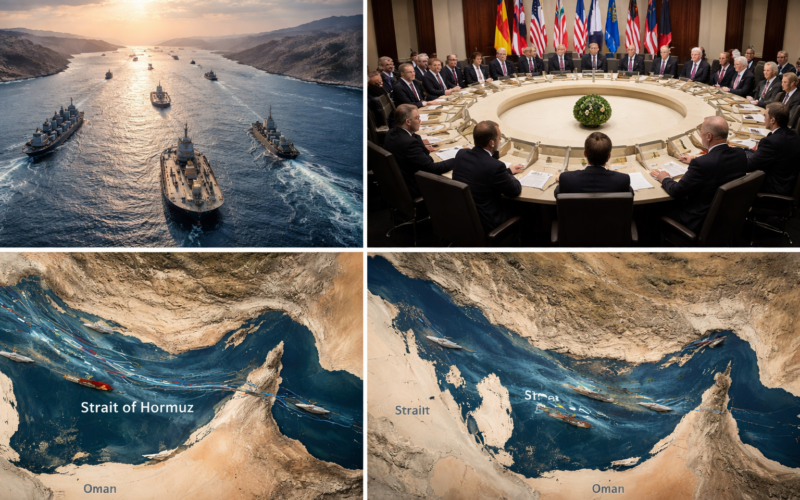
Twenty governments including the United Kingdom, France, Germany, Italy, the Netherlands, Japan, Canada, Republic of Korea, New Zealand, Denmark, Latvia, Slovenia, Estonia, Norway, Sweden, Finland, Czechia, Romania, Bahrain and Lithuania issued a joint statement on 19 March 2026 condemning Iranian attacks on unarmed commercial vessels in the Gulf, attacks on civilian infrastructure including oil and gas installations, and what the signatories described as the de facto closure of the Strait of Hormuz by Iranian forces.
The statement expressed deep concern about the escalating conflict and called on Iran to immediately cease its threats, the laying of mines, drone and missile attacks, and other actions aimed at blocking the Strait of Hormuz to commercial shipping. The governments also called on Iran to comply with United Nations Security Council Resolution 2817, adopted on 11 March 2026 by the 15-member Security Council.
The Strait of Hormuz is one of the world’s most consequential maritime chokepoints. The strait is 21 miles wide at its narrowest point, forming a seaway passage between Iran and Oman. Its two unidirectional sea lanes facilitate the transit of around 20 million barrels of oil per day, representing roughly 20 percent of global seaborne oil trade, primarily from producers including Saudi Arabia, the United Arab Emirates, Iraq and Qatar. About 20 percent of global liquefied natural gas exports from the Persian Gulf also pass through the strait, primarily those originating from Qatar.
How did the Strait of Hormuz crisis begin and what triggered Iran’s decision to close the waterway in 2026?
The crisis in the Strait of Hormuz emerged from a broader military conflict that began on 28 February 2026. On that date, the United States and Israel initiated coordinated airstrikes on Iran under Operation Epic Fury, targeting military facilities, nuclear sites, and leadership, resulting in the death of Supreme Leader Ali Khamenei. In response, Iran launched retaliatory missile and drone attacks on United States military bases, Israeli territory, and Gulf states. On 2 March 2026, a senior official in the Islamic Revolutionary Guard Corps officially confirmed that the strait was closed, subsequently threatening any ship that passed through it.
As of 12 March 2026, Iran had made 21 confirmed attacks on merchant ships. The warnings and subsequent attacks on vessels caused tanker traffic to drop by approximately 70 percent, with over 150 ships anchoring outside the strait to avoid risks. According to the United Nations Conference on Trade and Development, ship traffic through the Strait of Hormuz had dropped 97 percent since the war began.
The 19 March joint statement affirmed that freedom of navigation is a fundamental principle of international law, including under the United Nations Convention on the Law of the Sea. The signatory governments stated that the consequences of Iran’s actions would be felt by people in all parts of the world, with the most vulnerable populations bearing a disproportionate burden.
What is United Nations Security Council Resolution 2817 and why do the signatory governments invoke it against Iran?
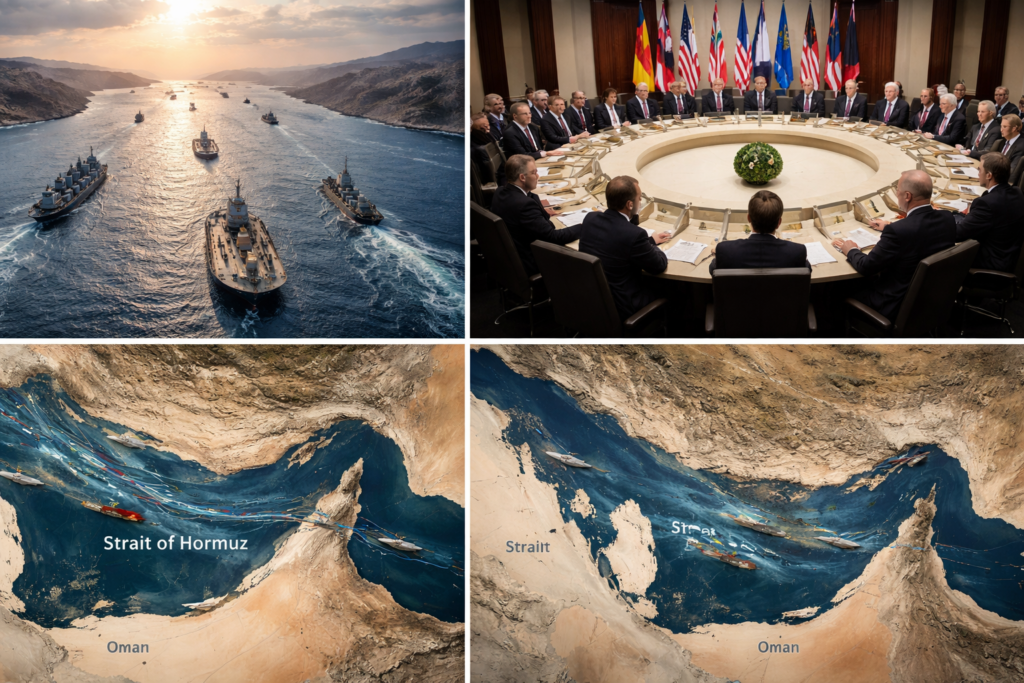
The 19 March joint statement’s invocation of United Nations Security Council Resolution 2817 placed the joint declaration within an established multilateral legal framework. The Security Council adopted Resolution 2817 on 11 March 2026 by a vote of 13 in favour with two abstentions from China and the Russian Federation. The resolution condemned Iran’s attacks against Bahrain, Kuwait, Oman, Qatar, Saudi Arabia, the United Arab Emirates and Jordan, and reiterated strong support for those countries’ sovereignty, territorial integrity and political independence.
Resolution 2817 was sponsored by Bahrain on behalf of the Gulf Cooperation Council and Jordan, and was co-sponsored by 135 United Nations member states, the highest number of co-sponsors ever achieved for a United Nations Security Council resolution. The resolution’s operational provisions determined that Iran’s attacks constituted a breach of international law and demanded their immediate cessation. The text specified that any attempt to impede lawful transit passage or freedom of navigation through the Strait of Hormuz constitutes a threat to international peace and security.
China and Russia chose to abstain rather than veto the resolution, with both permanent members placing on record their position that the resolution did not fully reflect the root cause and overall picture of the conflict. Russia’s representative stated in the Security Council chamber that the text failed to acknowledge the United States and Israeli strikes on Iran and could be interpreted by bad-faith actors to continue acts of aggression. Russia also tabled a separate draft resolution calling on all parties to cease military activities, which was rejected by four votes in favour against two opposed and nine abstentions.
What steps are the 20 signatory governments prepared to take to restore safe passage through the Strait of Hormuz?
Consistent with Resolution 2817, the 19 March joint statement called for an immediate and comprehensive moratorium on attacks on civilian infrastructure, explicitly including oil and gas installations. The signatory governments expressed readiness to contribute to appropriate efforts to ensure safe passage through the Strait of Hormuz and welcomed the commitment of nations engaged in preparatory planning toward that objective.
The joint statement addressed the energy market dimension by welcoming the International Energy Agency decision to authorise a coordinated release of strategic petroleum reserves. The signatory governments also pledged to take further steps to stabilise global energy markets, including working with certain producing nations to increase output. They committed to providing support for the most affected nations through the United Nations and international financial institutions.
How has the Strait of Hormuz closure affected global oil prices, energy supply chains, and Gulf oil production?
Brent crude oil prices surpassed 100 United States dollars per barrel on 8 March 2026 for the first time in four years, rising to 126 United States dollars per barrel at peak levels following the effective closure of the strait. The closure has been described as the largest disruption to the global energy supply since the 1970s energy crisis and the largest in the history of the global oil market. Iraq and Kuwait began curtailing oil production in early March 2026 as local storage facilities filled up and oil exports were unable to reach markets through the Strait of Hormuz.
South Asian nations faced particularly severe disruption. Qatar and the United Arab Emirates account for 99 percent of Pakistan’s liquefied natural gas imports, 72 percent of Bangladesh’s, and 53 percent of India’s. China, the world’s largest crude oil importer, also faced significant exposure, with roughly 40 percent of its oil imports passing through the Strait of Hormuz and around 30 percent of its liquefied natural gas imports originating from Qatar and the United Arab Emirates. Natural gas prices in Europe and Asia rose sharply in the weeks following the conflict’s outbreak.
United States officials acknowledged privately that reopening the Strait of Hormuz presented a problem without a clear solution. A Defense Intelligence Agency assessment that circulated inside the Pentagon determined that Iran could potentially keep the passage closed for between one and six months, according to sources familiar with the document. The White House and Pentagon disputed the longer end of that range as a worst-case scenario, but the assessment reinforced the urgency behind the 19 March joint declaration.
Why did Iran selectively allow some ships from certain countries to pass through the Strait of Hormuz?
Iranian authorities indicated that the Strait of Hormuz was open to all nations except the United States and its allies. A small number of vessels from certain countries were permitted to pass following negotiations. Iranian-flagged and Iranian-permitted ships carrying oil to China, Turkey, Pakistan and India were among those allowed to transit. India confirmed that two Indian-flagged tankers carrying liquefied petroleum gas had passed through the strait safely en route to western Indian ports. A Pakistani-flagged tanker and a Turkish-owned vessel were also reported to have received permission to transit.
The selective enforcement strategy gave Iran significant diplomatic leverage while drawing further condemnation from Western governments and multilateral institutions. The joint statement of 19 March 2026 implicitly addressed this asymmetry by affirming that maritime security and freedom of navigation benefit all countries and calling on all states to respect international law and uphold the fundamental principles of international prosperity and security.
Which nations joined the Strait of Hormuz joint statement and what does the breadth of support signal diplomatically?
The statement was initially published with seven founding signatories: the United Kingdom, France, Germany, Italy, the Netherlands, Japan and Canada. Following publication, Canada, Republic of Korea, New Zealand, Denmark, Latvia, Slovenia, Estonia, Norway, Sweden, Finland, Czechia, Romania, Bahrain and Lithuania confirmed they had also joined, bringing the total signatory count to 20 governments. The inclusion of Bahrain, a Gulf state directly affected by Iranian attacks, alongside Baltic and Nordic states that are significant contributors to the European energy and security architecture, reflected the breadth of the coalition.
The 19 March declaration followed United States President Donald Trump’s earlier calls for an international coalition to police the Strait of Hormuz, which had met with allied reluctance rooted in the risks of putting naval vessels and crews in harm’s way of Iranian drones, mines and missiles. The joint statement represented a diplomatic commitment rather than an immediate military deployment, though the signatory governments indicated readiness to contribute to appropriate efforts as circumstances evolved.
Key takeaways on what the 20-nation Strait of Hormuz declaration means for Iran, global shipping, and international energy security
- Twenty governments across Europe, the Indo-Pacific, and the Gulf signed a joint declaration on 19 March 2026 condemning Iranian attacks on commercial vessels, oil and gas installations, and the de facto closure of the Strait of Hormuz, representing one of the broadest multilateral diplomatic responses to the ongoing conflict.
- The statement explicitly invoked United Nations Security Council Resolution 2817, adopted on 11 March 2026 with a record 135 co-sponsors, which determined that Iranian interference with international shipping constitutes a threat to international peace and security and demanded an immediate cessation of attacks.
- The signatory governments expressed readiness to contribute to efforts to ensure safe passage through the Strait of Hormuz and welcomed the International Energy Agency decision to authorise a coordinated release of strategic petroleum reserves, signalling preparedness for both diplomatic and economic responses.
- Brent crude oil prices reached 126 United States dollars per barrel at peak levels following the effective closure of the strait. Tanker traffic through the Strait of Hormuz fell 97 percent according to the United Nations Conference on Trade and Development, and Gulf producers including Iraq and Kuwait began curtailing output as onshore storage reached capacity.
- South Asian and East Asian economies face disproportionate exposure to the strait closure given their high dependence on Gulf liquefied natural gas and crude oil imports. A United States Defense Intelligence Agency assessment indicated Iran could potentially maintain the closure for between one and six months, underlining the severity of the threat to global energy security and supply chains.
Discover more from Business-News-Today.com
Subscribe to get the latest posts sent to your email.