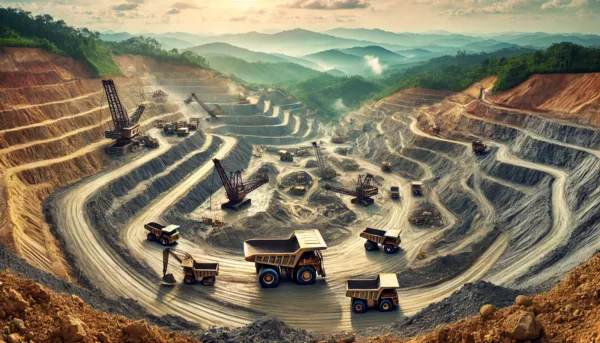



WA Kaolin Limited (ASX: WAK), operator of Australia’s largest kaolin production facility at Wickepin in Western Australia, has announced a comprehensive A$34.9 million recapitalisation via a non-renounceable 5:1 entitlement issue priced at one cent per share, alongside a debt conversion program designed to reduce total borrowings by up to A$22.5 million. The recapitalisation follows a voluntary trading suspension imposed on 20 February 2026 and is structured to resolve a working capital shortfall that has constrained production ramp-up at the Wickepin plant. WAK shares had last traded around A$0.025 to A$0.03 before the suspension, near the bottom of their 52-week range of A$0.022 to A$0.05, underscoring the urgency of the balance sheet reset. The structure of the offer, with its steep 5:1 ratio and penny pricing, signals that the company is prioritising survival and liquidity over conventional capital-markets optics.
What does the WA Kaolin entitlement issue structure mean for existing shareholders and dilution risk?
The terms of the offer are deliberately aggressive. Under the 5:1 non-renounceable structure, eligible shareholders receive the right to subscribe for five new shares for every one held on the record date of 27 March 2026, at A$0.01 per share. The non-renounceable format means shareholders who cannot or choose not to participate forfeit their entitlements entirely rather than being able to sell those rights. That construction eliminates any optionality premium for retail investors and concentrates the recapitalisation outcome in the hands of committed anchor participants. At minimum subscription, the total shares on issue will expand from approximately 698 million to 2.23 billion. At full subscription, the register expands to 4.19 billion shares. Each two new shares also carry one free-attaching option exercisable at A$0.02, expiring 30 April 2030, creating a further potential dilution layer if exercised. The 1:2 attaching option structure is designed as an incentive sweetener to encourage participation, but the four-year expiry also means the options will overhang the register for a prolonged period. Shareholders who do not participate will face dilution of their ownership that is, by any measure, structurally severe.
How is the debt conversion structured and which creditors are converting to equity in WAK?
The cornerstone of the recapitalisation is a debt conversion totalling approximately A$10.1 million at minimum subscription, rising to A$22.5 million if the offer is fully subscribed. Three creditors will convert their debt into new shares by partially underwriting the offer. Scientific Management Associates (Operations) Pty Ltd, an associate of 12.8 percent shareholder Scientific Management Associates (Victoria) Pty Ltd, will convert approximately A$5.5 million in debt. Boneyard Investments Pty Ltd, a 7.5 percent shareholder, will convert approximately A$3.5 million. Wamco Industries Pty Ltd, an associate of Silver Tropic Pty Ltd, which is a 10.7 percent shareholder and a related party of WA Kaolin through Managing Director Alf Baker, will convert approximately A$1.1 million. The related-party nature of the Wamco Industries and Silver Tropic conversion is a material governance consideration and will require careful handling at the upcoming extraordinary general meeting. If the minimum subscription is achieved, the post-offer voting power of these major creditor groups will shift meaningfully: Scientific Management Associates and associates to approximately 28.5 percent, Boneyard to approximately 20.6 percent, Wamco Industries and Silver Tropic to approximately 8.5 percent, and Century Horse Limited, a 12.14 percent shareholder committing A$4.2 million in fresh cash, to approximately 22.8 percent. The cumulative result is a register heavily dominated by four interconnected stakeholder groups.
Why did WA Kaolin need emergency recapitalisation and what caused the Wickepin working capital shortfall?
The immediate trigger for the recapitalisation is a working capital shortfall at the Wickepin processing plant driven by operational difficulties during the ramp-up of production capacity. WA Kaolin had been expanding supply from the Wickepin operation rapidly, but production challenges created a cash consumption gap that exceeded the company’s liquidity buffer. At 31 December 2025, the reviewed balance sheet showed cash of only AA$774,215 against total liabilities of AA$33.4 million, a position that left essentially no financial headroom. Borrowings of A$5.0 million were classified as current liabilities alongside A$22.4 million in non-current borrowings, reflecting a debt load that grew from A$25.7 million total at June 2025. The Wickepin project itself remains strategically significant: it hosts a JORC-compliant mineral resource of 644.5 million tonnes of high-grade kaolinised granite and sits 220 kilometres south-east of Perth, representing one of the larger premium primary kaolin deposits known globally. The disconnect between the scale of the underlying resource and the financial fragility of the operating company reflects the capital-intensity and execution complexity of ramping up industrial mineral processing from greenfield, a challenge that has tripped up multiple small-cap resources companies on the ASX.
What does the pro forma balance sheet tell us about WA Kaolin’s financial recovery trajectory post-offer?
The pro forma financial position appended to the announcement provides a useful, if limited, read on where WA Kaolin stands in different subscription scenarios. At minimum subscription, net assets recover from A$3.6 million at December 2025 to AA$18.0 million, driven primarily by the debt-to-equity conversion reducing non-current borrowings from A$22.4 million to A$17.4 million and injecting A$4.7 million in net working capital after costs. At full subscription, net assets reach A$36.8 million and non-current borrowings fall further to A$5.1 million, a materially healthier position. Cash rises from A$774,215 to A$5.5 million at minimum subscription and A$12.0 million if fully subscribed. The company’s own assessment is that the minimum subscription working capital of A$4.7 million is sufficient to fund operations through to end August 2026, giving it a five-month runway to complete plant improvements and initiate its two waste-recovery initiatives before a further capital raise is contemplated. That timeline is tight. A second capital raise in late 2026 carries execution risk, particularly if production improvements do not materialise on schedule or if market conditions for small-cap issuers deteriorate. The accumulated losses sitting at A$103.4 million on a pro forma basis also serve as a reminder that WA Kaolin has absorbed significant capital without yet reaching profitability.
How does the global kaolin supply-demand shift create strategic importance for WA Kaolin’s Wickepin project?
WA Kaolin’s announcement references a structurally altered global supply-demand environment for high-quality kaolin, a claim that deserves unpacking. Kaolin is a critical industrial mineral used in paper coating, ceramics, paint, rubber, and increasingly in battery and specialty materials applications. Premium-grade primary kaolin, characterised by high brightness and purity, is produced by a relatively small number of operations globally, with historical supply concentrated in Europe and the southeastern United States. Supply disruptions and tightening environmental constraints on legacy operations in key producing regions have created openings for new entrants offering consistent-quality output. The Wickepin deposit’s attributes, including its documented purity and brightness profile, position it to serve a tier-one customer base in Asia and elsewhere that values supply security and consistent specifications. If WA Kaolin can stabilise production and successfully execute its two-stage ramp-up toward 400,000 tonnes per annum, the commercial case becomes more compelling. The current recapitalisation is a prerequisite for reaching that inflection point, not an end in itself.
What are the execution risks and governance considerations investors should assess in the WAK recapitalisation?
Several risks warrant careful consideration. The non-renounceable structure, combined with a 5:1 ratio at penny-stock pricing, reduces practical shareholder choice to a binary: participate or be diluted heavily. For retail investors with small positions, the economics of participating are distorted by transaction costs relative to the A$0.01 issue price. The concentration of post-offer ownership in four related or aligned stakeholder groups raises questions about the practical exercise of minority shareholder rights going forward, even if formal governance obligations are met. The related-party debt conversion by Wamco Industries, controlled by Managing Director Alf Baker, requires shareholder approval at the extraordinary general meeting and will be subject to the exclusion of interested parties from that vote. ASX has granted two listing rule waivers to facilitate the structure: a waiver of Listing Rule 7.11.3 permitting a non-renounceable offer at above a 1:1 ratio, and a waiver of Listing Rule 7.15 permitting a record date that precedes shareholder approval. Both waivers are conditional, and the trading suspension must remain in place until the general meeting occurs. The operational risk layer is also real: the company’s cash runway to end August 2026 assumes plant improvement milestones are met and production volumes increase as expected. Any slippage on either front compresses the window available to execute a follow-on raise before cash runs out.
What does the WAK share price suspension and offer price say about market confidence in the recapitalisation?
WA Kaolin shares entered voluntary suspension on 20 February 2026 pending confirmation of the recapitalisation outcome. Prior to suspension, shares were trading around A$0.025 to A$0.03, having touched a 52-week low of A$0.022 in late January 2026 against a 52-week high of A$0.05. The offer price of A$0.01 per share represents a significant discount to the pre-suspension trading level, which is structurally necessary to incentivise participation and reflect the distressed working capital position. Once trading resumes, expected on a deferred settlement basis from 30 April 2026, the theoretical ex-entitlement price effect of a 5:1 offer at A$0.01 will anchor the share price considerably below prior levels, even assuming full uptake by existing shareholders. The attaching options with a A$0.02 exercise price add potential upside for long-term holders if the operational recovery materialises, but they sit substantially above where the share will likely open post-resumption under most subscription scenarios. Absent strong production news before the close of the offer on 29 April 2026, the market re-rating story for WAK is more likely a second-half 2026 development than an immediate-term catalyst.
Key takeaways: what the WA Kaolin recapitalisation means for shareholders, creditors, and the kaolin sector
- WA Kaolin Limited (ASX: WAK) is undertaking a A$34.9 million non-renounceable 5:1 entitlement issue at A$0.01 per share, with minimum subscription set to raise A$15.3 million including A$10.1 million via debt conversion.
- The debt conversion involves three creditors, including a related party entity controlled by Managing Director Alf Baker, converting approximately A$10.1 million into equity, a transaction requiring shareholder approval at the upcoming extraordinary general meeting.
- At minimum subscription, the share register will expand from 698 million to 2.23 billion shares, with four aligned stakeholder groups collectively controlling more than 80 percent of the post-offer register.
- Net working capital of approximately A$4.7 million post-minimum subscription provides a runway only to end August 2026, necessitating a further capital raise within six months if production targets are met.
- The Wickepin Kaolin Project holds a JORC-compliant resource of 644.5 million tonnes of high-grade premium kaolinised granite, one of the larger primary kaolin deposits known globally and the strategic asset underpinning the entire recapitalisation rationale.
- ASX has granted two listing rule waivers to facilitate the offer structure, including permission for a pre-meeting record date, reflecting the urgency of WA Kaolin’s liquidity position.
- Free-attaching options exercisable at A$0.02 and expiring 30 April 2030 provide a long-dated upside instrument for participating shareholders but will overhang the register for four years.
- The pre-suspension share price of A$0.025 to A$0.03 and the 52-week low of A$0.022 reflect a market that was already pricing significant balance sheet distress before this announcement.
- Full subscription of A$34.9 million would reduce non-current borrowings to A$5.1 million and lift net assets to A$36.8 million, a materially healthier position that could support the production ramp-up to 400,000 tonnes per annum.
- The recapitalisation’s success depends on execution of plant improvements and waste recovery initiatives within a compressed timeline, making operational delivery in the second half of 2026 the defining test for WA Kaolin’s commercial viability.
Discover more from Business-News-Today.com
Subscribe to get the latest posts sent to your email.