




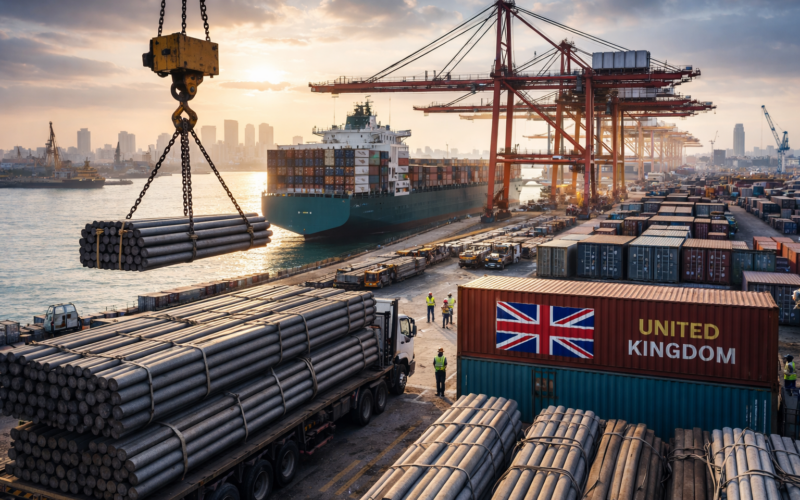
The United Kingdom and Nigeria signed a landmark financing agreement on 19 March 2026 valued at £746 million, equivalent to approximately 902 million United States dollars, to fund the comprehensive redevelopment of two of Nigeria’s most strategically important maritime infrastructure facilities. The deal, guaranteed by UK Export Finance, the United Kingdom government’s export credit agency, will finance the refurbishment of the Lagos Port Complex at Apapa Quays and the TinCan Island Port Complex, both located in Lagos. It was announced on the day Nigerian President Bola Ahmed Tinubu visited Downing Street for a bilateral summit with the United Kingdom’s Prime Minister, reinforcing the diplomatic weight of the transaction.
The financing will be delivered through UK Export Finance’s Buyer Credit Facility and has been coordinated and arranged by Citibank N.A. London Branch. The principal parties to the agreement include UK Export Finance, the Nigerian Ports Authority, and Nigeria’s Federal Ministry of Finance. At least £236 million in supplier contracts arising from the deal will be directed to British companies, making the arrangement a substantial stimulus for United Kingdom manufacturing and export industries.
The most prominent immediate beneficiary is British Steel, which has secured a £70 million contract to supply 120,000 tonnes of steel billets to construction companies Hitech Nigeria and ITB Nigeria. The contract represents the largest single export order in British Steel’s history backed by UK Export Finance, and the company has confirmed it is increasing steel production at its Scunthorpe facility to meet demand. The Scunthorpe operations employ approximately 4,000 workers, with many additional jobs supported across British Steel’s supply chains.
Why is the UK-Nigeria £746 million ports financing deal significant for British manufacturing and export industries?
The transaction carries particular significance because it coincides with the United Kingdom government’s announcement of a new Steel Strategy, which aims to revitalise the domestic steel sector and provide long-term support for British steelmakers at home and abroad. Business and Trade Secretary Peter Kyle framed the British Steel contract as a direct product of the government’s industrial policy, describing it as a major win for United Kingdom manufacturing made possible through UK Export Finance’s export credit mechanisms.
British Steel Chief Executive Officer Allan Bell stated that the company has worked hard to stabilise its operations following government intervention in April of the preceding year and described the deal as marking a transition from stabilisation to building long-term commercial sustainability. Allan Bell characterised the 120,000-tonne billet order as one of the largest in the company’s history and said it represents a significant vote of confidence in British Steel and in United Kingdom manufacturing more broadly.
Ronald Chagoury Jr., Vice-Chairman of Hitech Construction Africa Limited, provided context on the condition of the affected infrastructure, noting that the Tin Can Island and Lagos Apapa ports have not undergone any significant rehabilitation since their original construction in the mid-to-late twentieth century. Hitech Construction Africa Limited aims to extend the operational life of both facilities by at least fifty years, while significantly increasing capacity to accommodate larger vessels, faster turnaround times, and higher volumes of trade.
What are the Lagos Port Complex and TinCan Island Port Complex, and how do they fit into Nigeria’s maritime economy?
The Lagos Port Complex at Apapa Quays was established in 1913 and has operated for more than a century as Nigeria’s oldest and busiest seaport, functioning as the primary gateway for a substantial proportion of the country’s imports and exports. The TinCan Island Port Complex was developed as a complementary facility and was officially commissioned in 1977. Together, the two ports handle more than seventy percent of Nigeria’s total cargo trade and serve as the central arteries of the country’s maritime commerce.
Despite their critical role in Nigeria’s economy, neither facility has undergone meaningful modernisation in decades. This operational stagnation has been costly for Nigeria, with large vessels increasingly diverted to regional ports due to constraints at Apapa and TinCan. Nigeria’s Minister of Marine and Blue Economy, Dr Adegboyega Oyetola, described the modernisation and upgrading of the country’s ports as a major step forward and said the project aligns with the Federal Government’s commitment to unlocking the full potential of Nigeria’s marine and blue economy.
Dr Adegboyega Oyetola stated that the redevelopment will transform port operations through digitisation and automation, replacing paperwork-heavy procedures with streamlined systems and expanding physical capacity to remove longstanding bottlenecks. Projected operational improvements include sharply reduced vessel turnaround times, shorter cargo dwell times, lower demurrage and logistics costs for businesses, and more predictable and transparent cargo movement processes.
How does UK Export Finance’s Buyer Credit Facility work in the context of the UK-Nigeria infrastructure deal?
UK Export Finance operates as the United Kingdom government’s export credit agency and provides financial instruments that enable foreign buyers to access credit for the purchase of United Kingdom goods and services. The Buyer Credit Facility used in this transaction involves UK Export Finance guaranteeing a loan arranged by a commercial bank, in this case Citibank N.A. London Branch, which the Nigerian Ports Authority and Nigeria’s Federal Ministry of Finance will draw on to pay for infrastructure works. This structure transfers commercial lending risk from the arranging bank to the export credit agency and allows the borrowing government to access more favourable financing terms while ensuring United Kingdom suppliers receive payment.
Richard Hodder, Global Head of Export and Agency Financing at Citi, noted that the bank has maintained a presence in Nigeria for over forty years and expressed satisfaction at having worked in close partnership with UK Export Finance to deliver what he described as one of the largest Export Credit Agency supported Buyer Credit Facilities ever seen in West Africa.
Tim Reid, Chief Executive Officer of UK Export Finance, described the deal as a milestone for United Kingdom-Nigeria trade relations and said it demonstrates the full capacity of UK Export Finance to unlock transformational opportunities for British businesses while supporting sustainable economic growth in key markets. Tim Reid also highlighted the growing scale of UK Export Finance’s engagement with the region, noting that since 2018, the agency’s support for West and Central Africa has grown by over £3 billion.
What does the UK-Nigeria Memorandum of Understanding mean for future bilateral trade and infrastructure investment?
Alongside the financing agreement, the United Kingdom and Nigeria signed a Memorandum of Understanding on 19 March 2026 establishing a framework for future collaboration on trade and infrastructure. The Memorandum of Understanding sets out Nigeria’s priority project pipeline, which will seek UK Export Finance financing and support for upcoming infrastructure investments. The United Kingdom is positioned to benefit directly through substantial supply chain participation in those future projects.
The signing of the Memorandum of Understanding is intended to signal to international markets that Nigeria is open for trade and investment, demonstrating what both governments described as credible government-to-government delivery. It also forms part of the broader United Kingdom-Nigeria Strategic Partnership, which was a central item on the agenda when President Tinubu met with the United Kingdom’s Prime Minister at Downing Street on the same day.
President Tinubu and Nigeria’s First Lady were also hosted by King Charles III and Queen Camilla at Windsor Castle during the state visit, underscoring the diplomatic significance of the occasion. The visit brought together leaders to discuss shared priorities across trade, infrastructure, and bilateral cooperation at both governmental and royal levels.
How does the Nigerian ports redevelopment connect to the UK government’s newly announced Steel Strategy and trade defence measures?
The United Kingdom government’s Steel Strategy, announced on 19 March 2026, is designed to revitalise the domestic steel sector through a range of policy interventions including support for energy prices, workforce skills, public procurement reform, and export financing. The Nigerian ports contract for British Steel is presented by the government as a direct outcome of this strategy in action, demonstrating how export credit mechanisms and bilateral diplomacy can generate commercially significant orders for United Kingdom manufacturers.
In a parallel announcement made on the same day, the United Kingdom government confirmed that from 1 July 2026, overall quota levels for steel imports will be reduced by sixty percent compared to current arrangements, with imported steel above those thresholds subject to a fifty percent tariff. The government described these measures as necessary to protect United Kingdom steel production in the face of global steel overcapacity and to prevent reliance on overseas suppliers for materials considered essential to national energy security, defence, and transport infrastructure.
The Steel Strategy also references the Scrap Metal Taskforce and new Trade Defence Measures as part of a broader industrial policy framework. The combination of inward-facing trade protection and outward-facing export financing represents the government’s dual approach to sustaining the United Kingdom steel sector: shielding domestic producers from import competition while simultaneously opening new export markets through state-backed financing guarantees.
Key takeaways: what the UK-Nigeria £746 million ports deal means for trade, industry, and bilateral relations
- UK Export Finance has guaranteed a £746 million Buyer Credit Facility, coordinated by Citibank N.A. London Branch, to fund the comprehensive refurbishment of Nigeria’s Lagos Port Complex at Apapa Quays and the TinCan Island Port Complex, with at least £236 million in contracts directed to British suppliers.
- British Steel has secured a record-breaking £70 million export order to supply 120,000 tonnes of steel billets to construction companies Hitech Nigeria and ITB Nigeria, representing the company’s largest export contract backed by UK Export Finance and requiring increased production at its Scunthorpe operations.
- The two Lagos ports together handle more than seventy percent of Nigeria’s cargo trade and have not seen significant modernisation since their construction in the twentieth century; the refurbishment aims to reduce vessel turnaround times, cut logistics costs, and position Nigeria as a leading maritime hub in West and Central Africa.
- A Memorandum of Understanding signed simultaneously between the United Kingdom and Nigeria establishes a framework for future infrastructure collaboration, with Nigeria’s project pipeline expected to generate further United Kingdom supply chain participation and export financing opportunities.
- The deal was announced on the day of Nigerian President Bola Ahmed Tinubu’s state visit to the United Kingdom, which included meetings at Downing Street and Windsor Castle, and was framed by both governments as a milestone in the United Kingdom-Nigeria Strategic Partnership.
Discover more from Business-News-Today.com
Subscribe to get the latest posts sent to your email.