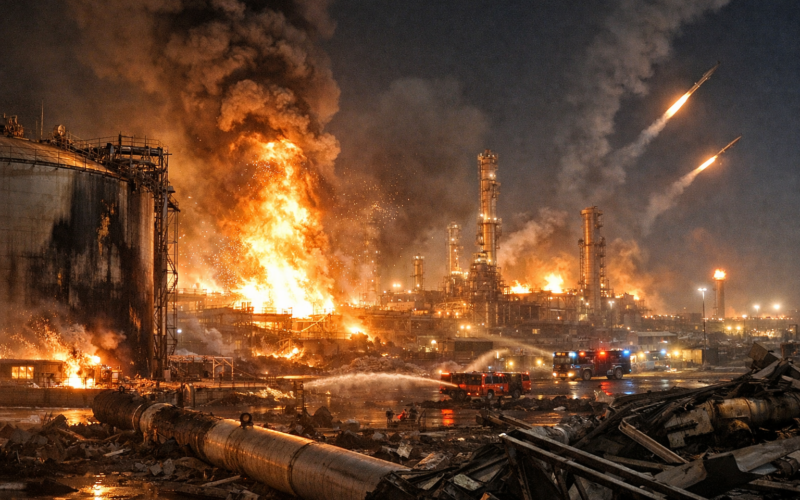
Iranian ballistic missiles struck the Ras Laffan Industrial City in Qatar on Wednesday, 18 March 2026, causing fires and extensive damage to the world’s largest liquefied natural gas export facility. The attack, the second Iranian strike on the complex since the start of the United States-Israeli military conflict with Iran, prompted Qatar to declare the Iranian Embassy’s military and security attaches persona non grata and order them to leave the country within 24 hours.
QatarEnergy, the state-owned company responsible for all oil and gas operations in Qatar and the world’s largest liquefied natural gas producer, confirmed in a statement that Ras Laffan Industrial City had been subjected to missile attacks on Wednesday evening. The company said emergency response teams were deployed immediately to contain the resulting fires. QatarEnergy confirmed that all personnel had been accounted for and that no casualties had been reported.
Qatar’s Ministry of Foreign Affairs issued a formal condemnation describing the attack as a “blatant Iranian attack” that caused fires resulting in significant damage to the facility. The ministry characterised the assault as a dangerous escalation, a flagrant violation of Qatar’s sovereignty, and a direct threat to its national security and the stability of the region. The ministry stated that the Iranian side was continuing escalatory policies that were pushing the region toward the brink and drawing countries not party to the conflict into the conflict zone.
Qatar’s Ministry of Interior confirmed that Qatar Civil Defence teams were responding to a fire in the Ras Laffan industrial area. The ministry stated that the fire had been preliminarily brought under control and that no injuries were reported. The Qatar Ministry of Foreign Affairs subsequently delivered an official note to the Embassy of the Islamic Republic of Iran in Doha, declaring both the military attache and the security attache at the Iranian Embassy, along with the staff of their respective offices, to be persona non grata, and requesting that they depart the country within a maximum period of 24 hours.
The decision to expel the Iranian diplomatic security and military personnel was conveyed during a meeting between the Director of Protocol at Qatar’s Ministry of Foreign Affairs, Ibrahim Yousif Fakhro, and the Ambassador of the Islamic Republic of Iran to Qatar, Ali Salehabadi. Qatar’s Ministry of Foreign Affairs stated that the move was made in response to repeated Iranian targeting and the blatant aggression against the State of Qatar, which had violated its sovereignty and security in a flagrant breach of the principles of international law and United Nations Security Council resolutions.
Qatar invoked Article 51 of the United Nations Charter in its formal statement, reiterating its right to respond in accordance with international law and self-defence provisions. The ministry stated that Qatar would not hesitate to take all necessary measures to protect its sovereignty, security, and the safety of its citizens and residents.

What triggered the Iranian missile strike on Qatar’s Ras Laffan gas facility on 18 March 2026?
The attack on Ras Laffan Industrial City occurred hours after Israeli fighter jets targeted Iran’s South Pars gas field in the Asaluyeh area on Wednesday. The South Pars gas field is the world’s largest natural gas reserve, and it shares a reservoir with Qatar’s North Field, the basis of Qatar’s own liquefied natural gas production. Iran’s Islamic Revolutionary Guard Corps warned in a statement that it would attack the energy infrastructure of Gulf states in retaliation for what it described as attacks by the United States and Israel on Iranian energy facilities.
Iran’s warning specifically named Qatar’s Mesaieed Petrochemical complex, Mesaieed Holding Company, and the Ras Laffan Refinery; Saudi Arabia’s Samref Refinery and Jubail Petrochemical complex; and the United Arab Emirates’ Al Hosn gas field as targets. Iran’s Islamic Revolutionary Guard Corps stated that if further attacks on Iranian energy infrastructure were repeated, subsequent attacks on the energy infrastructure of Gulf states and their allies would not cease until their complete destruction.
Iran’s President Masoud Pezeshkian separately condemned the targeting of Iran’s energy infrastructure, warning of uncontrollable consequences that could engulf the entire world. According to ITV News, Iran launched five ballistic missiles toward Qatar on Wednesday, with the country’s defence systems intercepting four of them. The single missile that was not intercepted struck the Ras Laffan Industrial City, causing the fires and extensive damage confirmed by QatarEnergy.
The broader conflict began on 28 February 2026, when United States President Donald Trump announced major combat operations against Iran. A joint United States-Israel strike campaign targeted military and government sites in Iran, including in Tehran. Iran’s Supreme Leader, Ayatollah Ali Khamenei, was among those killed on the first day of the strikes. His son, Mojtaba Khamenei, was subsequently chosen to succeed him. Iran responded with sustained missile and drone campaigns targeting Israel, regional United States military bases, and multiple Gulf nations.
How significant is Ras Laffan Industrial City to global LNG supply and energy security?
Ras Laffan Industrial City is located approximately 80 kilometres northeast of Doha, the Qatari capital. The complex is the world’s largest liquefied natural gas production and export facility. QatarEnergy, formerly known as Qatargas, operates 14 liquefied natural gas trains at the Ras Laffan complex with a total combined capacity of 77 million tonnes per annum. The facility accounts for approximately 20 percent of global liquefied natural gas supply, making it a central pillar of both European and Asian energy markets.
Qatar suspended liquefied natural gas production on 2 March 2026, following the first Iranian attack on the Ras Laffan facility and on a water tank at a power plant in Mesaieed Industrial City. QatarEnergy’s statement at that time cited military attacks on its operating facilities in both Ras Laffan Industrial City and Mesaieed Industrial City as the reason for ceasing production of liquefied natural gas and associated products. The 18 March 2026 missile strike therefore represents the second Iranian attack on the complex and compounds the disruption to liquefied natural gas output.
Global energy markets reacted sharply to the 18 March 2026 attack. Brent crude oil climbed to $107.38 per barrel in earlier trading and West Texas Intermediate advanced to $98.60 per barrel in Asian hours. Europe’s gas benchmark on the ICE Futures Europe exchange rose 6 percent on Wednesday. Brent crude reached $111 per barrel in some market reports following the confirmed attack on Ras Laffan. The earlier 2 March 2026 production halt had sent Dutch and British wholesale gas prices up by nearly 50 percent. United States liquefied natural gas exporters Cheniere Energy and Venture Global recorded gains of approximately 6 percent and over 14 percent respectively in that earlier session.
How are Gulf states and international partners responding to Iranian attacks on energy infrastructure?
Saudi Arabia’s Ministry of Defence reported on Wednesday that its air defences had intercepted four ballistic missiles launched toward Riyadh and two launched toward the country’s eastern region. Saudi Arabia’s National Early Warning Platform for Emergency Cases issued alerts in the governorates of Riyadh and al-Kharj. The Saudi Civil Defence reported that four people identified as Asian expatriates were injured by falling debris from an intercepted missile. Saudi Arabia’s Prince Sultan Air Base, which hosts American forces and aircraft, was also targeted, with a ballistic missile intercepted by Saudi defences.
The United Arab Emirates’ Ministry of Defence stated that its air defences engaged 13 ballistic missiles and 27 unmanned aerial vehicles launched from Iran on Wednesday. Operations were suspended at the Habshan gas facility in Abu Dhabi following two incidents involving falling debris from the successful interception of a missile. The Bab oil field was also targeted, the Abu Dhabi media office confirmed, though no injuries were reported. The United Arab Emirates’ Ministry of Foreign Affairs strongly condemned what it described as an Iranian terrorist attack on Gulf facilities, characterising the strikes as a dangerous escalation and a violation of international law. Since the onset of the conflict, the United Arab Emirates’ air defences have engaged a total of 327 ballistic missiles, 15 cruise missiles, and 1,699 unmanned aerial vehicles.
French President Emmanuel Macron stated on Wednesday that he had spoken with United States President Donald Trump and the Emir of Qatar following the missile strikes on gas production sites in Iran and Qatar. Macron called for an immediate moratorium on strikes targeting civilian infrastructure, specifically energy and water facilities. Egypt’s Ministry of Foreign Affairs issued a statement expressing solidarity with Saudi Arabia, Qatar, and the United Arab Emirates and condemning attacks on their oil and gas facilities. Egypt also condemned the reported Israeli attack on Iran’s natural gas field as a dangerous escalation and a flagrant violation of international law. The United Kingdom announced it was ramping up military and industrial support for Gulf allies, including plans to expand missile supplies and accelerate defence cooperation.
The Iranian attacks on Gulf energy infrastructure coincided with a scheduled meeting of foreign ministers from Arab and Muslim-majority countries in Riyadh, hosted by Saudi Arabia, to discuss potential pathways toward de-escalation. The attack on Ras Laffan and the simultaneous strikes on Saudi and Emirati infrastructure immediately became the dominant concern at the gathering. A joint statement issued earlier in the conflict by the United States, Bahrain, Jordan, Kuwait, Qatar, Saudi Arabia, and the United Arab Emirates condemned Iranian attacks across the region and affirmed the coalition’s right to self-defence.
Qatar’s foreign ministry spokesperson Majed al-Ansari had earlier in the day characterised the Israeli targeting of facilities linked to Iran’s South Pars gas field as dangerous and irresponsible and a threat to global energy security and the peoples of the region and its environment. Al-Ansari noted that the South Pars field is an extension of Qatar’s own North Field. Qatar called on all parties to exercise restraint, adhere to international law, and work toward de-escalation in a manner that preserves the security and stability of the region. This statement was issued before the subsequent Iranian missile strike on Ras Laffan.
What are the implications of the Ras Laffan attack for global LNG prices and energy-dependent economies?
Rachel Ziemba, a senior fellow at the Center for a New American Security, told Al Jazeera that because Ras Laffan had already paused liquefied natural gas production following the 2 March 2026 attack, there would be no immediate new global supply shock in the near term from the 18 March 2026 strike. Ziemba added that the attack could put further pressure on regional power supplies and risks prices staying high for longer.
Babak Hafezi, professor of international business at American University, told Al Jazeera that rising liquefied natural gas prices would affect European markets significantly, noting that since the start of the war in Ukraine and the destruction of the Nord Stream pipelines, Germany and the European Union had become net importers of liquefied natural gas. Other major economies reliant on liquefied natural gas imports include Japan, Turkiye, and India. Hafezi stated that smaller countries with weaker economies in the Global South would be most severely affected, as liquefied natural gas price increases would lead to demand destruction in those markets.
Iran has also continued its attempts to restrict shipping traffic through the Strait of Hormuz, through which approximately 20 percent of global liquefied natural gas exports pass, primarily from Qatar. The effective disruption of Strait of Hormuz transit has compounded the impact on energy markets. United States President Donald Trump suggested on Wednesday that other countries should take responsibility for the Strait of Hormuz, after some nations declined his demands for assistance in reopening the waterway. NATO Secretary General Mark Rutte stated that allies were discussing the best way to reopen the waterway.
Iran’s strategic targeting of Gulf energy infrastructure is interpreted as a deliberate attempt to drive up oil prices, increase economic pressure on the United States and Israel, and exploit the Gulf states’ lower appetite for direct conflict. The sustained energy infrastructure campaign has affected Saudi Arabia’s Ras Tanura refinery, Qatar’s Ras Laffan and Mesaieed facilities, and the United Arab Emirates’ Habshan gas operations and Bab oil field within the same conflict window, reflecting a pattern of systematic targeting of Persian Gulf energy assets.
Key takeaways on what the Iranian missile strike on Qatar’s Ras Laffan LNG complex means for global energy security and Gulf diplomacy
- Iran launched ballistic missiles at Qatar’s Ras Laffan Industrial City on 18 March 2026, causing fires and extensive damage to the world’s largest liquefied natural gas export facility, which accounts for approximately 20 percent of global liquefied natural gas supply. QatarEnergy confirmed no casualties were reported.
- Qatar declared the Iranian Embassy’s military and security attaches, along with their office staff, persona non grata and ordered them to depart within 24 hours, representing a significant shift in Qatari-Iranian diplomatic relations. Qatar invoked Article 51 of the United Nations Charter in asserting its right to self-defence.
- The 18 March 2026 attack is the second Iranian strike on the Ras Laffan complex; the first, on 2 March 2026, had already forced QatarEnergy to cease liquefied natural gas production. European natural gas futures and crude oil benchmarks surged sharply following the confirmed attack, with Brent crude reaching $111 per barrel.
- Saudi Arabia intercepted ballistic missiles targeting Riyadh and its eastern region, while the United Arab Emirates reported the interception of 13 ballistic missiles and 27 drones. Both countries reported physical impacts on energy infrastructure, including Saudi Arabia’s Ras Tanura refinery area and the United Arab Emirates’ Habshan gas facility and Bab oil field.
- The United States, the United Kingdom, France, and multiple Arab states have condemned the Iranian strikes on Gulf energy infrastructure. Diplomatic efforts led by Saudi Arabia, France, and NATO partners are ongoing, though no ceasefire framework has been announced as of 19 March 2026.
Discover more from Business-News-Today.com
Subscribe to get the latest posts sent to your email.