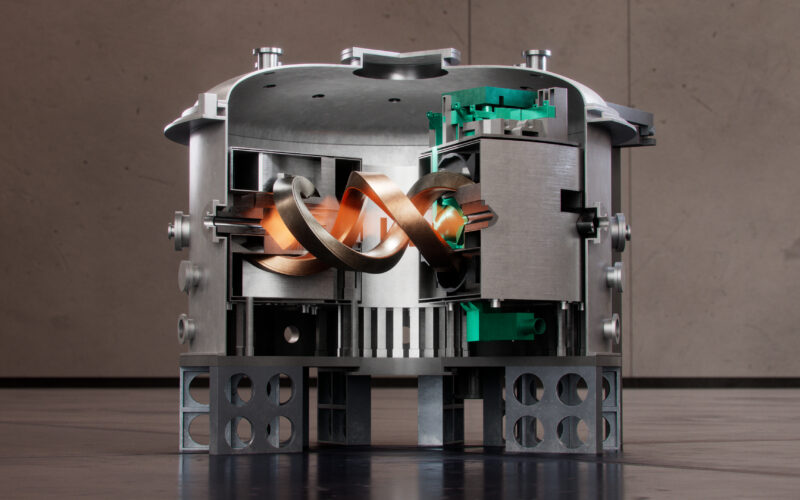
Helical Fusion Co., Ltd., a Tokyo-based fusion energy developer founded in 2021, has selected a construction site for Phase 1 of its Helix HARUKA integrated demonstration program, marking the company’s transition from research collaboration to physical hardware manufacturing and assembly. The facility will be built within a dedicated joint research workspace on the campus of the National Institute for Fusion Science in Japan. Phase 1 will focus on testing a high-temperature superconducting helical magnet system that forms the technological foundation of the company’s stellarator fusion approach. The move signals that Japan’s fusion commercialization effort is beginning to shift from laboratory science toward industrial engineering and hardware validation.
The announcement reflects an increasingly common pattern across the global fusion industry: startups moving beyond theoretical modeling and laboratory physics to the more difficult stage of manufacturing large-scale experimental systems.
Why does Helical Fusion’s Helix HARUKA magnet demonstration represent a critical engineering milestone for stellarator fusion power development?
The first phase of the Helix HARUKA program centers on demonstrating the performance of a non-planar helical magnet constructed with high-temperature superconducting technology. These magnets are not merely supporting components in a stellarator reactor. They effectively define the magnetic field geometry that confines plasma and determines how stable and efficient a fusion system can become.
Helical Fusion intends to conduct current energization tests on the magnet system in 2027. Those tests will evaluate whether the magnet design can maintain the magnetic field conditions required for stable plasma confinement under operating conditions expected in a commercial reactor environment.
This stage is widely regarded as one of the hardest transitions in fusion engineering. Designing magnets capable of generating extremely strong and precisely shaped magnetic fields while operating at cryogenic temperatures and handling enormous mechanical stress presents a combination of materials science, manufacturing precision, and systems engineering challenges.
For Helical Fusion, validating the magnet architecture is not just a technical checkpoint. It is a prerequisite for the integrated demonstration system planned in the second phase of the Helix HARUKA program.

How does the partnership between Helical Fusion and the National Institute for Fusion Science shape Japan’s public–private fusion commercialization model?
The Helix HARUKA project is also designed to showcase what Helical Fusion describes as a “Japan-style public–private partnership” for fusion commercialization.
The National Institute for Fusion Science provides decades of experimental research experience in stellarator systems through operation of the Large Helical Device. That facility has been one of the world’s most significant experimental platforms for the stellarator approach to magnetic confinement fusion.
The Large Helical Device has accumulated extensive operational knowledge, including experiments that sustained plasma for more than 3,200 seconds. Long-duration plasma operation is particularly relevant for stellarator concepts because they are designed to operate in steady-state conditions rather than pulsed cycles typical of many tokamak experiments.
Helical Fusion emerged as a commercial spinout built on that research foundation. The company aims to translate the scientific achievements of the institute into engineering systems capable of producing electricity.
By situating Phase 1 construction on the National Institute for Fusion Science campus, Helical Fusion is attempting to shorten the development cycle between laboratory experimentation and hardware manufacturing. Researchers, engineers, and industrial manufacturing partners will operate within a tightly integrated build-and-test environment.
What role do high-temperature superconducting magnets play in the race to commercialize magnetic confinement fusion reactors?
Across nearly all magnetic fusion designs, magnets remain among the most important and most difficult components to build.
High-temperature superconductors allow magnetic coils to carry extremely high electrical currents with minimal resistance when cooled to cryogenic temperatures. This capability enables stronger magnetic fields and potentially smaller, more efficient reactor designs.
In stellarator systems specifically, the complexity increases further because the magnets must follow twisted three-dimensional geometries that shape the magnetic confinement field. Unlike simpler toroidal coils used in many tokamak designs, stellarator magnets often require highly complex non-planar configurations.
Manufacturing these structures at industrial scale represents a significant engineering hurdle. The transition from theoretical field design to manufacturable coil assemblies has historically slowed stellarator development.
Helical Fusion’s Phase 1 program is therefore focused less on plasma physics and more on validating whether these magnets can be manufactured, assembled, and operated reliably.
How does the Helix HARUKA program connect to Helical Fusion’s long-term power generation plan with Helix KANATA?
The Helix Program is structured as a multi-stage development pathway leading toward a commercial fusion power plant.
The first stage, Helix HARUKA Phase 1, concentrates on validating the superconducting magnet architecture. The company will test current flow and magnetic field stability in a system-level configuration that approximates real reactor operating conditions.
Phase 2 of Helix HARUKA expands the scope dramatically. In that stage, Helical Fusion plans to integrate multiple enabling technologies, including magnet systems and plasma-facing components such as the blanket and divertor.
The objective of the second phase is to demonstrate sustained high-temperature plasma operation for durations long enough to support the engineering assumptions behind a future power-generating reactor.
The final stage of the program is Helix KANATA, which Helical Fusion describes as its first practical fusion power plant design. That system is intended to demonstrate steady-state operation and net electricity generation, although timelines and site selection for that stage remain undisclosed.
Why is Japan’s stellarator approach attracting renewed attention in the global fusion commercialization race?
The global fusion industry has entered a new phase in the past decade, with private investment accelerating development programs across multiple confinement approaches.
Most private fusion companies in the United States and Europe are pursuing tokamak or magnetized target fusion concepts. However, stellarators offer a distinct theoretical advantage. Because their magnetic fields are entirely generated by external coils, they can operate continuously without requiring the pulsed plasma current that tokamaks rely upon. This characteristic could potentially allow stellarators to achieve steady-state power generation more easily once engineering challenges are resolved.
Japan has spent decades refining stellarator research through national laboratories and universities. The Large Helical Device operated by the National Institute for Fusion Science represents one of the most mature experimental platforms for that approach. Helical Fusion is attempting to leverage that scientific foundation and combine it with private-sector engineering speed and industrial manufacturing capability.
What risks remain as Helical Fusion moves from experimental research into hardware integration and manufacturing?
Despite the progress represented by the Helix HARUKA construction announcement, the path to commercial fusion remains uncertain.
The most immediate risk lies in the engineering complexity of stellarator magnets. Even small manufacturing deviations in coil geometry can affect magnetic field precision and plasma stability.
Cost is another factor. Fusion hardware programs require extremely specialized materials, superconducting technologies, and cryogenic infrastructure. These requirements can drive capital expenditures far beyond the levels seen in typical energy projects.
Integration risk also remains significant. Even if individual technologies such as magnets or plasma-facing components perform well independently, integrating them into a full reactor system introduces additional technical challenges.
Finally, global competition in fusion energy development continues to intensify. Numerous startups and government programs across the United States, Europe, China, and the United Kingdom are pursuing different reactor architectures and commercialization timelines.
Helical Fusion’s strategy of combining academic research expertise with private manufacturing partnerships may provide a path forward, but the outcome will depend on whether its hardware demonstrations succeed.
Key takeaways: What Helical Fusion’s Helix HARUKA construction decision signals for the future of fusion commercialization
- Helical Fusion’s construction site announcement marks the company’s transition from research collaboration into physical hardware manufacturing and system integration.
- The Helix HARUKA Phase 1 program focuses on validating high-temperature superconducting stellarator magnets, a core technology for magnetic confinement fusion.
- Successful magnet testing in 2027 would represent a significant engineering milestone for Helical Fusion’s broader reactor development roadmap.
- The partnership with the National Institute for Fusion Science reflects a hybrid public–private model for fusion commercialization emerging in Japan.
- Decades of stellarator research conducted through the Large Helical Device provide the scientific foundation for Helical Fusion’s technology approach.
- The Helix HARUKA program is designed as a precursor to the Helix KANATA power plant concept targeted for practical electricity generation in the 2030s.
- Stellarator designs offer potential advantages for steady-state fusion power but present major manufacturing challenges due to complex magnet geometries.
- Helical Fusion’s strategy aims to shorten development cycles by colocating research teams and hardware manufacturing within a single integrated environment.
- Engineering integration risk and high capital requirements remain key obstacles as the fusion industry transitions toward commercial reactor prototypes.
- If Helix HARUKA succeeds, the program could strengthen Japan’s position in the global race to develop commercially viable fusion power systems.
Share this:
Discover more from Business-News-Today.com
Subscribe to get the latest posts sent to your email.