



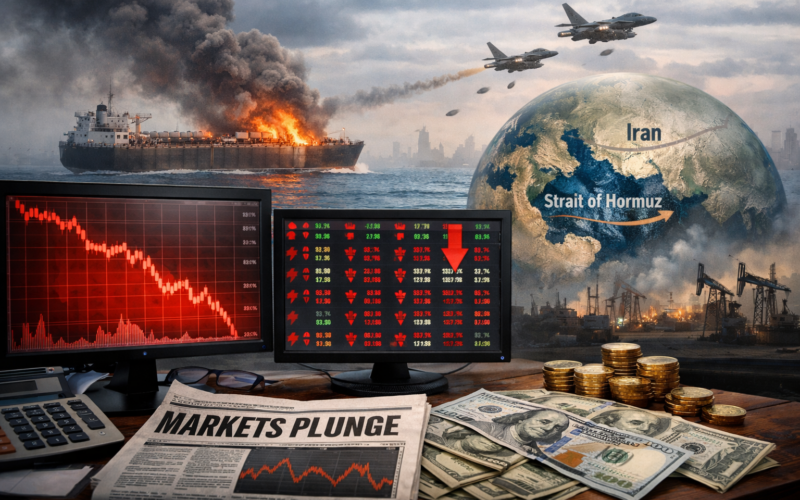
Global equity markets fell and the United States dollar strengthened on Friday, 13 March 2026, as the ongoing United States-Israel military campaign against Iran continued to disrupt energy supplies through the Strait of Hormuz, the world’s most critical maritime oil transit corridor. With the conflict now more than two weeks old and showing no clear signs of resolution, investors are recalibrating expectations for inflation, interest rates, and corporate earnings across multiple sectors.
Front-month West Texas Intermediate crude futures settled at USD 98.71 per barrel on Friday, a daily increase of 3.11 percent. Brent crude, the international benchmark, rose 2.67 percent to settle at USD 103.14 per barrel, moving above the USD 100 threshold for the first time since August 2022. The S&P GSCI Energy Index gained 1.86 percent on the session. Earlier in the week, Brent had briefly surged to nearly USD 120 per barrel before retreating, a trajectory that has unsettled institutional investors and prompted emergency measures from governments and multilateral energy bodies.
All three major United States stock indexes recorded both daily and weekly declines. The Dow Jones Industrial Average fell 0.25 percent on Friday. The S&P 500 retreated 0.6 percent. The Nasdaq Composite dropped 0.9 percent. MSCI’s gauge of global equities fell 0.9 percent on the day. European markets also closed lower, with the pan-European STOXX 600 index shedding 0.5 percent. Since the start of 2026, the S&P 500 is now down approximately 3 percent, a notable reversal from the index’s annual returns of more than 16 percent in each of the prior three years.

How the closure of the Strait of Hormuz is reshaping global oil supply and market expectations in March 2026
The Strait of Hormuz, the narrow waterway off Iran’s southern coast through which approximately 20 percent of global oil consumption transits daily, has been effectively closed to commercial shipping since the war began on 28 February 2026. The joint United States-Israel military operation, codenamed Operation Epic Fury, initially targeted Iranian leadership and military infrastructure. Iran’s retaliatory response included missile and drone strikes on United States military bases in the Gulf region, attacks on commercial vessels, and an official declaration by the Islamic Revolutionary Guard Corps that the Strait of Hormuz is a prohibited war zone.
Iran’s newly installed Supreme Leader Mojtaba Khamenei, who assumed the position following the death of Ali Khamenei in the initial strikes, has vowed to keep the Strait of Hormuz closed. The position has hardened investor sentiment. As of Friday, 13 March 2026, the United Kingdom Maritime Trade Operations Centre had recorded more than ten attacks on commercial vessels attempting to transit the Strait, including strikes on two vessels in Iraqi waters. Tanker traffic has dropped sharply, with major global shipping operators including Maersk and Hapag-Lloyd suspending Middle Eastern routes.
The International Energy Agency, in its March 2026 Oil Market Report, described the conflict as creating what it called the largest supply disruption in the history of the global oil market. The Agency estimated that global oil supply would fall by 8 million barrels per day in March 2026, with the Middle East accounting for the bulk of curtailments. The Agency also took the significant step of authorising a coordinated emergency release of 400 million barrels from strategic reserves held by member countries, a measure aimed at providing a short-term buffer while diplomatic and military efforts continue.
The Organisation of the Petroleum Exporting Countries and its allied producers, collectively known as OPEC+, announced early in the conflict that it would raise daily output by 206,000 barrels per day. Energy analysts noted the increase would have only a limited effect in offsetting a disruption of this scale. The Gulf state of Qatar declared force majeure on gas contracts on 4 March 2026 after Iranian drone strikes damaged Qatari gas facilities and halted all production. Qatari Energy Minister Saad Sherida al-Kaabi warned that if the conflict persists, other Gulf producers may similarly suspend exports.
Why the US dollar is strengthening against major currencies during the Iran war and what it means for global markets
The United States dollar has become the primary safe-haven asset during the conflict, gaining for the second consecutive week. The US Dollar Index, which tracks the greenback against a basket of major rival currencies, rose 0.8 percent on Friday, reaching its highest level for the year. The dollar’s appreciation has placed sustained downward pressure on most other currencies and has weighed on gold, which would typically benefit from geopolitical uncertainty but has faced headwinds because a stronger dollar makes dollar-denominated commodities more expensive for non-United States buyers.
United States Treasury yields also moved higher as bond markets repriced expectations for inflation. The 10-year Treasury yield rose to 4.24 percent, its highest level since early February 2026. The rise in yields has rippled into the mortgage market, with the average rate on a 30-year fixed mortgage rising to 6.11 percent in the week ending 12 March 2026, the largest weekly increase since President Donald Trump’s Liberation Day tariffs prompted a bond market reaction in April of the prior year. Higher mortgage rates add further pressure to the residential property market and consumer spending.
Market sentiment, measured by the Chicago Board Options Exchange Volatility Index, known as the VIX, spiked 9 percent during the week, signalling heightened uncertainty among institutional investors. The index briefly moved above 30 during peak oil price volatility. One measure of consumer and investor anxiety compiled by CNN, its Fear and Greed Index, moved into the extreme fear category.
How the Iran conflict is forcing the Federal Reserve to reconsider interest rate cuts and the inflation outlook for 2026
The prospect of sustained elevated energy prices has complicated the monetary policy outlook for the United States Federal Reserve. Before the conflict began, markets were pricing in a series of interest rate reductions in 2026. Analysts at EY-Parthenon revised their baseline to project only one 25 basis point rate cut, likely in December 2026, with EY-Parthenon Chief Economist Gregory Daco noting it is entirely plausible the Federal Reserve could deliver no rate cuts at all this year, given the higher headline and core personal consumption expenditures inflation forecast now required.
Goldman Sachs economists modelled a scenario in which Brent crude averages USD 98 per barrel during March and April 2026 before declining over the remainder of the year. Under that scenario, Goldman Sachs raised its 2026 United States inflation forecast by 0.8 percentage points to 2.9 percent and trimmed its gross domestic product growth forecast by 0.3 percentage points to 2.2 percent. In a more extreme scenario involving a full month of disrupted oil flows with Brent averaging USD 110 per barrel, Goldman Sachs projected inflation at 3.3 percent and GDP growth at 2.1 percent, with the probability of recession rising 5 percentage points to 25 percent.
The consumer price index reading for January 2026, released earlier in the week, came in at 2.4 percent. However, market participants noted that this backward-looking figure did not capture the oil price surge that began when the United States and Israel attacked Iran in late February. Personal consumption expenditures data for January, considered the Federal Reserve’s preferred inflation gauge, was due for release on Friday. The core PCE measure, which strips out volatile food and energy items, was expected to come in at 3.1 percent year-on-year for January, slightly above the 3.0 percent reading for December 2025.
What President Trump’s partial Russian oil sanctions waiver and G7 diplomacy reveal about United States energy strategy
President Donald Trump said on Friday that the United States was going to be hitting Iran very hard over the next week, indicating that military operations were expected to intensify rather than wind down. At the same time, the Trump administration issued a partial 30-day waiver for purchases of sanctioned Russian oil, a step aimed at softening the blow to global oil supply at a moment when Middle Eastern production is severely curtailed. The move acknowledged that supply constraints from the Strait of Hormuz closure were significant enough to require unconventional policy responses.
During a virtual meeting with Group of Seven leaders earlier in the week, President Trump told counterparts that Iran was about to surrender, according to a report by Axios citing three officials from Group of Seven countries briefed on the call. Market participants and analysts largely discounted the significance of the statement, noting that Tehran had not signalled any willingness to capitulate and that the new Iranian Supreme Leader Mojtaba Khamenei had reaffirmed the closure of the Strait of Hormuz. President Trump also posted on social media that the United States had unparalleled firepower, unlimited ammunition, and plenty of time, language that investors interpreted as indicating a prolonged rather than a short conflict.
An Indian oil tanker was reported to have navigated out of the Strait of Hormuz during the Friday session, representing one of the few transits to occur amid the near-complete shutdown of commercial shipping. Saudi Arabia moved to divert oil to the Red Sea port of Yanbu via the East-West Crude Oil Pipeline connecting its eastern oil fields, while the United Arab Emirates diverted oil to the port of Fujairah on the Arabian Sea. However, analysts noted that the combined pipeline capacity of these alternative routes falls well short of the volume previously transiting the Strait, leaving a deficit of approximately 12 million barrels per day.
How oil price volatility from the Iran war is affecting sectors from airlines to fertilizers and global supply chains
The oil price surge has spread disruption well beyond equity index movements. Airlines have faced sharply higher jet fuel costs, with Delta Air Lines and United Airlines recording double-digit declines in their share prices during March. FedEx announced the suspension of several Middle Eastern flight routes, with logistics operators warning of both rising fuel surcharges and reduced consumer demand at the pump. California gasoline prices surged above USD 5 per gallon during the second week of March 2026.
Commodity markets beyond oil are also under strain. The Strait of Hormuz handles significant volumes of aluminium inputs, fertilizers, petrochemical feedstocks, plastics, and liquefied petroleum gas. European natural gas prices nearly doubled after Iran targeted Qatari gas facilities on 2 March 2026. Global sulfur supply has been disrupted, with the Gulf states accounting for approximately 45 percent of the commodity’s trade, carrying downstream consequences for fertilizer costs, copper processing, and sulfuric acid production. New Orleans fertilizer hub urea prices rose from USD 475 per metric ton to USD 680 per metric ton.
Asian economies face particularly acute exposure. China receives approximately one-third of its oil imports through the Strait of Hormuz. Japan’s refiners, which source approximately 95 percent of their crude from Saudi Arabia, Kuwait, the United Arab Emirates, and Qatar, asked the Japanese government to release stockpiled oil. South Korea, the Philippines, Vietnam, and Thailand, which source the large majority of their oil from Gulf producers, are all facing heightened supply risk. The disruption has also affected the helium supply, a key input for semiconductor manufacturing sourced significantly from the Persian Gulf region.
What analysts and institutions are saying about the duration of the Iran conflict and long-term energy market impacts
Market commentary on Friday centred on the difficulty of predicting how long the disruption to oil supplies will last. Mitch Reznick, group head of fixed income at Federated Hermes, described the situation as headlines coming at the market like water from a fire hose, with the result being significant impacts on the price of oil and broader financial markets.
Adam Turnquist, chief technical strategist at LPL Financial, described oil as the primary market driver, with developments around the reopening of the Strait of Hormuz acting as either an accelerator or a brake on risk appetite. Felix Vezina-Poirier, chief strategist at BCA Research, described the implicit closure of the Strait as the hinge factor for global markets.
RBC analysts indicated the Iran conflict could prolong well into spring, potentially pushing oil prices above the highs reached in 2022. Analysts at Capital Economics noted that options market pricing implied a one-in-five probability of Brent crude remaining at or above USD 100 per barrel in three months’ time. Oxford Economics modelled a scenario in which global oil prices average USD 140 per barrel for two months, which the firm characterised as a breaking point for the world economy sufficient to push the eurozone, the United Kingdom, and Japan into economic contraction.
The Congressional Research Service, in a report on the Iran conflict and the Strait of Hormuz, noted that since 4 March 2026, Iranian forces had declared the Strait closed, threatening and carrying out attacks on ships attempting transit. The report documented growing congressional interest in potential oversight of the military campaign and associated United States policy options, including the possibility of formal legislation.
The broader geopolitical and supply chain context has drawn comparisons to historical precedents. The 1973 Arab Oil Embargo and the Tanker War of the 1980s have been cited by analysts as relevant reference points, though observers note that the more interconnected and just-in-time structure of global supply chains in 2026 means disruptions propagate with greater speed and breadth than in prior episodes.
Key takeaways: Iran war, oil prices above $100, and the outlook for global markets and inflation in 2026
- Brent crude settled above USD 100 per barrel on Friday, 13 March 2026, for the first time since August 2022, with WTI settling at USD 98.71 per barrel, as the Strait of Hormuz remained effectively closed to commercial shipping following joint United States-Israel military strikes against Iran that began on 28 February 2026.
- All three major United States equity indexes recorded weekly losses, with the S&P 500 down approximately 3 percent year-to-date. The US Dollar Index rose to its highest level of the year, with the dollar serving as the primary safe-haven asset. The VIX volatility index spiked above 30 at points during the week.
- The International Energy Agency described the conflict as creating the largest supply disruption in the history of the global oil market, authorised a coordinated release of 400 million barrels from strategic reserves, and projected that global oil supply would fall by 8 million barrels per day in March 2026.
- Iran’s Supreme Leader Mojtaba Khamenei reaffirmed the closure of the Strait of Hormuz, through which 20 percent of global oil consumption flows, while President Trump stated the United States would continue military operations and indicated the campaign would intensify in the coming week.
- Expectations for Federal Reserve interest rate cuts in 2026 have diminished materially, with analysts projecting at most one 25 basis point reduction in December, as energy-driven inflation threatens to push the core personal consumption expenditures gauge above the Federal Reserve’s 2 percent target.
Discover more from Business-News-Today.com
Subscribe to get the latest posts sent to your email.