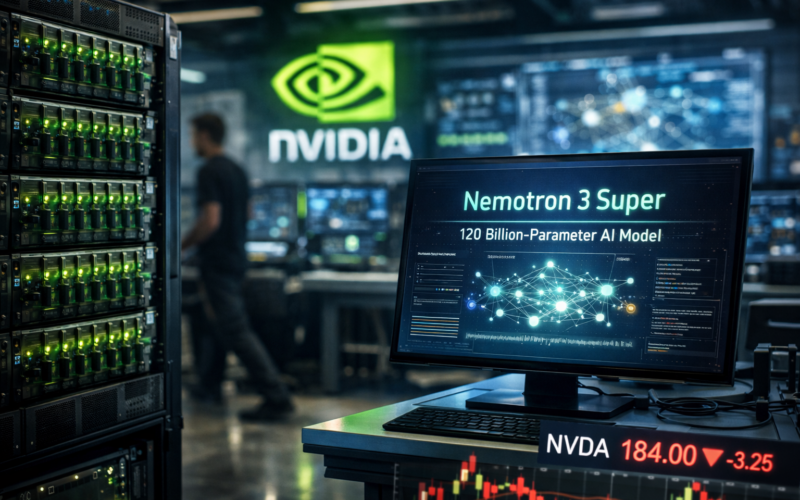
NVIDIA Corporation (NASDAQ: NVDA) has launched Nemotron 3 Super, a 120-billion-parameter open AI model with 12 billion active parameters designed to address two structural bottlenecks that have constrained enterprise adoption of multi-agent AI systems. The announcement, made on March 11, 2026, positions the model as a purpose-built reasoning engine for autonomous agent workflows, targeting use cases in software development, financial analysis, life sciences, and cybersecurity. NVIDIA claims the model delivers up to five times higher throughput and twice the accuracy of its predecessor, Nemotron Super, powered by a hybrid mixture-of-experts architecture that runs with notably reduced memory and compute overhead. The launch arrives as NVDA shares trade around $184, roughly 13% below their 52-week high of $212.19, reflecting a broader market recalibration of AI infrastructure valuations rather than any company-specific deterioration.
Why are multi-agent AI systems more expensive to run than standard chatbot applications?
The economics of agentic AI diverge sharply from those of single-turn conversational models, a distinction that is often underappreciated until deployment costs surface. NVIDIA identifies two core constraints that Nemotron 3 Super is designed to resolve. The first is what the company describes as context explosion: multi-agent workflows can generate up to 15 times more tokens than standard chat interactions, because each agent must re-transmit full conversation histories, tool call outputs, and intermediate reasoning chains with every step. At scale, this token volume drives up inference cost and introduces goal drift, a condition in which agents gradually lose alignment with the original task objective as context windows fill and older instructions are effectively deprioritised.
The second constraint is the thinking tax. Complex agentic systems require reasoning at each decision node, but routing every subtask through a frontier-scale model makes the economics unworkable for most production environments. A software development agent that needs to analyse an entire codebase, generate code, debug output, and verify results across hundreds of iterations cannot afford the latency or cost of a 400-billion-parameter model on every call. This is the commercial problem Nemotron 3 Super is designed to solve: a model large enough to reason accurately, but efficient enough to run continuously at production scale.

How does the hybrid mixture-of-experts architecture in Nemotron 3 Super deliver higher throughput at lower cost?
Nemotron 3 Super is built on a hybrid architecture that combines Mamba layers with transformer layers. The Mamba component handles memory and compute-intensive operations with four times greater efficiency than standard transformer blocks, while the transformer layers anchor the model’s advanced reasoning performance. At inference, only 12 billion of the model’s 120 billion parameters are active at any given time, a result of its mixture-of-experts design that routes each token through a subset of specialist modules rather than the full parameter set.
NVIDIA has introduced a technique it calls Latent MoE, which activates four expert specialists for the cost of one during token generation, improving accuracy without a proportional increase in compute. Multi-token prediction, a separate architectural feature, allows the model to predict multiple future tokens simultaneously, producing a claimed threefold improvement in inference speed. Running in NVFP4 precision on NVIDIA Blackwell hardware, the model delivers up to four times faster inference than FP8 performance on the previous NVIDIA Hopper generation, with no reported accuracy degradation. The net result is a model that NVIDIA says achieves top efficiency and openness rankings on the Artificial Analysis leaderboard among models of comparable size, alongside the number-one position on the DeepResearch Bench and DeepResearch Bench II benchmarks measuring multi-step research coherence.
Which industries and enterprise software platforms are deploying Nemotron 3 Super in agentic AI workflows?
The deployment roster announced alongside the launch reflects a deliberate cross-industry spread. In AI-native software, Perplexity is integrating Nemotron 3 Super as one of 20 orchestrated models in its Computer product, giving it a role in the competitive AI search and reasoning platform market. Software development agent providers CodeRabbit, Factory, and Greptile are combining the model with proprietary models to improve accuracy while managing per-query cost. Edison Scientific and Lila Sciences are deploying it for deep literature search, data science tasks, and molecular understanding within life sciences research pipelines.
At the enterprise platform level, Amdocs is targeting telecom workflow automation, Palantir is applying it to cybersecurity orchestration, and Cadence, Dassault Systemes, and Siemens are deploying the model in semiconductor design and manufacturing environments. The breadth of verticals is strategically significant: it signals that NVIDIA is positioning Nemotron 3 Super not as a niche research tool but as a general-purpose reasoning layer within commercial agentic pipelines across regulated and capital-intensive industries.
What does NVIDIA’s open-weights release strategy for Nemotron 3 Super mean for competition with closed frontier models?
NVIDIA is releasing Nemotron 3 Super under a permissive open-weights license, a deliberate positioning move that places it in the same strategic bracket as Meta’s Llama series and Mistral’s open releases, rather than alongside the closed proprietary models from OpenAI and Anthropic. The company is also publishing the full training methodology, including over 10 trillion tokens of pre- and post-training data, 15 reinforcement learning environments, and evaluation recipes. For enterprises that require full deployment control, on-premise customisation, or cannot route sensitive data through third-party API endpoints, this combination of open weights and published training recipes represents a materially different value proposition than procuring API access to a closed model.
The NVIDIA NeMo platform provides the fine-tuning infrastructure, meaning organisations can adapt the model to proprietary datasets and domain-specific tasks without rebuilding from scratch. Dell Technologies is bringing Nemotron 3 Super to the Dell Enterprise Hub on Hugging Face optimised for on-premise deployment on the Dell AI Factory, while Hewlett Packard Enterprise is introducing the model to its agents hub for enterprise adoption. The open-weights strategy also raises the competitive pressure on other mid-size model providers: a 120-billion-parameter model with 12 billion active parameters at inference, available openly and deployable on-premise, compresses the differentiation window for proprietary alternatives that occupy similar accuracy tiers.
How does Nemotron 3 Super’s one-million-token context window address goal drift in long-running autonomous agent tasks?
The model’s one-million-token context window is among its most commercially relevant specifications for enterprise agentic deployments. In practice, long-running multi-agent tasks accumulate context rapidly: tool outputs, intermediate reasoning steps, API responses, and updated task states pile up within a session. When context windows fill or require truncation, agents must either discard earlier information or implement retrieval-augmented mechanisms to compensate, both of which introduce latency, error, and the possibility that the agent drifts from its original objective.
A one-million-token window allows an agent to retain the full workflow state in memory across extended tasks without truncation. In the software development use case, this means loading an entire large codebase into context at once, enabling end-to-end code generation and debugging without document segmentation or retrieval overhead. In financial analysis, thousands of pages of regulatory filings and earnings transcripts can sit in context simultaneously, eliminating the need to re-reason from partial information. For high-stakes autonomous environments such as cybersecurity orchestration, where execution errors can have real-time consequences, the ability to maintain full context without degradation is a material operational advantage rather than a marketing specification.
What are the execution and competitive risks for NVIDIA as it scales Nemotron 3 Super through enterprise channels?
The distribution architecture for Nemotron 3 Super is extensive. Availability spans Google Cloud Vertex AI, Oracle Cloud Infrastructure, and Amazon Web Services through Amazon Bedrock, with Microsoft Azure listed as forthcoming. NVIDIA cloud partners Coreweave, Crusoe, Nebius, and Together AI are included, alongside inference providers Baseten, Cloudflare, DeepInfra, Fireworks AI, and others. The model is packaged as a NIM microservice, a format designed to standardise deployment from on-premise to cloud without reintegration overhead. The breadth of the distribution network reduces single-channel dependency and gives enterprises deployment optionality across cost, data governance, and latency requirements.
The competitive risk is less about distribution and more about benchmark durability. NVIDIA’s claims of five times throughput improvement and top-tier accuracy rankings on Artificial Analysis and DeepResearch Bench will be stress-tested by independent researchers and by deployment data from early enterprise adopters. Benchmark leadership in AI models tends to be provisional: rivals at Meta, Mistral, and Cohere are on comparable development cycles, and the gap between a model’s published benchmark performance and its real-world behaviour in specific enterprise workflows can be significant.
Execution risk also exists on the training reproducibility claim: publishing 10 trillion tokens of training data and 15 reinforcement learning environments invites scrutiny of methodology, and any inconsistencies between the published recipe and the model’s actual training procedure would be damaging to the open-weights positioning. The broader question for investors is whether Nemotron 3 Super expands NVIDIA’s total addressable market into inference-time software value, or primarily serves to drive additional Blackwell hardware adoption. The answer is probably both, but the market will want evidence that the software layer generates recurring revenue independent of chip sales.
How are NVDA shares performing in 2026 and what does the Nemotron 3 Super launch signal for the stock thesis?
NVDA is currently trading around $184, off roughly 13% from its 52-week high of $212.19 and well above its 52-week low of $86.62. The stock’s 2026 performance has been broadly flat rather than directionally bullish, which diverges from the strong operational narrative around accelerated computing demand. The Nemotron 3 Super launch does not directly alter near-term revenue guidance, but it reinforces the long-term thesis that NVIDIA is building a software and model layer on top of its hardware franchise, a move that would support higher-quality, more recurring revenue streams over time.
Analyst consensus remains heavily skewed positive, with 58 buy ratings, two holds, and one sell among 61 covering analysts. The consensus price target is above current levels, suggesting the analyst community views the current trading range as an entry point rather than a fair value equilibrium. The open-weights model release does not generate direct per-query API revenue in the way a closed model would, but it creates ecosystem lock-in through NIM microservice deployment, NeMo fine-tuning, and Blackwell hardware utilisation. For investors, the model launch is best read as a long-cycle competitive positioning move, not a near-term earnings catalyst.
Key takeaways: what Nemotron 3 Super means for NVIDIA, its competitors, and the enterprise AI market
- NVIDIA is solving the economics of agentic AI, not just its performance. The five times throughput gain and one-million-token context window are direct responses to the token cost and goal drift problems that have slowed multi-agent enterprise adoption.
- The hybrid MoE architecture with 12 billion active parameters from a 120-billion-parameter base is a commercially important design choice: it delivers frontier-level reasoning at sub-frontier inference cost, which is the sweet spot for high-frequency agentic workloads.
- The open-weights release under a permissive license, combined with published training recipes, directly challenges mid-tier proprietary model vendors and raises the bar for closed alternatives to justify their API pricing.
- Enterprise verticals targeted include telecom (Amdocs), cybersecurity (Palantir), semiconductor design (Cadence, Siemens), and life sciences (Lila Sciences, Edison Scientific), indicating a systematic sector-by-sector penetration strategy rather than a horizontal consumer play.
- The NIM microservice packaging, combined with Dell and HPE distribution partnerships, is designed to convert open-weights adoption into managed infrastructure deployment, preserving NVIDIA’s hardware and platform revenue even when the model itself is free.
- NVDA shares trading at roughly $184, approximately 13% below their 52-week high, present the model launch in the context of a stock that has given back significant gains from its late-2025 peak, making the software layer narrative more important as a re-rating catalyst.
- Benchmark leadership on DeepResearch Bench and Artificial Analysis is meaningful but provisional. Independent enterprise deployment results across the next two to three quarters will be the more durable test of the throughput and accuracy claims.
- The model’s availability across Google Cloud Vertex AI, Oracle Cloud Infrastructure, and AWS Bedrock, plus NVIDIA cloud and inference partners, gives it a distribution footprint that smaller open-source model releases cannot easily replicate.
- Competition from Meta Llama, Mistral, and Cohere remains active. The architectural innovations in Nemotron 3 Super are genuine, but the pace of capability improvement across all open-model providers means any performance lead has a limited shelf life without continuous iteration.
- For institutional investors, the strategic read is that NVIDIA is extending its moat from hardware into model and deployment infrastructure. If the NIM microservice ecosystem generates defensible adoption, the software layer could eventually contribute meaningfully to margin-accretive revenue alongside chip sales.
Discover more from Business-News-Today.com
Subscribe to get the latest posts sent to your email.