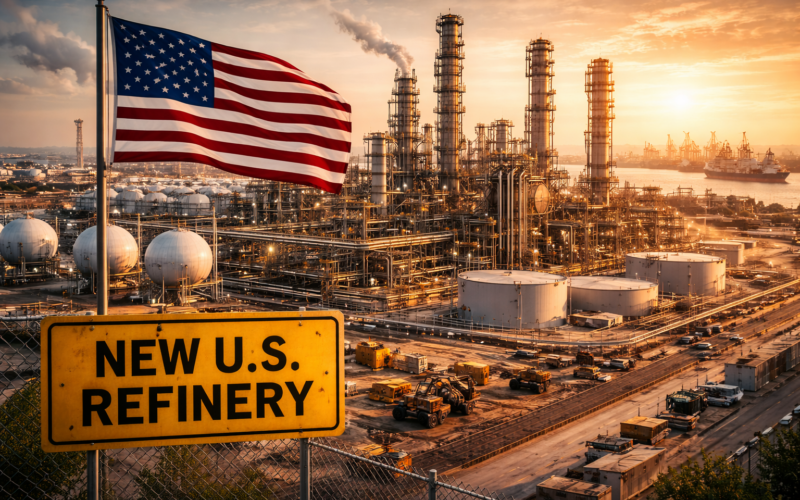
America First Refining, a privately held energy infrastructure company, has announced a 20-year offtake agreement and a nine-figure equity investment from an undisclosed global oil supermajor, committing to purchase, process, and distribute American light shale oil at a total implied contract value the company characterises as the largest energy deal in US history. The transaction, structured around a 10-figure valuation for America First Refining, will fund construction of a new crude oil refinery at the Port of Brownsville, Texas, breaking ground in the second quarter of 2026. If completed as described, the facility would be the first new oil refinery built in the United States in approximately five decades, a claim that reflects both the capital intensity and regulatory complexity that has historically made greenfield refinery construction in the country effectively unviable.
Why has no new refinery been built in the United States for fifty years, and what has changed now?
The last greenfield refinery constructed in the United States came online in the mid-1970s. Since then, the combination of environmental permitting requirements, capital costs running into the billions of dollars, thin refining margins, and the political difficulty of siting new heavy industrial facilities has consistently made such projects unattractive to the major integrated oil companies that might otherwise have funded them. Existing refinery capacity has instead been expanded incrementally, and the industry has operated within a framework where imported crude, particularly heavier grades from Saudi Arabia, Canada, and Mexico, kept older refinery configurations economically viable.
The shale revolution changed the supply picture but not the refinery configuration problem. Between 2014 and 2024, the United States exported nearly 10 billion barrels of domestically produced crude oil while simultaneously importing roughly 28 billion barrels, at a cumulative cost to the economy that America First Refining estimates at over $1.8 trillion. The core inefficiency is structural: US shale oil is predominantly a light, sweet crude with an API gravity around 47 degrees, while the majority of existing US refinery capacity was built or configured to process heavier, more sulphurous imported grades. Processing light shale through those refineries is suboptimal. Building a refinery specifically engineered for domestic light shale oil is the supply-side answer to that mismatch, but until now, no major capital allocation decision has supported it at scale.
America First Refining is positioning the current political environment as the enabling condition. The Trump administration’s explicit prioritisation of domestic energy infrastructure, combined with the Port of Brownsville’s status as a federally designated Economic Opportunity Zone offering potential tax incentives, has apparently provided the policy stability that persuaded a global supermajor to commit to a 20-year offtake arrangement. The identity of that supermajor has not been disclosed, which will be a focus of scrutiny as the project advances toward groundbreaking.
What does the 20-year offtake agreement mean for US energy security and the domestic refining industry?
The commercial structure as announced involves the supermajor purchasing and processing 1.2 billion barrels of US light shale oil over the 20-year term, with an implied feedstock value of $125 billion and a refined product output value of $175 billion at current pricing assumptions. The company states this will improve the US trade balance by $300 billion over the life of the agreement by redirecting domestically produced crude into domestic refining rather than exporting it raw and re-importing value-added products.
At a processing rate of approximately 60 million barrels per year, the facility would represent roughly 165,000 barrels per day of new refining capacity. To put that in context, total US refining capacity as of late 2024 sat at around 17.6 million barrels per day, so the Brownsville facility would add less than one percent to national throughput. The strategic significance is therefore less about headline capacity addition and more about the signal: that the economics and political conditions for new-build refinery investment in the United States may have fundamentally shifted.
For the existing US refining sector, which includes large integrated players such as Valero Energy Corporation (VLO), Marathon Petroleum Corporation (MPC), and Phillips 66 (PSX), the project introduces a longer-term competitive variable. A purpose-built light shale refinery with lower feedstock processing costs could put margin pressure on incumbents in certain product categories over a 10-to-20-year horizon, though the scale of the initial facility limits the near-term impact.
How does the Port of Brownsville location serve America First Refining’s distribution and export strategy?
The Port of Brownsville is a deep-water port on the Gulf of Mexico, situated at the southern tip of Texas adjacent to the Mexican border. It already serves as a significant hub for LNG export infrastructure, including operations connected to the Rio Grande LNG project, and has the logistics depth to handle large-scale energy commodity flows in both import and export directions. For America First Refining, the location provides access to domestic pipeline and tanker distribution networks while also enabling export of refined products to Latin America, Europe, and Asia, which is relevant given that the offtake agreement covers both domestic and international distribution.
The Economic Opportunity Zone designation provides potential capital gains tax advantages for investors, which would be a meaningful incentive for the private capital structure underpinning the project. Brownsville is also in a region with relatively lower land and labour costs than the Gulf Coast’s more saturated industrial corridors around Houston and Beaumont, though it is also more distant from the primary pipeline and terminal infrastructure that connects the Permian Basin to the coast.
What are the execution risks and unresolved questions facing America First Refining before the refinery becomes operational?
The announcement is a term sheet and a capital raise, not a completed refinery. The distance between a binding 20-year offtake term sheet and a producing facility is measured in permits, engineering, construction, and commissioning cycles that typically span five to seven years for a project of this complexity, even under favourable conditions. The press release does not specify a target operational date, total capital expenditure for construction, or the capacity of the engineering and project management organisation that will execute the build.
The non-disclosure of the supermajor partner is a significant gap in the public record. A 20-year offtake commitment at this scale from a credible counterparty would represent one of the most consequential long-term supply agreements in US energy history, and the absence of that name creates verification difficulties for investors and analysts assessing the project’s credibility. The announcement states the nine-figure investment was made in February 2026; that investment has presumably been completed, which is a stronger signal of commitment than a term sheet alone, but confirmation of the counterparty’s identity remains outstanding.
Permitting represents a structural risk. Environmental review for a new greenfield refinery under the National Environmental Policy Act and Clean Air Act requirements is a multi-year process and subject to legal challenge from environmental groups and competing stakeholders. The current administration’s posture toward energy permitting reform is supportive of the project’s prospects, but administrations change, and a 20-year investment thesis is inherently exposed to policy discontinuity risk.
Labour and supply chain constraints in the post-pandemic construction environment are also a material factor. The infrastructure buildout associated with LNG expansion, semiconductor fabrication, and onshoring of manufacturing has tightened the market for skilled trades and major equipment procurement. America First Refining’s claim of creating thousands of high-quality jobs is plausible given the scale of the project, but it also describes the resource acquisition challenge the company faces in delivering on schedule.
Who is behind America First Refining and what does their track record indicate about delivery capacity?
The three principals quoted in the announcement bring credible but non-overlapping experience to the project. John Calce, the founder and chairman, has spent two decades in early-stage shale basin development, having supervised over 200,000 acres of land transactions and assisted in deploying more than $2.5 billion of capital in US shale. That background is relevant to upstream origination and capital formation for exploration and production assets, though it is distinct from the project finance and engineering execution skill set required for a refinery build.
Trey Griggs, the company’s president, brings downstream and power sector experience through his role as president of Calpine Corporation, one of North America’s largest independent power producers, and prior work in Goldman Sachs energy risk management. Large-scale energy infrastructure management and capital markets access are directly applicable to the refinery project, and Griggs’s institutional background provides the project with credibility in commercial and financing negotiations.
Nick Ayers, incoming vice chairman and an early investor, is a political operative whose primary contribution to the project appears to be his proximity to the Trump administration and his articulation of the political thesis underpinning the investment case. His board positions at Veeam Software and PSQ Holdings are not directly relevant to refinery construction, but his role as a signal of political alignment with the administration’s energy agenda is clearly intentional.
Cantor Fitzgerald is serving as the financial adviser to the company, which suggests the capital raise and potential future financing rounds will have institutional support. The firm’s involvement does not resolve the execution risk questions but indicates the project has professional financial infrastructure around it.
Key takeaways: what America First Refining’s refinery project means for US energy, investors, and the industry
- America First Refining has announced a 20-year offtake term sheet and nine-figure equity investment from an undisclosed global supermajor, structured to fund the first new US oil refinery in approximately 50 years at Port of Brownsville, Texas.
- The facility is purpose-built for US light shale oil at 47 degrees API gravity, addressing a longstanding structural mismatch between domestic crude production profiles and existing US refinery configurations.
- At 60 million barrels per year processing capacity, the refinery adds less than one percent to total US refining throughput; the strategic significance lies in the precedent, not the scale.
- The identity of the global supermajor offtake partner has not been disclosed, which is the single most important unresolved question for external validation of the project’s commercial credibility.
- Execution risk is substantial: greenfield refinery builds in the US typically take five to seven years from groundbreaking to operation, and permitting, construction, and labour market constraints remain unquantified.
- For listed US refiners including Valero Energy (VLO), Marathon Petroleum (MPC), and Phillips 66 (PSX), the project introduces a longer-horizon competitive variable in light crude processing economics, though near-term impact is limited.
- The Port of Brownsville location provides deep-water export access and Economic Opportunity Zone tax incentives, strengthening the investment structure for private capital participants.
- Political enabling conditions, specifically the Trump administration’s permitting posture and energy infrastructure prioritisation, are foundational to the project’s risk timeline; policy discontinuity over a 20-year horizon is a structural exposure.
- The project’s success or failure will function as a proof-of-concept test for whether the US can reverse the trend of exporting raw crude and importing refined products, with implications for the trade balance and domestic industrial policy.
- Groundbreaking is targeted for Q2 2026; no construction timeline, total capex figure, or operational start date has been announced publicly.
Discover more from Business-News-Today.com
Subscribe to get the latest posts sent to your email.