






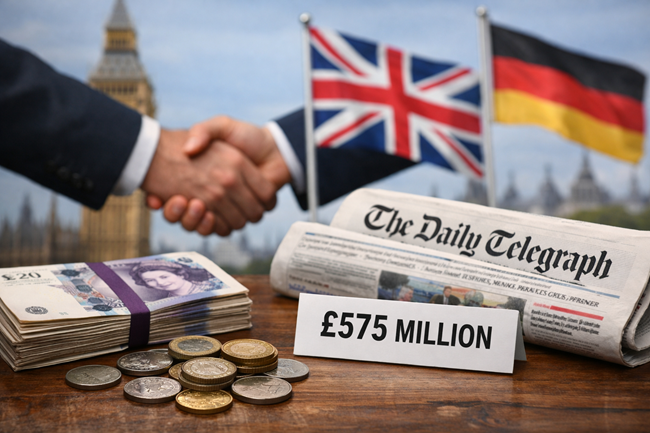
Berlin-headquartered Axel Springer SE has agreed to acquire Telegraph Media Group Holdings from RedBird IMI for 575 million pounds ($766.3 million) in an all-cash transaction, the German media company announced on 6 March 2026. The deal ends nearly three years of ownership uncertainty at one of Britain’s most recognised newspaper brands, publisher of the 171-year-old Daily Telegraph, the Sunday Telegraph, and Telegraph.co.uk. The acquisition displaces a rival bid from Daily Mail and General Trust (DMGT), which had itself been facing regulatory scrutiny from the UK Department for Culture, Media and Sport over media plurality concerns. For Axel Springer, the purchase represents its second-largest investment since the company’s founding in 1946, surpassed only by its acquisition of Politico in a deal valued at approximately $1 billion in 2021.
Why did Axel Springer agree to pay 575 million pounds for a newspaper group that has been mired in ownership uncertainty since 2023?
The strategic logic is straightforward, even if the price requires scrutiny. Telegraph Media Group Holdings generated revenue of 279.4 million pounds in 2024, with an operating margin of 20 percent before exceptional items. Digital subscriptions revenue grew 18 percent to 81.1 million pounds in the same period, and the group reported 842,000 digital subscribers out of a total subscription base of 1,086,000 by December 2024. Those figures compare favourably against most legacy print publishers navigating the transition to subscription-led revenue models.
Axel Springer has repeatedly targeted the British market over the past two decades, making unsuccessful approaches for the Telegraph in 2004 and the Financial Times in 2015. The company’s stated mission is to become the leading digital publisher of AI-enabled media in the free world, and its portfolio of Bild, Business Insider, Welt, and Politico reflects a coherent strategy of owning premium editorial assets across the political centre-right of the English and German-speaking markets. The Telegraph, with its conservative-leaning readership and a demonstrated capacity to grow digital subscriptions through two years of ownership chaos, represents exactly the kind of asset that fits that ambition.
Axel Springer chief executive Mathias Dopfner invoked the company’s founding narrative in announcing the deal, noting that Axel Springer established his publishing house in 1946 under a British press licence. That is corporate mythology, but it is also a useful framing device: the acquisition gives a German media group with deep roots in tabloid journalism an anchor in British quality broadsheet publishing, with a combined subscriber base and advertising inventory that can be deployed across Axel Springer’s existing digital infrastructure.
How did the Telegraph ownership saga unfold across three years and three failed bidders before Axel Springer arrived?
The origins of the sale lie in the financial collapse of the Barclay family’s holding structure. In June 2023, the Bermuda-based parent company of Telegraph Media Group entered receivership after failing to service debts of approximately 1.2 billion pounds owed to Lloyds Banking Group. Howard and Aidan Barclay were removed as directors, and the titles were effectively placed under bank control pending a sale.
Abu Dhabi-backed RedBird IMI, a joint venture between US investment firm RedBird Capital Partners and International Media Investments, a vehicle linked to Sheikh Mansour bin Zayed Al Nahyan, vice president of the United Arab Emirates, stepped in by paying off the Lloyds debt and taking a security interest in the business. That move triggered a political reaction in Westminster. The UK government, under the then-Conservative administration, introduced legislation restricting foreign state-linked entities from owning more than 15 percent of British newspapers. RedBird IMI was forced to seek a buyer.
RedBird Capital Partners then attempted to acquire the Telegraph for 500 million pounds in May 2025, with IMI retaining a capped minority stake. That bid collapsed in November 2025 after a slower-than-expected regulatory process and vocal opposition from senior figures within the Telegraph newsroom, concerned about the possibility of Chinese political influence following a reported meeting between RedBird’s chairman and a senior Chinese government official. Daily Mail and General Trust subsequently agreed terms with RedBird IMI to acquire the Telegraph, a proposal that ran into immediate resistance from Culture Secretary Lisa Nandy, who ordered a competition investigation over media plurality concerns given DMGT’s existing ownership of the Daily Mail, The i, and Metro. Axel Springer’s arrival in early March 2026 displaced that process entirely.
The total cost of the ownership saga to the Telegraph itself has been substantial. By the end of 2024, the group had paid 31.1 million pounds in exceptional costs related to the takeover process, comprising 18.3 million pounds in 2023 and a further 12.8 million pounds in 2024. That figure was continuing to accumulate into 2025.
What does the Axel Springer acquisition mean for the Telegraph’s competitive position in British and global media markets?
The most consequential element of Axel Springer’s stated strategy is its intent to use the Telegraph as a platform to compete in the United States. Axel Springer already operates Business Insider and Politico with meaningful American audiences, and the combination of a British broadsheet brand with a conservative editorial identity and a subscriber base approaching 1.1 million could, in theory, be repositioned as a transatlantic product aimed at centre-right readers in both markets. That is a different strategic bet from the one being made by the New York Times, which has pursued general-interest aggregation through The Athletic and Wordle, or the Financial Times, which operates as a premium global business title.
Whether the Telegraph’s audience, which is heavily weighted towards older, British readers, translates into a commercially viable American subscriber base is genuinely uncertain. Axel Springer’s track record in cross-border digital publishing is better than most: Politico operates credibly on both sides of the Atlantic, and Business Insider, despite a turbulent editorial period, retains a substantial global digital footprint. But the Telegraph brand carries limited recognition in the United States, and building it would require sustained investment in new editorial hires, product development, and marketing at a time when digital advertising conditions across the industry remain difficult.
For existing Telegraph competitors in the UK market, most notably The Times and The Sunday Times, The Guardian, and The Daily Mail, the change in ownership removes a period of strategic drift that had constrained the Telegraph’s ability to invest. The group had been unable to finalise a meaningful five-year plan while its ownership remained unresolved. Under Axel Springer, a company with a 2024 partnership with Microsoft integrating advertising technology across Politico and a track record of deploying AI-driven monetisation tools, the Telegraph’s commercial operations are likely to be reconfigured relatively quickly.
What regulatory hurdles remain before the Axel Springer and Telegraph Media Group deal can be completed, and how significant is the foreign ownership question?
The transaction remains subject to approval from the UK Department for Culture, Media and Sport. Both parties have signalled confidence that the deal complies with the UK’s Foreign State Influence regime, the legislation introduced to block state-backed entities from controlling British newspapers, and RedBird IMI characterised the regulatory path as straightforward. Axel Springer is a privately held, family-controlled German media company, not a state entity, which removes the primary concern that torpedoed the earlier RedBird IMI bid.
The more nuanced question is whether the DCMS review will examine media plurality more broadly. Axel Springer does not currently own any UK national newspaper titles, which means the deal is unlikely to raise the same competition concerns that undermined the DMGT bid. However, the government retains discretion to consider a broader range of public interest considerations in media transactions, and the political environment around press ownership remains sensitive following three years of parliamentary debate over the Telegraph sale.
Freshfields is acting as legal adviser to Axel Springer, and boutique investment bank LionTree served as financial adviser. The companies have stated they look forward to discussions with DCMS and other stakeholders in the coming weeks, suggesting a timeline measured in months rather than weeks before completion can be expected. RedBird IMI confirmed it is working closely with the UK government to obtain the necessary approvals.
How does the 575 million pound valuation reflect Telegraph Media Group’s underlying business performance and what are the risks for Axel Springer?
At 575 million pounds, Axel Springer is paying approximately 2.05 times the Telegraph’s 2024 revenues of 279.4 million pounds and roughly 10.5 times operating profit before exceptional items of 54.6 million pounds. That is a premium to most comparable legacy print-to-digital transitions, but a discount to pure digital subscription businesses. The valuation implies a belief that digital subscription revenue, which grew 40 percent over the two years to 2024, can continue compounding at meaningful rates under new ownership with genuine investment capacity.
The risks are real. Print revenue continued its structural decline in 2024: print subscriptions fell 5 percent to 69.4 million pounds, circulation revenue dropped 3 percent to 55.8 million pounds, and print advertising declined 13 percent to 29 million pounds. The Telegraph was also affected by Google’s algorithm changes and the arrival of AI-generated summaries at the top of search results, which reduced traffic to the site and were cited as a factor in the group’s 10 percent decline in other revenue categories. These are industry-wide challenges, but they are more acute for a title whose historical digital strategy relied on search-driven discovery of paywalled content.
There is also execution risk inherent in the integration of a British newsroom into a German corporate structure. Axel Springer’s track record with editorial independence at Business Insider has been mixed, and Telegraph staff have twice in three years mobilised newsroom resistance against proposed ownership structures they found politically or commercially objectionable. Dopfner’s invocation of journalistic independence and Fleet Street heritage is necessary corporate signalling, but sustaining editorial trust through a significant ownership transition requires more than rhetoric.
Key takeaways: what the Axel Springer acquisition of Telegraph Media Group means for British media, European publishing, and the digital news industry
- Axel Springer is paying 575 million pounds in cash for a business generating 279.4 million pounds in annual revenue and a 20 percent operating margin, valuing the Telegraph at a meaningful premium to legacy print peers but anchored in compounding digital subscription growth.
- The deal ends nearly three years of ownership uncertainty that cost the Telegraph at least 31.1 million pounds in exceptional advisory and transaction costs and prevented the business from pursuing a coherent long-term investment strategy.
- Axel Springer’s stated intent to make the Telegraph the leading centre-right media outlet in the English-speaking world signals an ambition to compete directly with the New York Times and Financial Times in the transatlantic premium subscription market, not simply maintain a British broadsheet.
- The US expansion thesis rests on the credibility of Politico and Business Insider as Axel Springer transatlantic brands, but the Telegraph carries limited brand recognition in North America and building it will require sustained investment beyond the acquisition price.
- For DMGT, the collapse of its Telegraph bid removes the operational synergies of approximately 40 to 50 million pounds estimated by analysts and leaves the Daily Mail publisher to pursue its digital strategy with a subscription base of around 325,000, significantly smaller than the Telegraph’s 842,000 digital subscribers.
- The deal’s regulatory profile is materially cleaner than the three failed bids that preceded it: Axel Springer is a private, family-owned entity with no state connections, removing the foreign state influence question that blocked RedBird IMI and the plurality concerns that complicated the DMGT process.
- Telegraph Media Group’s digital subscription revenue grew 40 percent over two years to 81.1 million pounds in 2024, a trajectory that justifies the premium but also creates an expectation of continued compounding that the business must now deliver without the cover of ownership uncertainty as an excuse.
- The print revenue decline accelerating across all metrics in 2024, combined with the impact of AI summaries on search-driven traffic, underlines that Axel Springer is acquiring a business in active structural transition, not a stable asset generating predictable returns.
- Axel Springer’s 2024 partnership with Microsoft to integrate advertising technology across its portfolio, including Politico, suggests the Telegraph’s commercial operations will be reconfigured into that infrastructure, with implications for advertising yield, data strategy, and programmatic revenue.
- The deal reshapes the competitive dynamics of British national newspaper ownership, removing the prospect of a DMGT-Telegraph combination that would have concentrated significant circulation and digital audience in a single group, and instead placing the Telegraph under a well-capitalised European operator with an explicit growth mandate.
Share this:
Discover more from Business-News-Today.com
Subscribe to get the latest posts sent to your email.

