

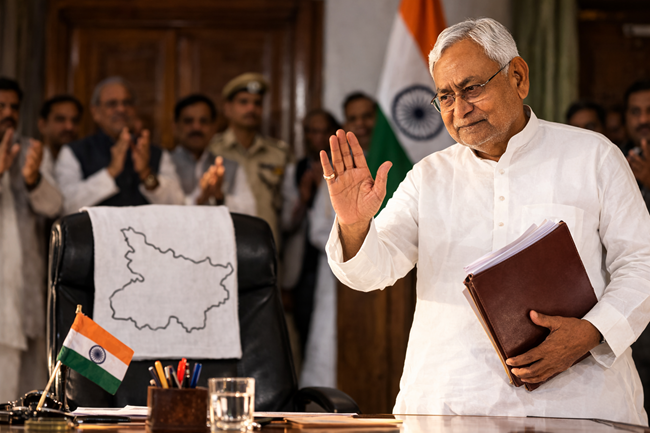
Janata Dal (United) president and Bihar Chief Minister Nitish Kumar formally filed his nomination papers for the upcoming Rajya Sabha elections on Thursday, March 5, 2026, confirming a transition that would end his two-decade dominance of Bihar’s state government and open the door for the Bharatiya Janata Party to hold the office of Chief Minister in the state for the first time in its history.
Kumar filed his nomination before the Secretary of the Bihar Legislative Assembly Office Cell in the presence of Union Home Minister Amit Shah and the two Deputy Chief Ministers of Bihar, Samrat Chaudhary and Vijay Sinha. The Bihar administration had issued directions restricting media access to the state assembly ahead of the filing, citing security and the sensitivity of the occasion, a move that political observers in Patna described as an effort to manage the optics of a contentious political change.
In a post on the social media platform X on Thursday, Kumar said that from the very beginning of his parliamentary career, he had carried a personal aspiration to become a member of both Houses of the Bihar Legislature as well as both Houses of Parliament. He said this long-standing goal had guided his decision to seek a Rajya Sabha seat in the current election cycle. He assured the people of Bihar that his relationship with them would continue and that the new government to be formed in the state would have his full cooperation and guidance.
Fewer than four months have passed since Kumar was sworn in as Chief Minister of Bihar for a record tenth time, following the National Democratic Alliance’s landslide victory in the November 2025 Bihar Assembly elections. The National Democratic Alliance won 202 of the 243 seats in the Bihar Legislative Assembly. The Bharatiya Janata Party emerged as the single largest party in the alliance, winning 89 seats, while the Janata Dal (United) was reduced to 85 seats, the first time the Janata Dal (United) trailed its coalition partner in seat count within Bihar.
Party sources confirmed that Kumar is likely to remain Chief Minister until the Rajya Sabha election scheduled for March 16, 2026, after which he is expected to resign from the state government post. Five Rajya Sabha seats from Bihar are up for election as the terms of sitting members expire on April 9, 2026. The vacating members include Janata Dal (United) leaders Harivansh Narayan Singh, who is also Deputy Chairman of the Rajya Sabha, and Ram Nath Thakur, Union Minister of State for Agriculture and Farmers’ Welfare. The terms of Rashtriya Lok Morcha president Upendra Kushwaha and Rashtriya Janata Dal members Prem Chand Gupta and Amarendra Dhari Singh are also concluding. In the 243-member Bihar Legislative Assembly, a candidate requires the support of 41 legislators to secure election to the Rajya Sabha.
Other National Democratic Alliance leaders who filed nominations on Thursday include Bharatiya Janata Party national president Nitin Naveen, Shivesh Kumar, and Upendra Kushwaha of the Rashtriya Lok Morcha.
What does Nitish Kumar’s move to the Rajya Sabha mean for Bihar’s political succession and coalition dynamics?
With Kumar’s exit from the Chief Minister’s post now anticipated, political attention in Patna and New Delhi has shifted to the question of succession within Bihar’s ruling coalition. The Bharatiya Janata Party, as the single largest party in the Bihar Legislative Assembly, is expected to claim the Chief Minister’s office. Several Bharatiya Janata Party leaders are considered frontrunners. Deputy Chief Minister Samrat Choudhary, who also holds the Home Affairs portfolio in the state government and is a former Bihar Bharatiya Janata Party president, is widely regarded as the leading candidate. Union Minister of State for Home Affairs Nityanand Rai, known to be close to Union Home Minister Amit Shah and representing the Yadav community, is another frontrunner. Patna Digha Member of the Legislative Assembly Sanjeev Chaurasia is also being discussed in party circles.
Political observers noted that the Bharatiya Janata Party’s choice for Chief Minister would prioritise caste representation and coalition stability, with the party expected to nominate a leader from a backward caste or extremely backward caste community in keeping with Bihar’s complex social landscape and electoral arithmetic. Political commentator Nawal Kishore Choudhary stated that the change would constitute a regime shift in Bihar after 20 years.
Under the anticipated coalition arrangement, the Bharatiya Janata Party would lead the state government while the Janata Dal (United) would receive two Deputy Chief Minister positions. Senior Janata Dal (United) sources confirmed that Kumar’s son, Nishant Kumar, is expected to enter active politics, with discussions ongoing about whether he would be given a Deputy Chief Minister designation. Senior Janata Dal (United) leader and minister Vijay Kumar Choudhary stated publicly that whatever was unfolding had Kumar’s consent and that the decision rested solely with the Chief Minister.
Why is Bihar significant as the only Hindi heartland state without a BJP chief minister?
Bihar has been the only state in India’s Hindi heartland where the Bharatiya Janata Party has never held the office of Chief Minister. Through successive National Democratic Alliance governments in Patna, Kumar served as the public face and administrative head of the coalition while the Bharatiya Janata Party provided legislative support and ministerial presence. The November 2025 Bihar Assembly elections altered this balance significantly. The Bharatiya Janata Party and the Janata Dal (United) contested an equal number of 101 seats each for the first time. The Bharatiya Janata Party exceeded the Janata Dal (United) in seat count, which political analysts in Bihar describe as the formal numerical basis for the party to now assert its claim to the Chief Minister’s post.
Bihar is also nationally significant because of its role in sustaining the National Democratic Alliance government in New Delhi. In the 2024 Lok Sabha elections, the Bharatiya Janata Party won 240 seats, falling short of a majority in the Lok Sabha on its own. The Janata Dal (United)’s 12 Lok Sabha Members of Parliament and the Telugu Desam Party’s 16 emerged as the two most critical coalition partners enabling National Democratic Alliance government formation at the centre. Kumar’s transition to the Rajya Sabha is therefore not a political retirement but a repositioning, ensuring that the Janata Dal (United) retains national relevance while Bihar’s day-to-day administration passes to the Bharatiya Janata Party.
How does Nitish Kumar’s Rajya Sabha bid compare with Bihar’s political history and the Maharashtra precedent?
If elected to the Rajya Sabha on March 16, 2026, Nitish Kumar would achieve a rare legislative distinction: membership in all four legislative bodies in India’s parliamentary and state system. He has previously served in the Bihar Legislative Assembly, the Bihar Legislative Council, and the Lok Sabha. Only three other Bihar political figures have achieved this distinction: former Chief Minister Lalu Prasad Yadav of the Rashtriya Janata Dal, the late Bharatiya Janata Party leader Sushil Kumar Modi, and former Member of Parliament Nagmani Kushwaha.
The circumstances of Kumar’s transition have drawn comparisons with the leadership change in Maharashtra following the November 2024 state assembly elections. In that instance, the Mahayuti alliance contested under then Chief Minister Eknath Shinde’s leadership and secured a decisive victory, but following the result, the Bharatiya Janata Party’s Devendra Fadnavis was installed as Chief Minister. The Bihar sequence follows a comparable pattern, in which a regional party led the election campaign and the Bharatiya Janata Party subsequently moved to claim the executive post once the mandate was secured.
Kumar has served as Chief Minister of Bihar since 2005, barring a brief interval between 2014 and 2015 when Jitan Ram Manjhi occupied the post. He is Bihar’s longest-serving Chief Minister and a founding figure of the Janata Dal (United). His governance record includes the schoolgirls’ cycle scheme, the state-wide liquor prohibition, and sustained development investment in Bihar’s infrastructure, all of which generated significant electoral support particularly among women voters.
What is the opposition’s response to Nitish Kumar’s exit from Bihar’s state government?
The principal opposition parties in Bihar and at the national level reacted sharply to the announcement. The Indian National Congress, through general secretary in charge of communications Jairam Ramesh, described the development as a leadership coup and regime change orchestrated at the highest levels of the central government, calling it a huge betrayal of the mandate of the people of Bihar who had voted in the November 2025 elections.
The Rashtriya Janata Dal, led by Tejashwi Yadav, characterised the move as a betrayal of Bihar’s electoral mandate. Senior Rashtriya Janata Dal leader and Rajya Sabha Member of Parliament Manoj Kumar Jha questioned whether Kumar’s statement on X reflected his own voice, suggesting the language had been crafted elsewhere. A section of Janata Dal (United) supporters gathered outside Kumar’s official residence in Patna to protest, raising slogans in his support and attempting to block the entry of Janata Dal (United) legislators’ vehicles. One Janata Dal (United) leader who led the protesting supporters said the people of Bihar had voted in Kumar’s name and wanted him to continue as Chief Minister.
Bihar minister Sharwan Kumar, responding to questions about Nishant Kumar’s future role, said a senior responsibility would be assigned to him within a day or two, without elaborating further.
Key takeaways: Nitish Kumar’s Rajya Sabha nomination and Bihar’s political transition
- Janata Dal (United) president Nitish Kumar filed his Rajya Sabha nomination on March 5, 2026 in the presence of Union Home Minister Amit Shah, confirming his intention to exit the Bihar Chief Minister’s post after more than two decades in office.
- Kumar is expected to remain Chief Minister of Bihar until the Rajya Sabha election on March 16, 2026, after which a new government is anticipated to be formed with the Bharatiya Janata Party taking the Chief Minister’s post for the first time in Bihar’s history.
- Deputy Chief Minister Samrat Choudhary and Union Minister of State Nityanand Rai are the leading Bharatiya Janata Party contenders for the Chief Minister’s office, with the party expected to nominate a leader from a backward or extremely backward caste community.
- Kumar’s son Nishant Kumar is expected to enter active politics, with discussions ongoing about a possible Deputy Chief Minister designation, though no formal announcement has been made.
- The Janata Dal (United) is expected to retain two Deputy Chief Minister positions under the new coalition arrangement, preserving its influence in Bihar’s government while Kumar exercises national-level oversight from the Rajya Sabha.
Share this:
Discover more from Business-News-Today.com
Subscribe to get the latest posts sent to your email.