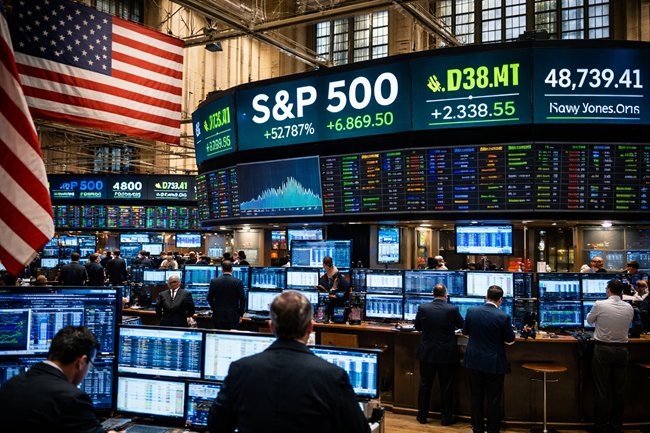
United States equity markets closed higher on Wednesday, March 4, 2026, following a report that Iran had signaled openness to diplomatic talks, and after President Donald Trump announced measures intended to stabilize global oil supply chains disrupted by the ongoing United States and Israeli military campaign against Iran.
The Nasdaq Composite led gains among the three major United States indices, rising 290.79 points, or 1.29 percent, to close at 22,807.48. The S&P 500 gained 52.87 points, or 0.78 percent, to end the session at 6,869.50, remaining close to its all-time closing high recorded in January 2026. The Dow Jones Industrial Average added 238.14 points, or 0.49 percent, to settle at 48,739.41, ending a three-session losing streak.
What triggered the recovery in US stock markets on March 4, 2026, after two days of Iran war volatility?
Wednesday’s recovery followed two days of intense volatility triggered by the commencement of joint United States and Israeli military operations against Iran, designated “Epic Fury,” beginning over the weekend of February 28 to March 1, 2026. The strikes immediately disrupted shipping through the Strait of Hormuz, the narrow waterway through which approximately 20 percent of global crude oil supply transits annually. Iran threatened to block the strait in response to the military action, sending Brent crude oil prices surging more than 10 percent across the prior two sessions, reaching their highest level since January 2025.
The central catalyst for Wednesday’s equity rebound was a report by The New York Times indicating that Iranian intelligence operatives had indirectly reached out to the United States Central Intelligence Agency one day after the initial strikes. The report described the outreach as exploratory, suggesting a possible Iranian willingness to discuss negotiations. United States officials were described as skeptical that either the Trump administration or Iran was prepared for near-term de-escalation. Despite that skepticism, financial markets responded to the signal as a reduction in immediate conflict escalation risk.
This market response followed a well-documented pattern from prior Middle East confrontations. A historical analysis by strategists at Carson Group of 40 major geopolitical events across the past 85 years found that the S&P 500 on average lost 0.9 percent in the first month following such events but recovered 3.4 percent over the subsequent six months. That historical context shaped investor behavior throughout the week, as large institutional participants balanced short-term hedging against selective dip-buying, particularly in technology and growth stocks.
How did Trump’s naval escort announcement and oil market pledges calm investor anxiety on March 4?
President Trump announced on Tuesday, March 3, that the United States Navy would provide escort services for oil tankers transiting the Strait of Hormuz, and that political risk insurance would be made available to vessels using the waterway. Treasury Secretary Scott Bessent separately indicated that additional measures to support Persian Gulf energy flows were under preparation, though he confirmed that broad global tariffs of 15 percent were also set to take effect during the same week.
Brent crude futures settled at approximately 81.40 dollars per barrel on Wednesday, broadly unchanged from the prior session, while West Texas Intermediate crude oil rose fractionally to around 74.66 dollars. After two sessions of oil price gains exceeding 8 percent each day, the stabilization provided material relief to equity markets.
Insurance industry analysts expressed doubt that the naval escort program would immediately restore full tanker traffic through the Strait of Hormuz. A container ship was struck in the waterway during Wednesday’s trading session, underscoring that maritime disruption remained a live risk. The aluminum market was also experiencing strain, with prices rising approximately 14 percent since the start of 2026 and 29 percent over the prior year, driven by reduced Gulf export volumes. Middle Eastern nations account for roughly 10 percent of global aluminum smelting capacity, nearly all of which ordinarily transits the Strait of Hormuz to reach international buyers.
Which technology stocks led the Nasdaq Composite higher during Wednesday’s Wall Street rebound?
Technology stocks were the primary contributors to Wednesday’s advance, continuing their role as the most resilient segment of United States equity markets since the conflict commenced on March 1. Micron Technology and Advanced Micro Devices each gained more than 5.5 percent. Broadcom and Nvidia added more than 1 percent apiece, with Nvidia rising approximately 1.5 percent. Amazon climbed close to 4 percent. Laser manufacturer NLight jumped 6.3 percent, hitting a 52-week high. The Nasdaq Composite has remained in positive territory throughout the conflict period, reflecting investor preference for cash-rich technology companies with limited direct exposure to Middle East energy or logistics chains.
Coinbase Global surged 15.3 percent and Robinhood Markets rose 7.8 percent as bitcoin’s price climbed above 73,000 dollars, its highest level in more than a month. Ross Stores gained 7.4 percent after reporting quarterly profit and revenue exceeding analyst expectations, and said it was entering 2026 with solid operational momentum. Expedia Group rose 3.6 percent. The energy sector led declines within the S&P 500, as oil producers that had rallied on rising crude prices in prior sessions reversed course. ConocoPhillips fell 2.8 percent, Chevron declined 1.42 percent, and Salesforce lost 1.56 percent.
What did the February ADP private payrolls report and services data reveal about US economic resilience?
Two economic data releases provided independent support for United States equity markets on Wednesday. ADP’s February private payrolls report showed that United States employers outside the government sector added 63,000 jobs during the month, exceeding economist estimates of 50,000. The data offered an early signal ahead of the United States Bureau of Labor Statistics’ comprehensive monthly employment report scheduled for release on Friday. A separate index tracking United States services sector activity, covering real estate, finance, and related industries, showed growth accelerating in February at the fastest pace since the summer of 2022. The same report indicated that price pressures within the services sector were easing before the Iran conflict began. Analysts noted that future readings would be needed to determine how higher energy costs were feeding through into the services economy.
Why did South Korean and Asian equity markets collapse while US stocks recovered on March 4, 2026?
Asian equity markets experienced historically severe declines on Wednesday, a sharp divergence from the recovery underway in the United States and Europe. South Korea’s benchmark Kospi index plunged 12.1 percent, its single worst trading session in the exchange’s history, extending a 7.24 percent loss from the prior day. Circuit breakers were triggered on both the Kospi and the Kosdaq, which fell approximately 13 percent. Kospi heavyweights SK Hynix and Samsung Electronics declined 5 percent and 7 percent respectively. Japan’s Nikkei 225 lost 3.6 percent, and Hong Kong’s Hang Seng fell 2 percent.
South Korea and Japan import virtually all of their liquefied natural gas requirements, a substantial portion of which originates from Gulf producers whose export routes normally transit the Strait of Hormuz. The closure or disruption of the strait therefore represents an acute supply threat to both economies in a way that has no comparable parallel in the United States, which has become a net energy exporter. Stock exchanges in Dubai and Abu Dhabi also declined sharply when they reopened following a two-day closure implemented after Iranian drone and missile strikes on the United Arab Emirates. Dubai’s main index fell 4.9 percent, its worst session since May 2022. The Nasdaq Dubai 20 declined 4.3 percent. European markets diverged from Asia, with Germany’s DAX rising 1.7 percent and France’s CAC 40 gaining 0.8 percent.
How does prolonged conflict with Iran threaten Federal Reserve interest rate policy and US economic growth in 2026?
The most significant macroeconomic risk embedded in the Iran conflict for United States monetary policy is inflationary. Higher oil prices increase transportation costs, raise energy bills for households and businesses, and flow through into broader consumer price measures. The Federal Reserve had indicated plans to resume interest rate cuts later in 2026 to support labor market conditions. Persistent or rising energy costs could reduce or delay those cuts, extending a period of relatively restrictive borrowing conditions for United States households and corporations.
Traders pushed back their forecasts for the first Federal Reserve rate cut of 2026 further into the summer following the conflict’s escalation. The yield on the benchmark 10-year United States Treasury note held at approximately 4.06 percent on Wednesday, relatively stable following sharp rises earlier in the week. Richard Bernstein, chief executive officer of Richard Bernstein Advisors, said that if investors concluded the conflict would be short and not materially affect the United States economy, equities would likely continue to recover. He said the reverse was also true: a prolonged conflict that measurably damaged the United States economy could sustain or intensify market volatility. Goldman Sachs chief executive officer David Solomon separately indicated it could take several weeks for markets to fully assess and price the war’s economic impact.
The CBOE Volatility Index, known as the VIX or Wall Street’s fear gauge, fell to approximately 21 on Wednesday, a decline of roughly 10 percent on the day, indicating that traders were assigning somewhat lower probability to severe near-term market disruption relative to earlier in the week, even as the Strait of Hormuz remained partially blockaded and military operations continued.
What does Iran’s diplomatic outreach and the Wall Street rebound on March 4, 2026, mean for global markets and geopolitical risk?
- The Nasdaq Composite gained 1.29 percent, the S&P 500 rose 0.78 percent, and the Dow Jones Industrial Average advanced 0.49 percent on March 4, 2026, reversing two days of losses driven by the United States and Israeli military campaign against Iran.
- A New York Times report that Iranian intelligence operatives made indirect contact with the United States Central Intelligence Agency was the primary catalyst for equity market recovery, even as United States officials expressed skepticism over near-term de-escalation prospects.
- President Trump’s announcement of United States naval escorts for oil tankers in the Strait of Hormuz, combined with political risk insurance provisions and Treasury Secretary Bessent’s pledges on energy market support, stabilized Brent crude at approximately 81.40 dollars per barrel after a two-day surge of more than 10 percent.
- South Korea’s Kospi benchmark index fell 12.1 percent on Wednesday, its worst single-session decline in history, reflecting acute energy import exposure among Asian economies dependent on Middle East liquefied natural gas supply routes through the Strait of Hormuz.
- United States Federal Reserve interest rate cut expectations were pushed further into summer 2026, with traders pricing in the risk that sustained oil price elevation could accelerate inflation and reduce the central bank’s flexibility to lower borrowing costs.
Discover more from Business-News-Today.com
Subscribe to get the latest posts sent to your email.