



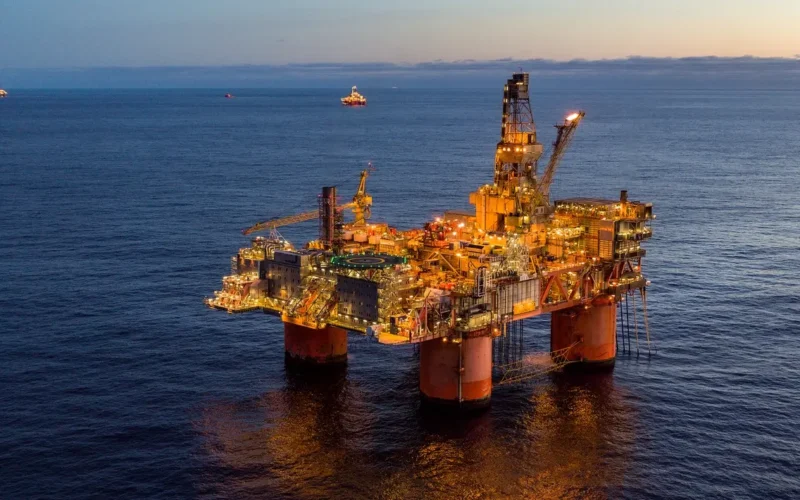
Equinor ASA has announced a commercial oil discovery in the Snorre area of the North Sea and is already planning a rapid subsea tie-back to the Snorre A platform, reinforcing its strategy of near-field exploration to sustain production on the Norwegian continental shelf. The discovery, drilled by the Deepsea Atlantic rig in exploration well 34/4-19 S in Production Licence 057, is estimated at 25 to 89 million barrels of recoverable oil equivalent and will be connected to existing infrastructure. The strategic relevance is immediate: with most infrastructure already depreciated, these barrels are expected to be capital-efficient and fast to market. For Equinor ASA, the development directly supports its ambition to maintain roughly 1.2 million barrels of oil and gas per day from the Norwegian continental shelf in 2035, broadly in line with 2020 levels.
The discovery, located 1.6 kilometres east of the Snorre field and approximately five kilometres from existing subsea facilities, confirms hydrocarbons in the Omega South Alpha prospect. Preliminary volume estimates range between 4 and 14.2 million standard cubic metres, or 25 to 89 million barrels of oil equivalent. Water depth at the site is 381 metres, placing it well within the operating envelope of existing Snorre infrastructure.
Why is Equinor planning field development before formal discovery, and how could this reshape Norwegian subsea project timelines?
A key strategic shift in the Omega South approach is that Equinor ASA and its partners planned development concepts prior to confirming discovery. According to senior executives, the exploration well was drilled through a foundation that can now be reused, along with parts of the well structure, in the final field development. This materially reduces engineering cycles, procurement delays, and installation complexity.
Traditionally, offshore developments on the Norwegian continental shelf have followed a sequential path: discovery, appraisal, concept selection, front-end engineering, investment decision, and then execution. By pre-engineering tie-back concepts and drilling through infrastructure-compatible foundations, Equinor ASA is compressing that timeline to an expected two to three years from discovery to production.
For operators facing declining base production, time compression is not cosmetic. It directly affects net present value. Every year shaved off development reduces exposure to commodity price volatility, regulatory change, and cost inflation. In an environment where European energy security remains politically sensitive, faster barrels also carry geopolitical weight.
If Omega South proves repeatable, it could become a template for smaller, satellite discoveries across mature basins. That matters because the Norwegian continental shelf is increasingly a brownfield story.

How does the Snorre tie-back strategy support Equinor’s 1.2 million barrel per day 2035 production ambition?
The Snorre field has been producing since 1992 and was recently extended through the Snorre Expansion Project in 2020, which added approximately 200 million barrels and pushed field life beyond 2040. The Omega South discovery slots into this extended infrastructure envelope.
Equinor ASA has publicly articulated an ambition to maintain production from the Norwegian continental shelf at roughly 1.2 million barrels of oil and gas per day in 2035, similar to 2020 levels. Achieving that in a mature basin requires continuous infill drilling, satellite tie-backs, and near-field exploration. Approximately 70 percent of future production toward that target is expected to come from new wells and developments, with around 250 exploration wells planned, most near existing fields.
In that context, Omega South is less about headline volumes and more about system efficiency. A 25 to 89 million barrel discovery is material, but not transformative on its own. Its real value lies in capital intensity and integration. When infrastructure is already installed and largely amortised, incremental barrels tend to carry lower break-even prices. That strengthens portfolio resilience in volatile oil markets.
What does this discovery signal about Norway’s role in European energy security as legacy fields decline?
Norway supplies approximately 20 percent of Europe’s oil demand and 30 percent of its gas demand, yet production from existing fields is declining.The policy implication is clear: accelerating new developments tied to existing infrastructure is not simply a commercial decision but a strategic one.
For European policymakers balancing decarbonisation goals with supply security, Norwegian near-field projects offer relatively low-emissions intensity compared to many global alternatives. Reusing subsea facilities and processing through established platforms such as Snorre A reduces incremental environmental footprint compared with greenfield developments.
Equinor ASA executives have framed the Omega South concept as aligned with portfolio optimisation and responsible energy transition goals. In practical terms, that alignment hinges on cost efficiency and carbon intensity per barrel. Brownfield tie-backs typically benefit from shared utilities, electrification where available, and shorter installation campaigns.
The broader industry question is whether such projects can collectively offset natural decline curves across the Norwegian continental shelf. The answer depends on discovery cadence and execution discipline. One fast-track project does not change basin geology, but it can change project economics.
How do partnership dynamics and licence structure influence risk sharing and capital discipline?
The discovery sits in Production Licence 057 with Equinor Energy AS holding 31 percent and operating the licence. Petoro AS owns 30 percent, Harbour Energy Norge AS holds 24.5 percent, INPEX Idemitsu Norge AS holds 9.6 percent, and Vår Energi ASA owns 4.9 percent.
This diversified partnership spreads capital exposure while preserving operational control under Equinor Energy AS. For Petoro AS, which manages the Norwegian state’s direct financial interest, such tie-backs support state revenue continuity. For Harbour Energy Norge AS and Vår Energi ASA, participation strengthens their North Sea portfolio depth without committing to standalone infrastructure.
Shared infrastructure lowers each partner’s capital intensity per barrel. However, it also requires tight alignment on schedules and cost control. Fast-track models reduce flexibility; once development planning is pre-aligned before discovery, partners implicitly commit to rapid sanctioning if volumes meet commercial thresholds.
Execution risk therefore shifts from engineering novelty to coordination and supply chain timing. Subsea hardware reuse and foundation repurposing may reduce cost, but only if engineering validation confirms integrity and performance reliability.
What happens next if the Omega South model proves scalable across the North Sea?
If Equinor ASA can consistently bring satellite discoveries online within two to three years, the Norwegian continental shelf could experience a shift toward modular, repeatable subsea development models. This would favour operators with strong digital subsurface capabilities, pre-engineered tie-back templates, and established processing hubs.
Competitors operating mature North Sea assets will be watching closely. If the cost curve for near-field developments compresses, standalone greenfield projects may face tougher capital allocation scrutiny. Investors increasingly demand capital discipline in upstream portfolios, especially as energy transition pressures intensify.
There is also a second-order supply chain implication. A pipeline of smaller, faster projects could stabilise demand for subsea equipment providers and drilling contractors, including semi-submersible operators like those deploying rigs such as Deepsea Atlantic. Instead of feast-and-famine cycles around mega-projects, activity could become steadier but more fragmented.
The risk scenario is equally clear. If early planning assumptions prove optimistic, or if reservoir performance underdelivers relative to the 25 to 89 million barrel range, fast-track models could amplify disappointment. Pre-engineered concepts reduce flexibility to pivot once a discovery is confirmed. Reservoir complexity always has the final say.
From a macro perspective, the Omega South discovery reinforces a strategic truth about mature basins. The future is unlikely to be defined by giant new fields. It will be defined by disciplined aggregation of smaller, capital-efficient projects that extend infrastructure life while managing decline.
For Equinor ASA, the near-field model is not optional. It is a structural requirement to defend production targets, sustain state revenues, and maintain relevance in European energy security debates. Whether Omega South becomes a blueprint or remains a case study will depend on execution speed, cost containment, and reservoir performance over the next several years.
What are the key takeaways on how the Snorre oil discovery reshapes Equinor’s North Sea strategy?
- Equinor ASA is prioritising pre-planned subsea tie-backs to compress development timelines to two to three years, improving net present value and reducing exposure to price volatility.
- The 25 to 89 million barrel discovery is strategically meaningful because it leverages already amortised infrastructure at Snorre A, lowering break-even thresholds.
- Planning development before formal discovery signals a structural shift toward template-based, repeatable brownfield execution on the Norwegian continental shelf.
- The project directly supports Equinor ASA’s ambition to sustain approximately 1.2 million barrels per day from Norway in 2035.
- Norway’s continued role in supplying 20 percent of Europe’s oil and 30 percent of its gas heightens the geopolitical relevance of fast-track near-field projects.
- Partnership structure in Production Licence 057 spreads financial risk while anchoring operational control with Equinor Energy AS.
- If scalable, the Omega South model could alter capital allocation priorities across the North Sea in favour of smaller, integrated tie-backs over standalone greenfields.
- Execution discipline and reservoir performance remain the principal risks, particularly given compressed planning cycles.
- The broader industry signal is clear: mature basin growth will depend less on mega-discoveries and more on capital-efficient aggregation of incremental volumes.
Discover more from Business-News-Today.com
Subscribe to get the latest posts sent to your email.

