



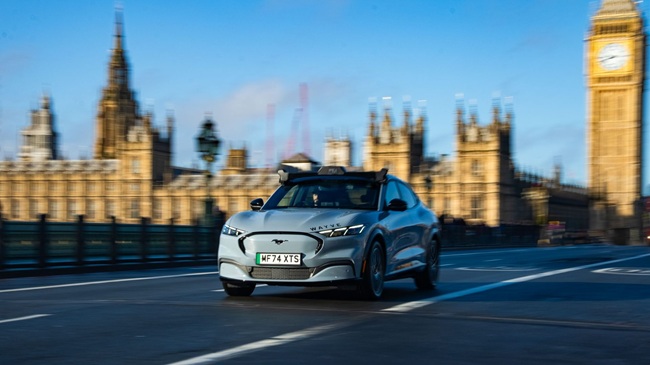
Wayve has secured $1.5 billion in capital, including a $1.2 billion Series D, bringing its post-money valuation to $8.6 billion and marking its transition from research-focused autonomous driving developer to commercial autonomy platform provider.
The round includes participation from Microsoft Corporation, NVIDIA Corporation, Uber Technologies Inc., and global automakers Mercedes-Benz Group AG, Nissan Motor Co Ltd, and Stellantis NV. The funding shifts Wayve’s strategy decisively toward scaled deployment across consumer vehicles and robotaxi fleets starting in 2026.
What changed is not simply the size of the round. It is the composition of the backers and the timing relative to commercial launch. The presence of hyperscale cloud infrastructure, advanced semiconductor supply, global ride-hailing distribution, and legacy automakers in the same cap table signals alignment around Wayve’s end-to-end embodied AI architecture as a viable commercialization pathway.
Why does Wayve’s $1.5 billion raise signal industry convergence around end-to-end embodied AI?
For years, autonomous vehicle development was divided between rule-based, map-heavy stacks and learning-based, data-centric approaches. Wayve positioned itself early around end-to-end neural network training, using foundation models to interpret driving tasks directly from sensor inputs without reliance on high-definition maps.
That approach was once viewed as technically ambitious and commercially uncertain. The latest capital raise suggests that skepticism has narrowed. Institutional investors including SoftBank Vision Fund 2, Ontario Teachers’ Pension Plan, Baillie Gifford, Schroders Capital, and others are not funding a laboratory experiment. They are funding deployment infrastructure.
Microsoft Corporation’s involvement reinforces the compute and cloud backbone required to train and refine large-scale embodied AI models. NVIDIA Corporation’s participation connects Wayve’s software stack to advanced automotive-grade compute hardware ecosystems. Uber Technologies Inc. provides distribution and fleet utilization, reducing the go-to-market friction that has constrained many autonomy programs.
The convergence matters because autonomy economics depend on scale. If an autonomy stack cannot generalize across geographies and vehicle platforms, capital intensity rises sharply. Wayve claims to have driven zero-shot across more than 500 cities in Europe, North America, and Japan within a single year, meaning without city-specific engineering.
That claim, if validated in scaled deployment, directly addresses the long-standing cost bottleneck in robotaxi expansion.
How does the Uber partnership reshape the commercialization path for Wayve-powered robotaxis?
Wayve and Uber Technologies Inc. plan to launch their first commercial robotaxi service in London in 2026, with expansion into more than 10 global markets over time.
Under the partnership, Wayve supplies the AI Driver, while Uber owns and operates the fleet.
This structure is strategically important. Wayve is not vertically integrating into fleet ownership, vehicle manufacturing, or direct-to-consumer mobility operations. Instead, it licenses the AI Driver and embeds within existing ecosystems.
That lowers capital burden relative to fully integrated robotaxi operators. It also distributes execution risk. Uber handles fleet logistics, insurance frameworks, regulatory engagement, and consumer acquisition. Wayve concentrates on autonomy performance and software scaling.
However, this division also creates dependencies. Wayve’s revenue trajectory will hinge on Uber’s willingness to accelerate fleet build-out and on regulatory approvals in urban markets such as London. Robotaxi economics remain sensitive to utilization rates, safety validation milestones, and insurance frameworks. If early deployments underperform, scaling could slow.
What does Wayve’s licensing model mean for Mercedes-Benz, Nissan and Stellantis?
Wayve licenses its AI Driver directly to automakers, enabling deployment from L2+ hands-off systems through L3 and L4 autonomy. This spans supervised consumer features starting in 2027 and potentially driverless capability in defined contexts.
For Mercedes-Benz Group AG, Nissan Motor Co Ltd, and Stellantis NV, the investment is less about minority equity exposure and more about strategic positioning. The automotive industry faces escalating software complexity and increasing competition from vertically integrated electric vehicle manufacturers.
By aligning with Wayve’s unified platform, these manufacturers potentially avoid fragmented autonomy stacks across models and markets. A generalized AI model that can adapt across vehicle architectures could reduce long-term software engineering overhead.
But there are risks. Integration into production vehicles requires compliance validation, hardware harmonization, and long-cycle regulatory approval. Automotive timelines are unforgiving. A slip in readiness or safety validation can delay multi-billion-dollar vehicle programs.
Moreover, reliance on an external autonomy layer introduces supplier concentration risk. Automakers must balance control over core driving intelligence with the cost and feasibility of in-house alternatives.
Is zero-shot deployment across 500 cities commercially meaningful or still a technical proof point?
Wayve’s assertion that it drove zero-shot in over 500 cities across multiple continents is strategically significant.
The autonomous vehicle industry has historically struggled with geographic scalability, often requiring detailed local mapping and engineering adaptation.
If Wayve’s foundation model architecture truly generalizes across urban environments without city-specific fine-tuning, the cost curve for expansion changes materially. That capability could compress the timeline between regulatory approval in one city and deployment in the next.
However, zero-shot testing does not automatically translate to regulatory approval or consumer deployment. Commercial service requires safety certification under national transport authorities, insurance validation, and public trust.
The real test will occur when Wayve moves from controlled evaluation to revenue-generating service in 2026. Investors will watch disengagement rates, safety metrics, and regulatory clearance speed more closely than demonstration claims.
How does this funding round position Wayve within the broader AI infrastructure and mobility ecosystem?
The cap table composition reflects more than mobility ambition. It aligns Wayve with the broader AI infrastructure build-out cycle.
Microsoft Corporation provides cloud compute and model training capacity. NVIDIA Corporation anchors hardware acceleration. Uber Technologies Inc. offers network effects in ride-hailing. Automakers supply production-scale distribution. Institutional investors provide long-term capital.
This multi-layered alignment reduces strategic isolation. It embeds Wayve within the same AI value chain that is reshaping enterprise computing.
For the United Kingdom, the raise also reinforces London and Cambridge as viable AI scale-up ecosystems. UK government officials have publicly framed the round as validation of Britain’s AI sector credibility.
That political support may smooth domestic regulatory pathways for early deployment.
What execution risks could derail Wayve’s path from research leader to scaled platform provider?
Several risk vectors remain.
First, safety validation under L4 deployment conditions is complex. Any high-profile incident during early robotaxi rollout could slow regulatory approvals across markets.
Second, capital intensity remains high despite the licensing model. $1.5 billion provides runway, but autonomy R&D, validation testing, and global expansion are expensive. Additional capital rounds may be required before sustained profitability.
Third, competitive pressure is intensifying. Other autonomy developers are pursuing end-to-end architectures. If larger automotive or technology incumbents develop equivalent foundation models internally, Wayve’s differentiation may narrow.
Fourth, monetization timing remains uncertain. Supervised L2+ features in consumer vehicles from 2027 may generate earlier licensing revenue than full robotaxi fleets, but pricing power and attach rates are unproven at scale.
Finally, regulatory fragmentation across Europe, North America, and Asia could slow uniform deployment.
What happens next if Wayve’s commercialization roadmap executes as planned?
If Wayve successfully launches London robotaxi operations in 2026 and expands into more than 10 markets, the company moves from proof-of-concept to networked autonomy provider.
Supervised autonomy in consumer vehicles from 2027 creates a dual revenue model. One channel monetizes fleet-based ride-hailing deployments. The other monetizes per-vehicle licensing and software updates.
Over time, a continuously improving foundation model trained on diverse global data could create compounding performance advantages. The more vehicles deployed, the more training data collected, and the more robust the model becomes.
If that feedback loop strengthens, Wayve could evolve into a horizontal autonomy layer serving multiple vehicle classes. That would materially increase its total addressable market beyond robotaxis alone.
Conversely, if early deployments stall or safety validation lags, investor patience may narrow. An $8.6 billion valuation assumes credible scaling prospects.
Key takeaways on what Wayve’s $1.5 billion raise means for global autonomous driving competition
- Wayve’s $1.5 billion capital raise marks a shift from research-stage autonomy developer to commercial platform contender.
- Participation from Microsoft Corporation, NVIDIA Corporation, Uber Technologies Inc., and major automakers signals cross-ecosystem alignment.
- The Uber partnership reduces capital burden by separating software development from fleet ownership.
- Licensing to Mercedes-Benz Group AG, Nissan Motor Co Ltd, and Stellantis NV positions Wayve within mainstream automotive production cycles.
- Zero-shot deployment claims across 500 cities, if validated commercially, could lower geographic scaling costs.
- Regulatory approval and safety performance in 2026 robotaxi trials will be the first decisive inflection point.
- Supervised L2+ deployment in consumer vehicles from 2027 diversifies revenue beyond fleet operations.
- Execution risks include safety validation, capital requirements, competitive replication, and regulatory fragmentation.
- An $8.6 billion valuation reflects expectations of platform-level economics rather than pilot-stage experimentation.
- If successful, Wayve could become a horizontal autonomy layer embedded across global vehicle ecosystems rather than a niche robotaxi operator.
Share this:
Discover more from Business-News-Today.com
Subscribe to get the latest posts sent to your email.