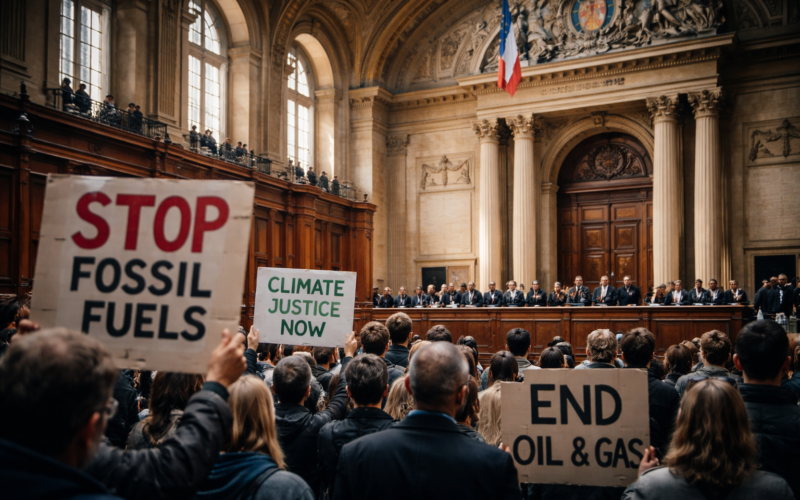
TotalEnergies SE, one of the world’s largest integrated energy companies, is facing a landmark legal challenge in Paris that could force it to halt new oil and gas projects. A coalition of environmental organizations and the City of Paris has asked the Paris Judicial Court to order the company to align its business strategy with climate goals by stopping further fossil fuel expansion, using France’s 2017 duty of vigilance law as the legal basis. The case has emerged as one of the most consequential climate lawsuits yet for the global oil and gas industry, with potential implications for corporate strategy, capital allocation, and investor risk assessment.
The plaintiffs argue that TotalEnergies SE’s continued investment in new oil and gas developments contradicts France’s climate commitments and exposes communities to foreseeable environmental harm. If the court accepts this argument, it would represent a significant escalation in how climate obligations are enforced on multinational corporations, shifting climate risk from a reputational concern to a legally binding operational constraint.
Why the Paris climate lawsuit against TotalEnergies SE could redefine corporate climate accountability in Europe
At the core of the lawsuit is France’s duty of vigilance law, which requires large companies to identify and prevent serious risks to human rights and the environment arising from their activities, including across subsidiaries and supply chains. The plaintiffs contend that climate change constitutes such a risk and that TotalEnergies SE has failed to adequately mitigate it by continuing to pursue new fossil fuel projects.
Unlike previous climate cases that focused on disclosure or long-term net zero commitments, this lawsuit directly challenges the company’s future project pipeline. The plaintiffs are asking the court to intervene not only in how TotalEnergies SE reports climate risk, but in what it is allowed to build and develop going forward. This distinction is critical, because it places the judiciary in a position to influence capital investment decisions traditionally reserved for corporate boards and regulators.

Legal observers see this case as a test of whether climate science can be translated into enforceable corporate obligations under existing commercial law. A ruling in favor of the plaintiffs could open the door to similar litigation against other European energy majors, especially those with active exploration and production portfolios outside Europe.
How TotalEnergies SE’s oil and gas growth strategy is being challenged by climate litigation risk
TotalEnergies SE has publicly positioned itself as a diversified energy company investing in renewables, electricity generation, and low carbon technologies alongside its oil and gas business. However, the plaintiffs argue that the scale and pace of its fossil fuel investments undermine those transition claims. They point to continued spending on upstream oil and gas projects as evidence that the company’s strategy remains misaligned with the Paris Agreement temperature targets.
From a strategic perspective, the lawsuit challenges the balancing act TotalEnergies SE has attempted to maintain between energy transition messaging and hydrocarbons cash flow. Oil and gas still generate the majority of the company’s earnings and fund shareholder returns as well as investments in new energy segments. An enforced halt on new projects would not immediately eliminate production, but it could gradually constrain reserves replacement and long-term output.
This risk introduces a new variable into long-term planning for energy companies. Even if governments continue to approve projects, courts could become an additional gatekeeper, increasing uncertainty around project timelines and future returns.
What the French public prosecutor’s intervention signals about state and corporate climate responsibility
In an unusual move, the French public prosecutor’s office intervened in the case in support of TotalEnergies SE. The prosecutor argued that climate policy is primarily the responsibility of states and legislators, not courts interpreting corporate vigilance obligations. This intervention highlights the tension between judicial activism on climate issues and concerns about separation of powers.
For policymakers, the case exposes a structural gap between climate ambition and enforcement mechanisms. Governments have committed to emissions reductions, but implementation often relies on market forces and voluntary corporate action. Climate litigation attempts to fill that gap, but not without controversy. If courts begin dictating corporate production strategies, it could blur the line between legal oversight and economic governance.
For TotalEnergies SE, the prosecutor’s position provides legal support, but it does not eliminate reputational and strategic risk. The fact that the case has progressed to a full hearing already signals that courts are willing to entertain arguments linking climate harm to corporate duty of care.
How investors and energy markets may interpret the outcome of the Paris lawsuit against TotalEnergies SE
From an investor perspective, the lawsuit introduces a form of regulatory risk that is harder to model than traditional policy changes. Court decisions can be binary and precedent-setting, and they can apply retroactively to existing strategies. While no immediate financial penalties have been imposed, the plaintiffs have requested production reduction targets and compliance deadlines that could materially affect future cash flows.
Institutional investors are increasingly factoring climate litigation risk into their assessment of oil and gas companies, particularly in Europe where legal frameworks are more conducive to such cases. A ruling against TotalEnergies SE could prompt reassessments of long-term valuation assumptions, especially those tied to reserves growth and project optionality.
Even if TotalEnergies SE ultimately prevails, the case may still influence investor expectations by reinforcing the idea that fossil fuel expansion faces rising legal and social constraints. This could accelerate pressure on companies to demonstrate that capital expenditure plans are resilient not only to price volatility, but also to legal and societal scrutiny.
What this lawsuit reveals about the future of climate litigation targeting oil and gas majors
The Paris case against TotalEnergies SE is part of a broader global trend in climate litigation that is shifting from symbolic actions to concrete demands. Plaintiffs are no longer satisfied with emissions disclosures or aspirational targets. Instead, they are seeking court orders that affect real world operations, project approvals, and production levels.
If successful, this approach could reshape how climate risk is internalized within corporate governance. Boards may need to treat climate alignment not just as a strategic or reputational issue, but as a legal compliance requirement. This would have ripple effects across capital allocation, project sanctioning processes, and risk management frameworks.
At the same time, there is a risk of legal fragmentation, where different courts impose different standards, creating complexity for globally operating companies. For energy markets already navigating geopolitical uncertainty, supply security concerns, and transition pressures, this adds another layer of unpredictability.
What happens next if the Paris court rules for or against TotalEnergies SE
The Paris Judicial Court is expected to issue its ruling in the coming months. If the court sides with the plaintiffs, TotalEnergies SE could be ordered to revise its vigilance plan and potentially suspend new oil and gas projects. Such an outcome would almost certainly be appealed, but it would immediately alter the strategic landscape for the company and its peers.
If the court rules in favor of TotalEnergies SE, it would reinforce the limits of judicial intervention in climate matters under current French law. However, it would not end climate litigation risk. Instead, it may prompt lawmakers to strengthen statutes or encourage plaintiffs to pursue alternative legal strategies in other jurisdictions.
Either way, the case marks an inflection point. It signals that the debate over fossil fuel expansion is moving beyond policy forums and into courtrooms, where outcomes can directly constrain corporate action.
What are the key takeaways from the Paris climate lawsuit against TotalEnergies SE for executives and investors
- The lawsuit represents one of the most direct legal attempts to stop new oil and gas projects by targeting corporate strategy rather than emissions disclosure.
- France’s duty of vigilance law is emerging as a powerful tool for climate litigation with potential implications for other European multinationals.
- TotalEnergies SE faces long-term strategic risk even if short-term operations are unaffected by the case.
- Judicial intervention introduces a new layer of uncertainty into oil and gas project development and capital planning.
- Investor sentiment toward European energy majors is increasingly shaped by legal and social license considerations, not just commodity prices.
- A ruling against TotalEnergies SE could accelerate similar lawsuits globally, increasing systemic litigation risk for the sector.
- A ruling in favor of the company would limit immediate legal exposure but would not eliminate climate-related strategic pressure.
- The case underscores a broader shift in how climate accountability is being enforced, moving from voluntary commitments to potential court-mandated constraints.
Discover more from Business-News-Today.com
Subscribe to get the latest posts sent to your email.