



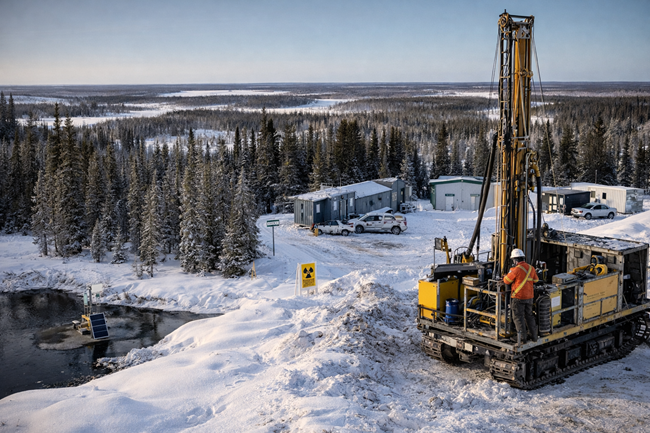
Paladin Energy Ltd (ASX: PDN) has received ministerial approval for the Environmental Impact Statement covering its Patterson Lake South uranium project in Saskatchewan, Canada, clearing a critical provincial regulatory hurdle and materially advancing the project toward construction and federal licensing. The approval moves the shallow, high-grade uranium development out of environmental review and into execution-focused permitting, a transition that carries strategic implications for Paladin Energy Ltd’s asset pipeline, capital planning, and long-term positioning within the global uranium supply chain.
The decision by the Saskatchewan Minister of Environment follows technical acceptance of the Environmental Impact Statement in June 2025 and an extensive public and Indigenous consultation process that ran through the third quarter of the year. With provincial environmental clearance now secured, the Patterson Lake South project enters a narrower and more predictable regulatory corridor, where federal licensing timelines rather than environmental uncertainty become the dominant variable.
Why Environmental Impact Statement approval under Saskatchewan law is a defining de-risking event for uranium projects
Environmental Impact Statement approval under The Environmental Assessment Act of Saskatchewan represents one of the most consequential regulatory milestones for mining developments in the province. Unlike preliminary studies or conditional findings, ministerial approval confirms that a project’s environmental management framework, mitigation strategies, and consultation processes meet provincial standards for development readiness.
For Paladin Energy Ltd, this approval materially reduces the category of regulatory risk that often proves most disruptive to uranium projects. Environmental challenges, community objections, or deficiencies identified late in review can stall projects for years. By clearing this stage, the Patterson Lake South project now benefits from a higher degree of regulatory certainty that investors and lenders typically require before engaging seriously with financing or long-lead procurement discussions.
This approval also enables the project to pursue the additional permits and licences required from both provincial and federal authorities. While further regulatory steps remain, the Environmental Impact Statement approval removes a foundational barrier that would otherwise constrain project sequencing and capital allocation decisions.
How the approval reshapes the Patterson Lake South project timeline and development narrative
Prior to ministerial approval, the Patterson Lake South project remained in a regulatory validation phase, where progress was defined by document review and public consultation rather than tangible development momentum. The Saskatchewan decision marks a transition from assessment to implementation planning, even as federal approvals are still pending.
This shift matters because it allows Paladin Energy Ltd to begin aligning internal technical teams, contractors, and regulatory specialists around a clearer development pathway. Project timelines can now be modeled with fewer binary risks, enabling more realistic scenario planning for construction readiness, workforce mobilization, and capital deployment.
In uranium markets, where development cycles are long and supply responsiveness is constrained, projects that advance steadily through regulatory gates often command greater strategic interest than those with larger but less certain resource profiles.
Why the Canadian Nuclear Safety Commission process now becomes the primary execution risk
With provincial environmental approval secured, the Canadian Nuclear Safety Commission becomes the central regulatory authority governing the project’s next phase. Paladin Energy Ltd is already progressing through the Commission’s licensing framework, including advancing technical documentation in support of its construction licence application.
The Commission’s review process focuses on nuclear safety, radiation protection, environmental stewardship, waste management, and operational controls. While the process is structured and transparent, it is also exacting, and timelines are sensitive to the completeness and robustness of submitted technical materials.
For investors, this phase tends to be less visible than environmental assessment but more decisive for project economics. Delays at the federal licensing stage can affect capital costs, contractor availability, and market timing, while smooth progression can materially improve project credibility and valuation resilience.
What Saskatchewan government support signals about uranium policy stability in Canada
Public statements from Saskatchewan’s political leadership underscore the province’s continued support for uranium development as part of its broader energy and economic strategy. Saskatchewan has long positioned itself as a stable, technically sophisticated jurisdiction for uranium mining, and reaffirmation of that stance carries weight in global nuclear fuel markets.
Government recognition of the Patterson Lake South project’s alignment with provincial growth objectives and environmental safeguards reinforces the perception of regulatory continuity. For uranium developers, this matters because long-life assets require confidence that policy frameworks will remain consistent across political cycles.
Such stability is increasingly valued by nuclear utilities and institutional investors seeking long-term supply security in jurisdictions with predictable governance and permitting regimes.
How Patterson Lake South fits into Paladin Energy Ltd’s broader asset and geographic strategy
Paladin Energy Ltd has described the Patterson Lake South project as economically and strategically important within Canada. The project’s shallow, high-grade characteristics differentiate it from deeper and more capital-intensive uranium developments, potentially offering advantages in development complexity and operating flexibility.
From a portfolio perspective, progress in Canada enhances Paladin Energy Ltd’s geographic diversification and aligns the company with jurisdictions favored by Western nuclear fuel buyers. As global attention returns to uranium supply security, assets located in politically stable regions with strong regulatory oversight tend to attract disproportionate strategic interest.
While production timelines remain dependent on federal approvals, the project’s regulatory advancement strengthens Paladin Energy Ltd’s longer-term optionality and reinforces its relevance in discussions around future uranium supply growth.
How institutional investors are likely to interpret Paladin Energy Ltd’s regulatory de-risking at Patterson Lake South
Environmental approvals rarely produce immediate share price reactions in isolation. However, they contribute to a cumulative de-risking process that institutional investors track closely when assessing development-stage resource companies.
For Paladin Energy Ltd, the Saskatchewan decision removes a category of uncertainty that could have constrained future financing discussions or strategic partnerships. Investors focused on execution discipline rather than speculative exploration upside are likely to view the milestone as evidence of regulatory competence and project governance.
In a sector where capital is increasingly selective, demonstrated progress through complex permitting frameworks can influence investor perception more than short-term commodity price movements.
What happens next if Paladin Energy Ltd executes efficiently through federal licensing
If Paladin Energy Ltd continues to advance smoothly through the Canadian Nuclear Safety Commission licensing process, the Patterson Lake South project could move closer to a construction decision supported by clearer timelines and improved capital market visibility. Efficient execution would strengthen the company’s credibility as a developer capable of navigating stringent nuclear regulatory environments.
Such progress could also enhance Paladin Energy Ltd’s strategic flexibility, whether through self-funded development, project-level financing, or potential partnerships with nuclear fuel stakeholders seeking long-term supply exposure.
What risks remain if regulatory or technical challenges emerge at the federal level
Despite the importance of the Saskatchewan approval, meaningful risks remain. The federal licensing process is detailed and can surface additional technical requirements that extend timelines or increase upfront costs. Requests for supplementary studies or design modifications could defer development milestones and test investor patience.
While such outcomes would not undermine the project’s underlying resource quality, they could delay value realization and heighten sensitivity to uranium market cycles. Managing expectations during this phase will be critical for maintaining market confidence.
Why the Patterson Lake South environmental approval signals a broader inflection point for Canadian uranium development
Beyond its immediate project-level implications, the approval highlights how uranium development in Canada is re-entering an execution phase after years of regulatory inertia. Projects that demonstrate progress through environmental and safety frameworks are likely to shape the next generation of Western uranium supply.
For Paladin Energy Ltd, the Patterson Lake South milestone reinforces its role within that emerging supply narrative and positions the company to benefit if nuclear power continues to gain policy and investor support globally.
Canada’s ability to move uranium projects from assessment into permitting also carries broader implications for capital allocation across the nuclear fuel cycle. As utilities, governments, and financiers increasingly prioritise supply security, jurisdictional reliability becomes as important as resource grade or cost curves. Regulatory follow-through at assets such as Patterson Lake South strengthens Canada’s standing as a dependable supplier within the Western uranium ecosystem, potentially influencing where development capital flows and which projects advance from option value into construction reality.
Key takeaways: What Paladin Energy’s Patterson Lake South approval means for investors and the uranium sector
- Paladin Energy Ltd has secured a critical provincial environmental approval that materially reduces regulatory risk for the Patterson Lake South project in Canada.
- The decision enables the project to advance toward construction and operational permitting, subject to federal licensing.
- Focus now shifts to the Canadian Nuclear Safety Commission as the primary determinant of development timing.
- Saskatchewan’s support reinforces Canada’s standing as a stable, uranium-friendly jurisdiction.
- The approval strengthens Paladin Energy Ltd’s long-term asset diversification and strategic optionality.
- Investor sentiment is likely to view the milestone as incremental de-risking rather than a short-term catalyst.
- Execution through federal licensing will be the key variable shaping valuation upside or delay risk.
- The project aligns with renewed global interest in secure, politically stable uranium supply chains.
Share this:
Discover more from Business-News-Today.com
Subscribe to get the latest posts sent to your email.