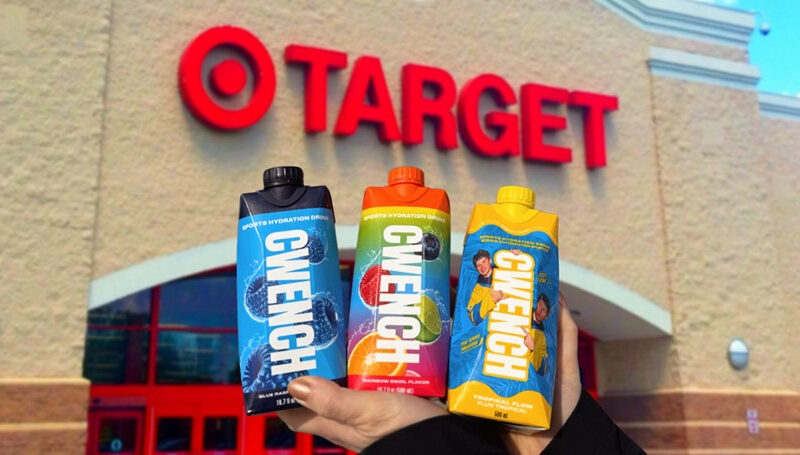
Cizzle Brands Corporation (Cboe Canada: CZZL) (OTCQB: CZZLF) announced that its CWENCH Hydration sports drink has launched in 109 Target Corporation stores across the United States, marking the company’s first national retail listing in the country. The placement immediately shifts Cizzle Brands Corporation from a regional and specialty-led U.S. presence into the competitive mass retail hydration arena, with implications for scale, supply discipline, and brand validation.
The move matters not because of the absolute store count, but because of what Target Corporation represents in the United States consumer packaged goods ecosystem. For emerging beverage brands, Target Corporation is often the first true test of whether a product can survive outside niche communities and controlled distribution environments. CWENCH Hydration is now entering that test phase.
Why securing shelf space at Target Corporation changes the strategic trajectory for Cizzle Brands Corporation
Target Corporation operates close to 2,000 stores nationwide and plays a gatekeeping role in mainstream consumer adoption, particularly for functional beverages positioned between traditional sports drinks and wellness-focused hydration products. Entry into Target Corporation’s isotonic and sports drink aisle places CWENCH Hydration directly alongside incumbents with decades of consumer recognition, pricing power, and promotional budgets.
For Cizzle Brands Corporation, this is not simply a distribution milestone but a strategic escalation. Until now, CWENCH Hydration’s United States exposure has been shaped by controlled environments such as fitness clubs, select regional grocers, and community-driven team sales. These channels allow brand storytelling and grassroots loyalty to compensate for limited national visibility. Target Corporation removes that insulation. The product must now win on packaging clarity, shelf velocity, repeat purchase behavior, and operational reliability.
From an industry standpoint, this move signals that Cizzle Brands Corporation believes CWENCH Hydration has crossed the threshold from community brand to scalable consumer packaged goods asset. That belief will now be validated or challenged in real time.

How regional rollout strategy reflects an attempt to de-risk national retail execution
The initial Target Corporation rollout is concentrated in the Northeast and Midwest regions, areas where Cizzle Brands Corporation has already invested heavily in brand-building through hockey and lacrosse communities. This geographic focus is not incidental. It reflects a deliberate attempt to reduce execution risk during the most fragile phase of national retail expansion.
Retail data repeatedly shows that early velocity in familiar markets strongly influences whether national listings are expanded, reduced, or discontinued. By anchoring the launch in regions where CWENCH Hydration already benefits from word-of-mouth familiarity, Cizzle Brands Corporation is attempting to tilt early performance metrics in its favor.
This approach also aligns with Target Corporation’s internal merchandising logic, which increasingly emphasizes data-driven regional testing rather than uniform national rollouts. Success in these regions could open the door to broader store penetration. Underperformance would limit exposure while containing downside.
What the acquisition of the CWENCH Hydration Factory signals about supply-side readiness
One of the quiet but strategically significant elements behind this launch is Cizzle Brands Corporation’s acquisition of the CWENCH Hydration Factory. Vertical integration in beverage manufacturing is capital intensive and operationally demanding, particularly for companies still in the early stages of U.S. expansion.
The decision suggests that management anticipates volatility in demand and wants direct control over production scheduling, quality assurance, and packaging flexibility. For mass retailers such as Target Corporation, supply consistency is not negotiable. Out-of-stock events, packaging errors, or delivery delays can quickly jeopardize shelf allocation.
Owning production capacity does not eliminate risk, but it does shift it from external dependency to internal execution. Investors and industry observers should view this acquisition less as a margin play and more as an insurance policy against scale-related failure.
Why the United States hydration market remains both attractive and unforgiving
The functional hydration segment in the United States continues to grow, driven by consumer shifts toward lower sugar content, added electrolytes, and perceived performance benefits. However, growth has not reduced competition. If anything, it has intensified it.
Legacy sports drink brands retain dominance through distribution muscle and price promotions, while newer entrants differentiate through ingredient narratives, influencer marketing, and lifestyle positioning. CWENCH Hydration’s formulation and branding place it squarely in the middle of this spectrum, appealing to families and amateur athletes rather than elite endurance niches or purely wellness-driven consumers.
That positioning offers volume potential but also exposes the brand to substitution risk. Consumers in mass retail environments are less loyal than those in specialty channels. Winning shelf presence is only the first step. Sustaining it requires repeat purchase economics that work at scale.
How partnerships with amateur sports organizations translate into retail credibility
Cizzle Brands Corporation has invested heavily in partnerships with amateur sports organizations including USA Hockey, USA Lacrosse, and multiple state-level hockey associations. These relationships have helped build authenticity within tightly knit sports communities, particularly among youth athletes and their families.
The Target Corporation launch converts that credibility into visibility. Parents who already recognize the brand from tournaments and training facilities now encounter it during routine shopping trips. This overlap between community presence and retail access is a meaningful advantage, but it is not automatic.
Retail success depends on whether that recognition translates into impulse purchases and habitual use beyond organized sports settings. If CWENCH Hydration remains perceived as a team-only product, growth may plateau. If it successfully broadens into everyday hydration occasions, the upside expands materially.
How investors are assessing execution risk, revenue visibility, and valuation discipline at Cizzle Brands Corporation
As a publicly traded microcap, Cizzle Brands Corporation operates under a different investor lens than private beverage startups backed by venture capital. Market participants tend to scrutinize execution milestones rather than brand narratives.
The Target Corporation listing provides a tangible data point that can anchor valuation discussions. However, it also raises expectations around revenue visibility, working capital management, and inventory discipline. Retail expansion often precedes profitability, and investors will watch closely for signs that growth is being purchased at unsustainable cost.
Short-term share price reactions, if any, should be interpreted cautiously. The more meaningful signal will emerge over subsequent quarters as sell-through data, reorder frequency, and geographic expansion trends become visible.
What this launch suggests about broader consolidation and gatekeeping in sports hydration
The CWENCH Hydration rollout underscores a broader reality in the sports hydration market. National retailers increasingly act as arbiters of which brands move from niche relevance to mainstream presence. Digital-native success and community-driven growth are no longer sufficient on their own.
For emerging brands, the path to scale increasingly runs through a small number of retail gatekeepers. Those who secure early footholds gain optionality for future partnerships, acquisitions, or expanded listings. Those who fail often retreat back to niche channels with diminished momentum.
In that context, Cizzle Brands Corporation has crossed an important threshold. The outcome remains uncertain, but the strategic direction is now unambiguous.
What happens next if CWENCH Hydration succeeds or struggles at Target Corporation
If CWENCH Hydration demonstrates strong velocity and reorder rates, Cizzle Brands Corporation could leverage this success to negotiate broader store coverage, additional product formats, or expanded shelf placement. The company would also gain credibility in discussions with other national retailers.
If performance falls short, the implications are not existential, but they are instructive. Management would need to reassess pricing strategy, packaging communication, or channel focus. A failed mass retail test often clarifies where a brand truly belongs.
Either way, the Target Corporation launch transforms CWENCH Hydration from an emerging brand story into a measurable execution case study.
Key takeaways: what Cizzle Brands Corporation’s Target Corporation launch signals for investors and the sports hydration market
- Entry into 109 Target Corporation stores marks Cizzle Brands Corporation’s first true test of mass retail scalability in the United States.
- The regional focus on the Northeast and Midwest reflects a deliberate attempt to de-risk early retail performance using existing brand equity.
- Ownership of the CWENCH Hydration Factory highlights management’s emphasis on supply reliability rather than short-term margin expansion.
- CWENCH Hydration’s positioning targets families and amateur athletes, offering volume potential but exposing the brand to substitution risk.
- Target Corporation’s shelf placement forces CWENCH Hydration to compete directly with entrenched incumbents on velocity and repeat purchase behavior.
- Amateur sports partnerships provide authenticity but must now translate into everyday consumer habits beyond organized sports.
- Investor focus will likely shift from narrative growth to execution metrics such as sell-through, inventory turnover, and working capital discipline.
- Success could unlock broader national listings and strategic optionality, while underperformance would clarify the brand’s natural market limits.
Discover more from Business-News-Today.com
Subscribe to get the latest posts sent to your email.