




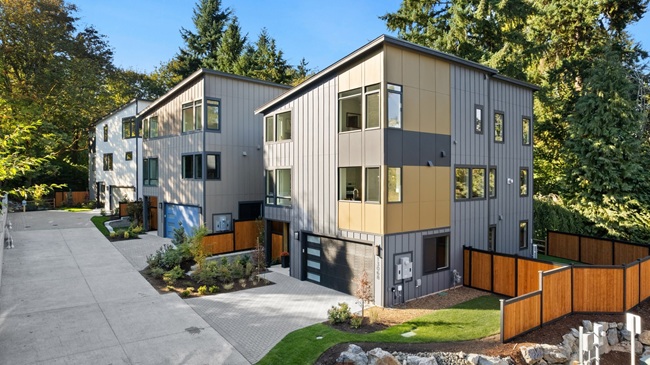
Conner Homes has opened Richards Ridge, a four-home luxury single-family community in Bellevue, with pricing starting just under $2.4 million and immediate move-in availability, signaling a deliberate push into one of the Pacific Northwest’s most supply-constrained high-income submarkets. The launch positions Richards Ridge as a low-volume, high-margin project aimed at senior professionals tied to the Bellevue, Redmond, and Seattle employment corridor rather than at broad speculative demand.
How does the Richards Ridge launch reflect Conner Homes’ capital allocation strategy in a high-rate housing market?
Richards Ridge is notable less for its scale than for its restraint. With only four homes brought to market, Conner Homes appears to be optimizing capital exposure rather than pursuing volume growth in an environment where interest rates, construction costs, and buyer selectivity remain elevated. For a privately held regional builder, the decision to deploy capital into a tightly scoped enclave suggests confidence in micro-location fundamentals while limiting balance-sheet risk if absorption slows.
Unlike large national builders that rely on extended subdivision pipelines and standardized product, Conner Homes is effectively treating Richards Ridge as a boutique asset. Immediate availability reduces carry risk, while the limited unit count allows pricing discipline to be maintained without the need for aggressive incentives. This approach aligns with a broader shift among local builders toward smaller, faster-turn projects that preserve margin integrity rather than chasing scale in an uncertain macro backdrop.
Why does Bellevue’s executive housing corridor continue to attract premium single-family development despite affordability pressures?
Bellevue remains one of the most structurally resilient housing markets on the U.S. West Coast, driven by persistent executive employment density, constrained land availability, and zoning limitations that restrict new single-family supply. Richards Ridge sits within commuting reach of downtown Bellevue, Redmond, and Seattle, areas anchored by technology, professional services, and corporate headquarters, including major employers such as Amazon.
While affordability challenges have cooled demand in many suburban markets, Bellevue’s buyer pool skews toward dual-income households and senior professionals with substantial equity buffers. For this demographic, proximity, privacy, and turnkey quality often outweigh price sensitivity. Conner Homes’ decision to price Richards Ridge above $2.3 million reflects confidence that this buyer segment remains active, particularly for move-in ready homes that eliminate construction delays and uncertainty.
What does the ultra-low unit count reveal about demand targeting and absorption risk management?
By limiting Richards Ridge to four homes, Conner Homes effectively removes the risk of prolonged absorption that can erode returns in luxury developments. Each unit becomes a discrete sale rather than part of a long tail of inventory that must be financed and marketed over multiple quarters. This structure also allows the builder to maintain negotiating leverage, as buyers have fewer alternatives within the same development.
From an execution standpoint, this strategy reduces exposure to shifts in buyer sentiment or sudden changes in financing conditions. If demand softens, the carrying cost impact remains contained. If demand remains firm, the builder benefits from rapid turnover and capital recycling into future projects. For a local builder with multiple communities in its pipeline, this model prioritizes flexibility over headline growth.
How does product specification factor into pricing power in Bellevue’s luxury segment?
Richards Ridge homes are positioned squarely within the executive luxury tier, with floor plans nearing 3,000 square feet and layouts designed to accommodate hybrid work patterns. Lower-level bedrooms with full bathrooms and flexible media room potential reflect evolving buyer preferences for multi-use space rather than purely formal living areas.
While the original announcement highlighted premium appliances and ventilation systems, the more material point for investors and industry observers is how specification supports price anchoring. In Bellevue’s competitive luxury segment, buyers often compare new construction against high-end remodels of older homes. Delivering modern layouts, energy efficiency features, and immediate occupancy allows new builds like Richards Ridge to command a premium without requiring buyers to factor in renovation risk or timelines.
What does Richards Ridge signal about Conner Homes’ positioning versus national homebuilders?
Conner Homes operates in a markedly different strategic lane from national builders focused on scale, standardized products, and broad geographic diversification. Richards Ridge underscores a hyper-local model built around deep familiarity with zoning, buyer behavior, and neighborhood-level demand dynamics in the Seattle-Bellevue region.
This positioning offers both advantages and constraints. On the positive side, local builders can move quickly, tailor product more precisely, and avoid the margin compression often seen when national players discount inventory to maintain volume targets. On the downside, growth is inherently capped by land availability and the builder’s ability to source premium lots at acceptable prices. Richards Ridge reflects a conscious choice to lean into the strengths of local execution rather than compete head-to-head with national operators on scale.
How does immediate move-in availability affect buyer psychology and closing velocity?
Immediate occupancy is increasingly valuable in high-end markets where buyers may be relocating for senior roles or seeking to exit temporary housing arrangements. In contrast to build-to-order projects that can stretch timelines by months, Richards Ridge removes uncertainty around delivery, financing lock-ins, and rate exposure.
For Conner Homes, this approach also accelerates cash conversion. Homes completed and ready for sale shift the business model closer to inventory turnover than long-cycle development. In an environment where financing costs remain elevated, shortening the time between capital deployment and revenue realization can materially improve project economics.
What execution risks remain despite Bellevue’s favorable fundamentals?
Despite strong underlying demand, Richards Ridge is not without risk. Luxury housing remains sensitive to broader financial market conditions, particularly equity market volatility and executive compensation cycles. A sustained downturn in technology hiring or bonus structures could slow buyer activity even in historically resilient submarkets like Bellevue.
There is also the risk of price resistance if comparable inventory increases, whether through resale listings or competing boutique developments. With pricing near $2.4 million, Richards Ridge sits in a narrow band where buyers are highly selective and expect near-flawless execution. Any perceived mismatch between price and value could extend marketing timelines, even if ultimate demand remains intact.
What does this development suggest about near-term trends in Pacific Northwest luxury housing?
Richards Ridge reinforces a broader pattern emerging across the Pacific Northwest: fewer homes, higher price points, and a sharper focus on execution quality rather than volume. Builders appear increasingly unwilling to take on large speculative projects, instead favoring contained developments that can be sold quickly to a defined buyer profile.
For policymakers and urban planners, this trend highlights the persistent tension between housing supply constraints and affordability goals. While projects like Richards Ridge meet demand at the top end of the market, they do little to alleviate broader housing shortages. For builders like Conner Homes, however, the calculus is clear. In a capital-intensive industry, predictability and margin discipline currently outweigh ambitions for scale.
Key takeaways on what the Richards Ridge launch means for Conner Homes and the Bellevue luxury housing market
- Conner Homes is prioritizing margin protection and capital efficiency over volume growth by limiting Richards Ridge to four homes.
- Bellevue’s executive employment base continues to support premium single-family pricing despite broader affordability pressures.
- Immediate move-in availability reduces buyer uncertainty and accelerates cash conversion for the builder.
- Ultra-low inventory acts as a risk management tool by containing absorption exposure in a volatile macro environment.
- Product design reflects post-pandemic demand for flexible living and work-from-home configurations.
- The project underscores the competitive advantage of local builders with deep neighborhood-level expertise.
- Luxury housing demand remains resilient but sensitive to technology sector compensation and equity market trends.
- Richards Ridge illustrates a wider regional shift toward smaller, high-confidence developments rather than large subdivisions.
Discover more from Business-News-Today.com
Subscribe to get the latest posts sent to your email.


