




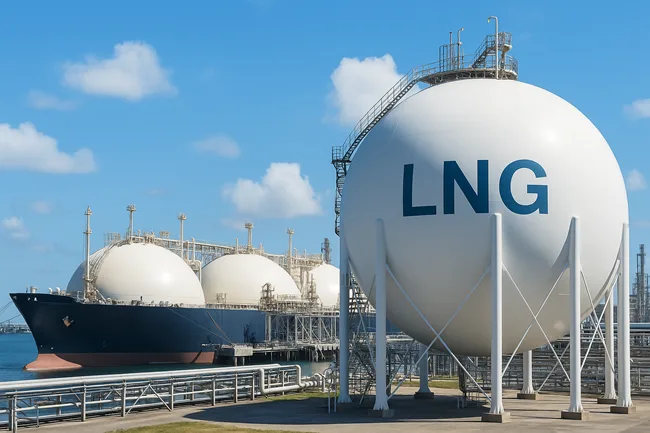
MAIRE S.p.A. (BIT: MAIRE) has marked a strategic expansion into the global liquefied natural gas market through its subsidiary TECNIMONT S.p.A., which has signed a term sheet with Argent LNG, LLC to serve as the integrated engineering partner for a major LNG export project in Port Fourchon, Louisiana. The deal positions TECNIMONT as the engineering lead in the development of a 25 million tonnes per annum (MTPA) modular export facility valued at approximately $18 billion, placing it squarely in the race to support global LNG demand amid shifting energy transition narratives.
The agreement is TECNIMONT’s first formal entry into the U.S. LNG export infrastructure segment, reinforcing MAIRE’s strategy to diversify its Integrated Engineering and Construction (IE&CS) portfolio while leveraging its OEM integration experience and modular execution approach. It also reflects rising institutional appetite for scalable, financeable, and hurricane-resilient LNG assets on the Gulf Coast, with Port Fourchon increasingly emerging as a next-generation energy hub.
Why is TECNIMONT’s entry into U.S. LNG infrastructure strategically significant for MAIRE?
The TECNIMONT–Argent LNG partnership marks more than a commercial win. It formalizes MAIRE’s first operational footprint in the U.S. LNG market and initiates a strategic repositioning of TECNIMONT beyond downstream refining and petrochemicals. The deal aligns with MAIRE’s roadmap to become a multi-vector player in the energy transition by entering high-growth, capital-intensive LNG infrastructure development—a segment previously dominated by engineering incumbents such as Bechtel, McDermott International, and Technip Energies.
What distinguishes this project is not just its scale but its modularity. The facility’s 25 MTPA capacity will be built using a modular design platform aimed at reducing interface risk, expediting construction, and improving cost predictability for final investment decisions (FID). MAIRE’s expertise in integrating Original Equipment Manufacturers (OEMs) like Baker Hughes further enhances its value proposition, signaling a bankable engineering partner profile in an increasingly fragmented global LNG EPC (engineering, procurement, and construction) landscape.
This strategic alignment also gives MAIRE proximity to U.S. policy frameworks around energy security and LNG permitting, especially as the Federal Energy Regulatory Commission (FERC) advances new project approvals against the backdrop of Europe’s supply diversification and Asia’s base-load demand rebound.
How does the TECNIMONT–Argent LNG platform differ from legacy LNG infrastructure models?
The Argent LNG platform is engineered to be fully replicable and scalable across geographies. This is a deliberate deviation from legacy LNG megaprojects, which have traditionally suffered from cost overruns, extended timelines, and rigid engineering architectures. Instead, TECNIMONT’s model relies on modularization, pre-integrated OEM components, and what both parties describe as a “bankable and repeatable” solution. This implies not just technical excellence but financial structuring tailored to attract long-horizon capital.
The phased buildout includes a 20 MTPA base configuration, scalable to 25 MTPA, with an additional dedicated train for LNG bunkering and Offshore Supply Vessel (OSV) fueling. This marine-focused segment adds a decarbonization layer to the Gulf Coast’s maritime logistics footprint, opening doors to new policy-aligned revenue streams such as low-carbon fueling credits and compliance-based incentives under evolving U.S. maritime emissions standards.
Moreover, Port Fourchon’s unique geographic profile—elevated hurricane resilience and existing pipeline connectivity—adds a layer of operational durability that aligns with lender and insurance expectations. The emphasis on modular execution, digitalized project tracking, and OEM-aligned risk management collectively form a blueprint that other midstream players may look to emulate.
What does this reveal about MAIRE’s capital allocation strategy and LNG sector priorities?
For MAIRE, the pivot into LNG is more than opportunistic. It underscores a portfolio rebalancing effort underway across its three core verticals: Sustainable Fertilizers & Nitrogen-Based Fuels, Low-Carbon Energy Vectors, and Circular Solutions. The Argent LNG project aligns most closely with the low-carbon energy vectors portfolio, but also potentially touches the fertilizers segment through synergies in gas-sourced ammonia or hydrogen production, should future phases evolve toward integrated fuel supply chains.
Financially, the move places MAIRE in a position to attract U.S.-based capital partners, public-private partnership frameworks, and possibly sovereign-aligned infrastructure investors seeking reliable LNG export exposure. The company’s listed status on the Borsa Italiana (ticker: MAIRE) also allows for flexibility in raising project-linked capital through equity or convertible instruments, particularly if the project reaches final investment decision ahead of current industry timelines.
TECNIMONT’s scope will span FEED (Front-End Engineering Design) and FERC permitting, both of which are critical gating milestones. The presence of a strong engineering partner at the pre-FID stage de-risks early-stage funding, improves regulatory compliance, and supports bankability metrics that matter to infrastructure funds, debt underwriters, and credit insurers.
How could this affect EPC competition and modular LNG project norms?
The deal introduces a new competitive archetype in the LNG EPC market: a modular-first, OEM-integrated, mid-cap European engineering group operating in partnership with a U.S. LNG challenger. This deviates from the historical dominance of mega-cap EPC firms and may accelerate a shift toward smaller, more agile design–build partnerships that prioritize speed to FID and repeatability over bespoke engineering.
If the Argent LNG platform proves successful—financially, operationally, and from a policy alignment standpoint—it could prompt a reevaluation of how future greenfield LNG terminals are conceptualized. This includes a likely move away from static master-planned designs toward dynamic, plug-and-play formats that minimize overbuild risk and enable expansion in line with demand cycles.
Competitively, this may impact North American peers such as NextDecade Corporation, Sempra Infrastructure, and Venture Global LNG, all of whom are at various stages of modular LNG development along the Gulf Coast. It could also influence how engineering and construction firms recalibrate their offshore LNG strategy, especially those attempting to scale LNG-to-power ecosystems across Asia and Sub-Saharan Africa.
What are the institutional signals behind the project’s early design and stakeholder mix?
The inclusion of a dedicated LNG bunkering and OSV fueling train is not just a technical footnote. It signals a structural intent to align with future maritime decarbonization policies and offers a forward hedge on marine fuel transition regulations such as those being pushed by the International Maritime Organization (IMO). This also places the project in favorable territory for green bond certification or sustainability-linked financing tranches, depending on how the emissions strategy is structured.
Moreover, the stakeholder mix—anchored by Argent LNG’s founder Jonathan Bass, and TECNIMONT’s parent MAIRE—suggests a blend of founder-led vision with institutional engineering rigor. This governance structure is likely to appeal to infrastructure equity investors looking for early-stage access with credible execution partners.
Given the project’s location, U.S. political and permitting stability also becomes a critical factor. FERC and local regulatory engagement will be decisive, particularly as LNG terminals remain a flashpoint in U.S. climate discourse. The project’s emphasis on constructability, integration with proven OEM systems, and FERC-friendly design principles preempts potential resistance and aligns with bipartisan energy security narratives.
What happens next if the collaboration clears permitting and reaches FID?
If TECNIMONT and Argent LNG reach FID in the projected timeline, the project will likely trigger a procurement cascade across modular LNG equipment, OEM components, digitalized EPC systems, and marine fueling infrastructure. Execution risk will shift from engineering design to supply chain coordination, labor mobilization, and local environmental management.
MAIRE’s stock performance may respond to FID visibility, especially if paired with forward disclosures on project revenues, backlog contribution, or capital return profiles. Institutional investors will watch closely for margin signals, as modular EPC margins differ from MAIRE’s traditional downstream portfolio.
If the platform proves scalable as claimed, TECNIMONT could replicate this model across LNG-short geographies including South Asia, Sub-Saharan Africa, or Eastern Europe—unlocking a repeatable revenue engine built on modularity, not mega-scale.
Key takeaways: What the TECNIMONT–Argent LNG deal means for LNG infrastructure and MAIRE’s future
- MAIRE, through TECNIMONT, makes its first strategic entry into the U.S. LNG export infrastructure segment.
- The Argent LNG project is designed to be modular, financeable, and scalable, with a target capacity of 25 MTPA.
- Port Fourchon’s hurricane-resilient location enhances project bankability and reduces infrastructure risk.
- The collaboration leverages TECNIMONT’s experience integrating OEM technologies such as those from Baker Hughes.
- Inclusion of a marine bunkering train signals alignment with maritime decarbonization policies.
- The platform could set a precedent for scalable LNG infrastructure models across emerging markets.
- Institutional appeal is boosted by early engineering engagement, permitting clarity, and modular certainty.
- Competitive implications extend to other LNG developers and EPC firms across the U.S. Gulf Coast.
- Final investment decision will serve as a key inflection point for MAIRE’s balance sheet and sector standing.
- Project success could unlock a new revenue vector for MAIRE in modular LNG beyond the Americas.
Discover more from Business-News-Today.com
Subscribe to get the latest posts sent to your email.
