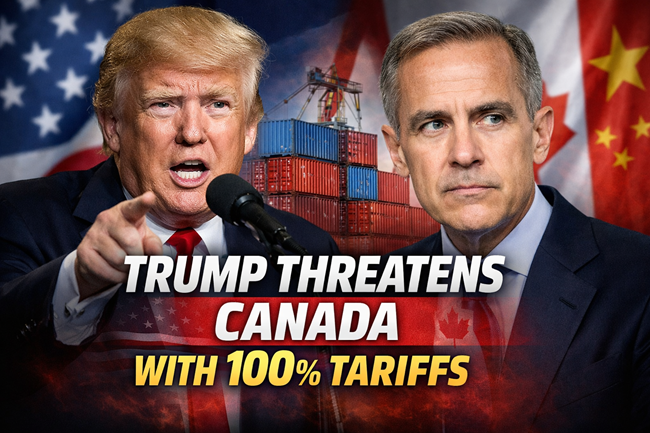
United States President Donald Trump has issued a stark warning to Canada that a comprehensive 100 percent tariff would be imposed on all Canadian imports if Prime Minister Mark Carney moves forward with a recently announced trade deal with China. Trump’s message, delivered via his Truth Social platform, represents one of the most dramatic escalations in United States–Canada relations in recent memory, placing long-standing economic cooperation at the center of a geopolitical confrontation that now involves competitive trade alignments and differing views on global economic order. The president accused China of seeking to use Canada as a conduit to enter the United States market and claimed such a scenario would “completely devour” Canadian industry, social fabric, and the broader economy.
What exactly did President Trump warn about Canada becoming a ‘drop off port’ for Chinese goods and why does he call it dangerous to US economic interests
In a social media post on January 24, Trump warned that if “Canada makes a deal with China, it will immediately be hit with a 100 percent tariff against all Canadian goods and products coming into the U.S.A.” The president specifically used the phrase “drop off port” to describe his concern that Canada could become a logistical gateway for Chinese goods bound for the United States, bypassing existing United States tariffs and protections. Trump argued this dynamic would undermine United States domestic industries and encourage Chinese market influence deep within North American supply chains.
Trump also referred to Prime Minister Carney as “Governor Carney,” a repeated rhetorical choice that echoes his past comments about Canada’s relationship with the United States and political unity. That phrasing has been received by analysts as part of Trump’s broader strategy of using pointed language to assert dominance in bilateral discussions.
What is Canada’s trade deal with China that triggered US tariff threats and how did Ottawa describe it
Canada’s recently announced trade agreement with China, reached during Prime Minister Carney’s state visit to Beijing in mid-January, involves mutual tariff reductions and expanded market access after a period of strained relations between Ottawa and Beijing. The deal includes lowering Chinese tariffs on Canadian canola oil to approximately 15 percent and reducing Canada’s tariffs on Chinese electric vehicles to 6.1 percent, subject to annual import quotas. These measures follow a period when China imposed steep duties on Canadian canola and other products as part of a broader trade dispute.
Canadian officials, including Dominic LeBlanc, the minister responsible for Canada–United States trade relations, have emphasized that the deal with China resulted from resolving “several important tariff issues” and was not a pursuit of a comprehensive free trade agreement with Beijing. Ottawa has described its strategy as diversifying trade partnerships and strengthening Canada’s economic resilience, particularly after years of variable engagement on tariffs with both China and the United States.
How do Canadian officials describe Canada’s trade strategy in the face of US opposition and what messaging has Dominic LeBlanc offered
In response to Trump’s tariff threat, Canada’s government pushed back against the notion that it is pursuing a free trade agreement that would harm relations with the United States. LeBlanc reiterated that Canada’s goal is to build “a stronger Canadian economy” and to bolster trade relationships worldwide, not to undermine the bilateral partnership with its closest neighbor. He described the agreement with China as focused on tariff resolutions rather than a sweeping trade pact.
Canadian officials have also underlined that economic diversification is not only a strategic choice but necessary amid global shifts in manufacturing, supply chains, and geopolitical realignments. While Canada and the United States conducted deep integration under agreements like the United States–Mexico–Canada Agreement, Ottawa now seeks balance by cultivating ties in Asia and Europe in addition to managing its North American partnership.
Why has the relationship between Trump and Carney deteriorated so sharply since the World Economic Forum and how do their world views differ on global alliances
Tensions between Trump and Carney have intensified since their appearances at the World Economic Forum in Davos earlier this month. Carney’s speech there emphasized that the post–Cold War rules-based international order has experienced “a rupture not a transition” and that middle powers should unite to protect their interests amid economic coercion from larger powers. He argued that combining efforts was essential to avoid being “on the menu” in a world where tariffs and supply chains can be used as instruments of leverage.
Trump’s reaction to Carney’s critique was direct. The United States president responded in his own Davos remarks by asserting that “Canada lives because of the United States,” a comment Canadian officials found dismissive and provocative. Carney later strongly refuted that view, insisting that Canada thrives through its own diversity and sovereignty.
This clash of world views represents deeper strategic differences between the leaders. Carney promotes multilateral cooperation and diversified economic partnerships, while Trump continues to emphasize protectionist policies and prioritizing domestic industry and national leverage. The philosophical gap has transformed trade and diplomatic engagement into a broader contest over global economic influence and alliance frameworks.
What broader geopolitical implications arise from the US tariff threat against Canada and how might it affect North American trade stability
Trump’s tariff threat carries broader geopolitical implications for the North American economic order and the stability of trade frameworks that have underpinned regional prosperity for decades. The United States, Canada, and Mexico are bound by the United States–Mexico–Canada Agreement, a cornerstone of continental economic integration. Although Trump has described that deal as “irrelevant,” political and business leaders consider its durability crucial to supply chain certainty and investor confidence.
Imposition of a sweeping 100 percent tariff on Canadian goods would disrupt deeply integrated industries such as automotive manufacturing, machinery, metals, and energy. Canada is a critical supplier of natural resources that support United States manufacturing and national security. Analysts warn that aggressive tariff policies could provoke reciprocal actions, further fracturing economic ties and prompting businesses to reconsider investment strategies across borders.
The escalating rhetoric also influences diplomatic dynamics beyond North America. Canada’s outreach in Asia, for example in markets like China and Australia, reflects a calculated attempt to balance heavy reliance on the United States with expanded cooperation elsewhere. Recent purchases of Canadian canola by Chinese importers, following tariff reductions after Carney’s Beijing visit, illustrate early signs of revived trade flows in Asia.
How is public and institutional sentiment shaping Canada’s response and what voices are emerging in the debate over trade strategy
Public and institutional sentiment in Canada displays a mix of cautious optimism and concern. Business groups see potential in diversified markets but worry about destabilizing repercussions from strained relations with the United States, Canada’s largest trading partner. Critics of Carney’s approach argue that closer ties with China risk undermining national security and economic stability, pointing to past episodes of retaliatory tariffs and diplomatic tensions.
Meanwhile, proponents of diversification stress that long-term economic strategy requires engaging with multiple markets. Canada’s expanded trade cooperation with China, coupled with strengthening relations with countries like Australia, reflects a proactive response to global economic shifts. Institutional voices in Ottawa assert that Canada will continue defending its sovereignty and economic interests, even as it navigates complex pressures from Washington.
As the dispute unfolds, Canada’s scheduled diplomatic engagements, including Prime Minister Carney’s upcoming visit to Australia, may provide further insight into how Ottawa seeks to position itself within trans-Pacific and global trade networks.
What are the prospects for deescalation between the United States and Canada and how might upcoming forums shape the dispute
The prospects for deescalation remain uncertain. Both leaders are expected to speak at regional and international forums in the coming weeks, but no formal bilateral meetings have been announced. Canada continues to emphasize that its trade policies are geared toward economic resilience and partnership diversification, while the United States has signaled a hardline stance rooted in strategic competition with China and protectionist trade priorities.
Analysts believe diplomatic channels and economic consultations may be necessary to prevent a deeper rupture that could destabilize continental trade. The evolving narrative also underscores larger questions about the balance between national sovereignty, alliance commitments, and the influence of rising economic powers in shaping the rules of global commerce.
What are the key takeaways from Trump’s tariff threat over Canada’s China trade deal
- United States President Donald Trump has threatened a 100 percent tariff on all Canadian imports if Canada proceeds with its new trade agreement with China.
- Trump accused Prime Minister Mark Carney of turning Canada into a “drop off port” for Chinese goods, claiming it would destroy Canada’s economy and sovereignty.
- The tariff threat reverses Trump’s earlier supportive remarks and followed Carney’s speech at the World Economic Forum advocating for multilateral cooperation.
- Canada’s trade deal with China includes tariff reductions on canola oil and electric vehicles but is not a full free trade agreement, according to Ottawa.
- Canadian officials, including Dominic LeBlanc, emphasized the deal resolves specific tariff issues and is aimed at economic diversification, not undermining the United States.
- Trump’s threat comes ahead of a scheduled review of the United States–Mexico–Canada Agreement, raising concerns about regional trade stability.
- The dispute marks a sharp deterioration in the personal and diplomatic relationship between Trump and Carney, who differ on trade, diplomacy, and global alliances.
- Canadian business and political leaders are divided, with some warning of economic fallout if United States tariffs are enacted, and others defending diversification.
- Trump’s warning reflects a broader strategy of confronting China-aligned trade moves globally and signals tougher policy lines against traditional allies.
- No bilateral meetings have been announced, but upcoming regional forums may offer a venue for de-escalation or further confrontation.
Discover more from Business-News-Today.com
Subscribe to get the latest posts sent to your email.