



Tumble 22 will officially open its ninth Texas location in Pflugerville on January 31, 2026, bringing its Nashville-style hot chicken and full bar concept to one of Central Texas’s fastest-growing suburbs. Located at 18725 FM 685, across from Target and near Costco, the new restaurant marks a strategic bet on suburban retail growth and further cements the company’s Central Texas expansion strategy. The opening comes with a promotional push, including a free year of sandwiches for early guests.
The move deepens Tumble 22’s regional footprint beyond its Austin-area core and follows prior launches in Cedar Park, Round Rock, Burnet Road, and Lake Austin, as well as Houston and San Marcos. Managing Partner Mike Stockton said the timing was right for Pflugerville, pointing to community demand and a desire to embed local identity into the new location. The launch event doubles as a customer acquisition tool and brand-building moment in a crowded quick-service segment.
Why is Tumble 22 opening a location in Pflugerville now, and what does it signal about Texas food retail trends?
Tumble 22’s entry into Pflugerville taps directly into the retail expansion corridor driven by suburban sprawl, highway adjacency, and a growing population with middle-income buying power. Pflugerville, situated between Austin and Round Rock, has become a magnet for new residential development and retail clusters targeting both commuter families and local weekday foot traffic.
In the broader quick-service restaurant (QSR) landscape, Pflugerville represents a sweet spot for chains that want to test medium-density markets with high repeat traffic and limited saturation. For a brand like Tumble 22, which still positions itself as a regional niche player, Pflugerville offers a semi-urban sandbox where pricing, portion sizes, and menu specials can be tuned for an audience less bound by urban constraints yet still receptive to premium-casual experiences.
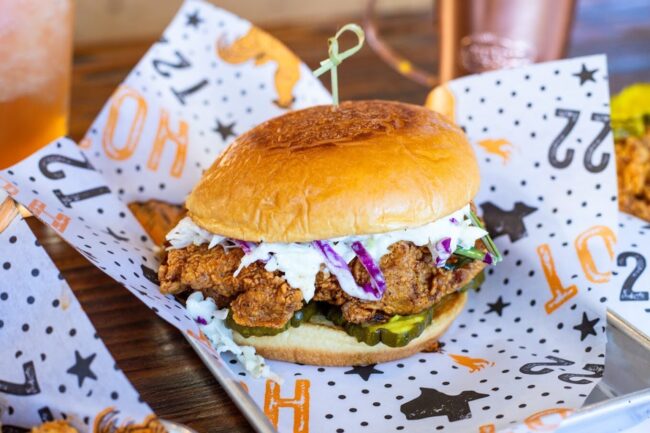
What this expansion signals is that suburban retail corridors like FM 685 are no longer backup locations for regional food brands but are quickly becoming front-line testbeds for new customer engagement models. With its full bar format, branded spice levels, and hybrid dining model, Tumble 22 is clearly angling for a differentiated QSR identity somewhere between a traditional chicken shack and a sit-down gastropub.
How is Tumble 22 positioning itself competitively in Texas’s crowded hot chicken market?
The Texas hot chicken market has grown increasingly competitive in the past three years, with entrants ranging from national names like Dave’s Hot Chicken to franchised operations like Hattie B’s and smaller regional brands. Tumble 22’s strategy appears to be based less on speed of scale and more on deliberate regional dominance with local roots. Originating as a food truck in Austin, the brand has maintained a culinary-forward, chef-driven narrative while building infrastructure around full-service capabilities.
Unlike many QSR brands that limit their footprint to counter service or lean dine-in, Tumble 22 has consistently pursued a full-bar, dine-in model that caters to both lunch and dinner crowds. That differentiates it from fast-casual concepts, allowing it to anchor retail plazas and attract evening footfall that includes couples and group dining, not just solo or takeaway customers.
In terms of menu differentiation, Tumble 22’s use of spice level branding, proprietary breading process, and fresh pie offerings serve as a counter-narrative to the frozen, fried, and franchised feel of many hot chicken upstarts. It is also one of the few regional chains that explicitly promotes mocktails, showing an early awareness of non-alcoholic beverage trends that could drive incremental sales and weekday traffic.
What are the operational risks and brand challenges associated with this expansion?
With nine locations now operational, Tumble 22 is entering what could be called its “controlled growth phase”—a stage where maintaining product quality, staff training, and hospitality standards across multiple outlets becomes more operationally complex. The Pflugerville store will be a test of whether the brand’s service model and supply chain resilience can scale with consistent outcomes, particularly in suburban locations where labor pools and delivery logistics differ from inner-city cores.
Another risk is overextension of brand identity. Tumble 22 still benefits from its Austin origin story and startup aesthetic, but each new store adds pressure to maintain that authenticity without slipping into formulaic territory. Chains in similar positions often struggle to preserve their original culinary credibility while implementing standardized systems for service and output. The Pflugerville location’s proximity to big-box retailers and highway traffic will introduce new dynamics—more walk-ins, wider demographic spread, and greater expectation for speed without sacrificing service.
In addition, promotional mechanisms like the “free sandwich for a year” incentive will test the brand’s loyalty-building ROI. If not followed up with targeted engagement strategies, such activations risk becoming one-off spikes rather than long-term acquisition tools.
Could Pflugerville act as a blueprint for further suburban expansion across Texas?
If the Pflugerville opening succeeds—measured by volume throughput, customer retention, and return-on-promo spend—it is likely to serve as a blueprint for additional stores in suburbs with similar profiles. Suburban clusters around San Antonio, Dallas–Fort Worth, and even secondary markets like Temple, Waco, or College Station could be natural targets for replication.
What makes Pflugerville particularly valuable as a case study is its mix of working professionals, families, and transplants from Austin who are already familiar with the Tumble 22 brand. If that affinity can be activated effectively, the company may be able to pursue a low-cost awareness strategy in new locations with minimal traditional marketing spend.
Moreover, the coexistence of dine-in, carry-out, and delivery channels will allow the company to study channel profitability and operational efficiency in real time. That data can then inform kitchen design, staffing ratios, and menu configuration for future rollouts. In this sense, Pflugerville may not just be store number nine—it could be store zero for a new phase of scale.
What happens next for Tumble 22 if this expansion model proves sustainable?
If the Pflugerville store hits its performance targets and demonstrates replicable economics, Tumble 22 could explore two main growth avenues: deeper penetration within Texas and potential franchising in adjacent southern states. While no franchise plans have been publicly disclosed, the chain’s current trajectory suggests a tight regional clustering strategy designed to maximize brand control and consistency.
Another likely next step is enhancement of digital ordering and loyalty systems. Suburban customers often engage differently with QSR apps and promotions than urban dwellers, and this store offers a chance to optimize incentives, upsell mechanics, and repeat visit strategies through integrated point-of-sale analytics.
Longer term, Tumble 22’s ability to scale without diluting its brand identity will hinge on continued investment in staff training, supply chain resilience, and store-level autonomy. Managing partner Mike Stockton’s comments suggest a focus on community immersion and hospitality, themes that may become more central if the company begins differentiating itself not just by flavor, but by culture.
What does Tumble 22’s Pflugerville launch reveal about its growth model and suburban strategy in Texas?
- Tumble 22 is expanding into Pflugerville with its ninth Texas store, signaling confidence in suburban corridor growth potential.
- The opening location’s proximity to high-traffic retail anchors supports a multi-demographic footfall strategy.
- The company continues to differentiate with a dine-in, bar-enabled, chef-driven model uncommon in the hot chicken segment.
- Operational success in Pflugerville could inform replication strategies across other Texas suburbs or adjacent southern markets.
- The brand’s use of promotional activations will test conversion to long-term customer loyalty and frequency.
- Execution risks include maintaining culinary quality and hospitality standards as store count increases.
- Competitors may view Tumble 22’s hybrid service model as a disruptive template in a saturated fast-casual space.
- Pflugerville may evolve into a data-rich blueprint for digital engagement and delivery-channel optimization.
Discover more from Business-News-Today.com
Subscribe to get the latest posts sent to your email.