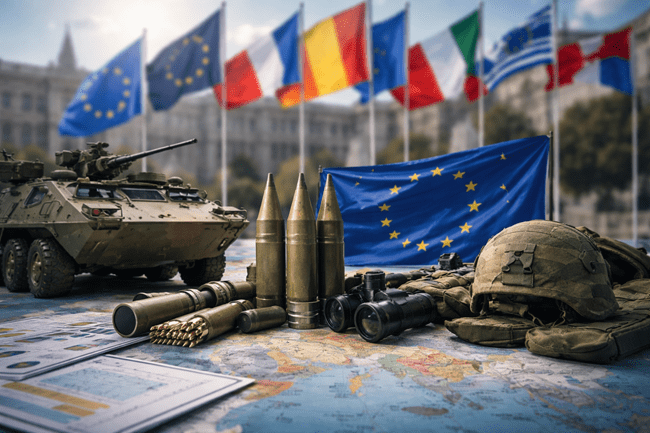
The European Commission (EC) has endorsed the first set of national defence investment plans under the SAFE (Security Action for Europe) initiative, proposing a €38 billion loan package for eight Member States. The move marks the bloc’s first concrete step toward delivering on its Readiness 2030 roadmap, with Belgium, Bulgaria, Denmark, Spain, Croatia, Cyprus, Portugal, and Romania cleared for initial funding. Pending final Council approval, these states could receive low-interest, long-duration loans starting March 2026 to rapidly upgrade their defence capabilities.
How does the SAFE initiative change the economics of European defence investment?
The SAFE initiative represents a structural pivot in the European Union’s (EU) approach to military spending. Instead of relying solely on national budgets and fragmented procurement, SAFE pools demand across Member States and offers access to substantial EU-backed financing. The program explicitly targets high-priority defence capabilities and aims to reduce duplication and cost inefficiencies by enabling joint procurement from the European defence industry.
Cyprus and Romania stand out as early beneficiaries, with €1.18 billion and €16.68 billion respectively earmarked under the scheme. The funding formula—based on “solidarity and transparency” according to the Commission—signals an intent to equalize access across smaller and larger economies. By integrating joint purchasing frameworks, SAFE attempts to standardize interoperability across national militaries while boosting domestic industrial production capacity.
From a fiscal policy standpoint, the key shift is the availability of “low-cost, long-term” EU loans for defence, which effectively allows Member States to increase military spending without breaching national debt thresholds or triggering austerity constraints. That design also acts as a lever to accelerate contract execution with local suppliers, giving the European defence sector more predictable order flow.
What role does Ukraine play in the SAFE defence funding strategy?
A subtle but consequential feature of the SAFE rollout is its integration of Ukraine into Europe’s defence planning architecture. Although Ukraine is not an EU Member State, the SAFE Regulation explicitly allows participation from EFTA, EEA, accession countries, and those with formal security partnerships. That means Ukraine can co-purchase or co-develop systems alongside EU countries, enabling access to industrial supply chains and potentially accelerating its alignment with NATO standards.
This opens two important dynamics. First, it allows Ukrainian defence procurement—historically reliant on U.S. and bilateral aid—to diversify funding sources. Second, it reinforces the EU’s signal that Ukrainian security is functionally inseparable from its own. SAFE thus doubles as both a military investment vehicle and a geopolitical integration tool.
In parallel, the inclusion of Ukrainian industries in common procurement channels raises questions around eligibility criteria, quality control, and supplier trust. It also introduces cross-border logistics and regulatory complexities that will require tight alignment between Brussels, Kyiv, and participating industries.
Could SAFE reshape Europe’s defence industrial base through demand aggregation?
One of SAFE’s most ambitious targets is not just strengthening Member States’ forces, but structurally reshaping the defence manufacturing base within Europe. The initiative’s joint procurement model is designed to replace fragmented national contracts with pooled demand—consolidating orders for key capabilities such as air defence systems, ammunition, UAVs, and C4ISR platforms.
This carries direct implications for prime contractors and Tier-2 suppliers across the EU. Companies able to meet interoperability requirements and cross-border delivery obligations are likely to capture a disproportionate share of SAFE-related contracts. In particular, countries like France, Germany, and Italy—although not in the initial funding wave—could position their defence majors as system integrators or anchor suppliers for future tranches.
From a job creation and economic development standpoint, the European Commission has framed SAFE as an industrial stimulus program as much as a security policy. Commissioner for Defence and Space Andrius Kubilius emphasized that defence sector scale-up must be accompanied by innovation and employment. For mid-tier firms and small advanced manufacturers, the SAFE model could offer predictable multi-year procurement cycles—something long lacking in Europe’s traditionally reactive defence spending culture.
What are the execution risks for SAFE in terms of timing, capability focus, and political coordination?
While the Commission’s approval signals policy momentum, the SAFE initiative still faces a dense execution challenge. The Council must formally adopt the implementing decisions within four weeks. Only then can loan agreements be finalized and disbursement proceed, with March 2026 targeted as the starting point for capital release.
Political cohesion across 27 Member States could complicate scaling. Although the first eight Member States have been cleared, other countries will likely demand parity in both timing and scope. Balancing industrial strategy with strategic autonomy goals may also lead to friction over sourcing rules and eligibility for non-EU contractors.
Capability prioritization is another risk zone. Unlike NATO’s structured defence planning process, the SAFE roadmap allows Member States flexibility in aligning national procurement with EU-level goals. This could result in divergent spending patterns that undercut interoperability gains. Whether Brussels will enforce standardization conditions on loan access remains an open question.
Finally, administrative throughput could emerge as a bottleneck. SAFE’s design includes complex eligibility, audit, and transparency requirements—particularly for dual-use technologies and advanced manufacturing. Ensuring rapid, accountable, and high-impact disbursement will require a new layer of defence procurement bureaucracy at the EU level.
What does this mean for the broader strategic direction of European defence in 2026 and beyond?
SAFE is the EU’s first structural attempt to merge fiscal, industrial, and military policy into a unified framework. If successful, it will not only increase short-term readiness but create a longer-term procurement engine tied to strategic autonomy goals. That could eventually rival foreign military financing programs like the U.S. Foreign Military Sales (FMS) system in scale and predictability.
SAFE’s implementation also complements broader shifts in the EU’s geopolitical posture. The Readiness 2030 roadmap, under which SAFE falls, is an overt attempt to create an EU-wide defence planning infrastructure. As Henna Virkkunen, the Commission’s Executive Vice-President for Tech Sovereignty, Security and Democracy, noted, this marks the transition from “opportunity” to “delivery.”
In that light, SAFE could be a litmus test for whether the EU can act as a single security actor in an age of strategic competition. Its success will likely be measured less by the headline amounts disbursed and more by how much capability is delivered, how fast, and how interoperable.
What are the key takeaways from the EU’s first SAFE defence funding approvals for eight Member States?
- The European Commission has endorsed €38 billion in loans under the SAFE initiative, targeting military readiness upgrades across eight Member States.
- Cyprus and Romania are among the largest early beneficiaries, with earmarked funding of €1.18 billion and €16.68 billion respectively.
- SAFE allows for low-cost, long-term loans to accelerate joint procurement and strengthen Europe’s defence industrial base.
- Ukraine is positioned to participate in joint procurement, reinforcing its integration into EU defence planning structures.
- The initiative aims to standardize military capabilities across Member States, but faces execution risks tied to capability prioritization and political alignment.
- Industrial implications include demand aggregation benefits for EU-based defence contractors and long-term job creation.
- Council approval is required within four weeks for disbursement to begin by March 2026, making implementation timing critical.
- SAFE is part of the broader Readiness 2030 framework and could signal a long-term shift toward unified EU defence planning.
Discover more from Business-News-Today.com
Subscribe to get the latest posts sent to your email.