


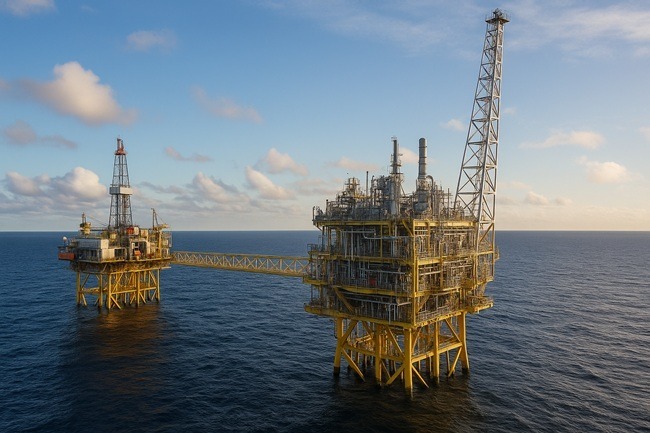
When Equinor ASA (OSE: EQNR) and Aker BP ASA (OSE: AKRBP) announced twin discoveries of gas and condensate in the Lofn and Langemann wells this December, the news barely raised eyebrows in a market fixated on billion-barrel oil plays and multi-phase frontier projects. Yet the real story may not lie in the size of the finds, but in what they represent: the growing dominance of brownfield-led exploration and the re-emergence of tie-back economics as the new North Sea standard.
Estimated at between 30 million and 110 million barrels of oil equivalent, the discoveries are not blockbusters by historical standards. But their value lies in their location—both fields sit within short range of the Sleipner gas hub, one of the most well-integrated infrastructure assets on the Norwegian continental shelf. That changes everything. It makes small discoveries viable. It compresses project timelines. It slashes emissions intensity. And it reduces capital expenditure to a fraction of what would be needed for a greenfield development.
The announcement may have been modest in tone, but industry analysts and institutional investors are interpreting it as a significant indicator. Not just for Equinor and Aker BP, but for the entire offshore energy sector navigating an era of lower-carbon mandates, higher project scrutiny, and unpredictable commodity cycles.
How are brownfield tie-back projects changing offshore oil and gas economics in 2025?
Brownfield tie-backs, which are projects that tap new reservoirs near existing platforms and infrastructure, have shifted from being viewed as incremental add-ons to becoming central pillars of production strategy. With lower upfront capital requirements and faster time-to-first-gas, these developments offer compelling economics in an environment where cost certainty, emissions compliance, and return discipline are paramount.
In the case of the Sleipner hub, both Lofn and Langemann can be connected via subsea infrastructure to existing facilities that already handle gas from fields such as Gudrun and Gungne. The Sleipner system includes not only processing capacity but also direct pipeline links to continental Europe, creating immediate export pathways with no need for new midstream buildout.
By using existing pipelines, risers, and control systems, operators like Equinor can bypass some of the most time-consuming and expensive elements of offshore development. The benefits are especially pronounced in regions like the North Sea, where decades of exploration have left behind a dense network of underutilized assets. The equation is simple: smaller finds become more valuable the closer they are to infrastructure.
In 2025, that equation is driving operator strategy across multiple mature basins. Tie-backs are no longer viewed as marginal gains—they are central to production planning, particularly in asset portfolios where cash flow, not reserve growth, defines success.
Why are companies like Equinor and Aker BP leaning into brownfield expansion?
Equinor’s shift toward infrastructure-led exploration is not accidental. It reflects a deliberate pivot away from high-risk frontier exploration and toward surgical drilling around its core hubs. By focusing on seismic reprocessing, enhanced geomodelling, and reservoir infill potential, the Norwegian major has been able to deliver exploration success rates that exceed global benchmarks—without committing to massive capital exposure.
For Aker BP, the rationale is even clearer. As a fast-growing independent with a reputation for capital efficiency, it has built a North Sea portfolio specifically engineered for rapid tie-backs and early monetisation. Its partnership model allows it to participate in discoveries like Lofn and Langemann while keeping development risk low and payback periods short.
Industry observers note that both companies are responding to the same set of pressures: a need to generate shareholder returns in a climate-constrained policy environment, access to existing processing and export facilities, and the erosion of investor enthusiasm for multi-billion-dollar greenfield mega-projects. In that context, tie-backs offer flexibility, scalability, and a path to continued relevance in a world that demands both energy and emissions discipline.
What makes the Sleipner hub a poster child for Norway’s infrastructure-led strategy?
Sleipner is not a new asset. Commissioned in the 1990s, it has already produced billions of cubic meters of gas. But it has remained commercially and technically relevant by serving as a backbone for other field developments, including Gudrun, Gungne, and now likely Lofn and Langemann.
Its infrastructure includes not just processing platforms and pipelines but also carbon capture integration—a rare capability that positions it well for continued operation under stricter regulatory regimes. The Sleipner CO₂ storage facility, one of the first in the world, has sequestered over 25 million tonnes of CO₂ since 1996. This gives Equinor a built-in ESG advantage when seeking project approvals and investor support for new tie-backs in the area.
The latest discoveries are a continuation of this model. By extending the life of the hub and layering in new resources without requiring new surface installations, Equinor and Aker BP can optimize both commercial returns and carbon performance.
How does investor sentiment favor tie-back strategies over greenfield mega-projects?
Across global capital markets, investors are favouring oil and gas operators that demonstrate capital discipline, quick payback timelines, and emissions reduction pathways. Tie-back strategies tick all three boxes.
While large discoveries still garner media attention, their economics are increasingly viewed with skepticism—especially when tied to multi-year permitting, new infrastructure, and exposure to political and regulatory delays. In contrast, near-field finds like Lofn and Langemann often deliver production within two to three years and require a fraction of the capital.
Institutional investors tracking Equinor and Aker BP noted that the market reaction to the December announcement was neutral-to-positive, with no volatility despite broad commodity headwinds. That in itself is a signal. Brownfield announcements may not trigger a stock rally, but they provide operational confidence and contribute to long-term cash flow visibility—both key metrics for institutional fund flows.
With Norway’s government continuing to support infrastructure reuse and low-carbon project design, companies that can execute brownfield strategies are finding favour among sovereign wealth funds, pension investors, and ESG-screened institutional portfolios.
Are we seeing the start of a North Sea infrastructure consolidation cycle?
Some analysts argue that what we are witnessing is not just a tie-back trend but the early stages of infrastructure consolidation. As older fields decline, infrastructure like Sleipner, Statfjord, and Troll will become increasingly valuable—not just for their remaining reserves, but for their ability to unlock new volumes nearby.
Operators that control processing hubs, pipeline connections, and platform access points will have a commercial edge in farming in smaller independents or partnering on marginal discoveries. Equinor’s control of Sleipner gives it a gatekeeper role in regional development. Similar dynamics may emerge at hubs operated by Aker BP, Shell, or TotalEnergies across the UK and Norwegian sectors.
This consolidation dynamic creates a virtuous cycle. Infrastructure owners gain throughput. Smaller players get low-cost access to markets. And governments benefit from extended tax revenues without greenfield emissions exposure.
What is the broader future outlook for mature basin exploration across Europe?
Looking ahead to 2026 and beyond, the outlook for mature basin exploration is increasingly tied to infrastructure availability, regulatory stability, and digital subsurface investment. The days of wildcat drilling in uncharted basins may not be over, but they are no longer the industry’s centre of gravity.
Instead, companies are prioritising prospects that sit within 20–30 kilometres of active hubs, can be drilled from existing platforms or short tie-backs, and align with corporate net-zero strategies. In this context, Equinor’s Lofn and Langemann discoveries are not outliers. They are the blueprint.
Exploration managers are now tasked with building portfolios of “infrastructure-led growth,” where seismic quality, reservoir predictability, and tie-in timing matter more than raw volume. And the best opportunities are increasingly located not in the frontier, but just beneath the shadows of the rigs already in place.
Discover more from Business-News-Today.com
Subscribe to get the latest posts sent to your email.