




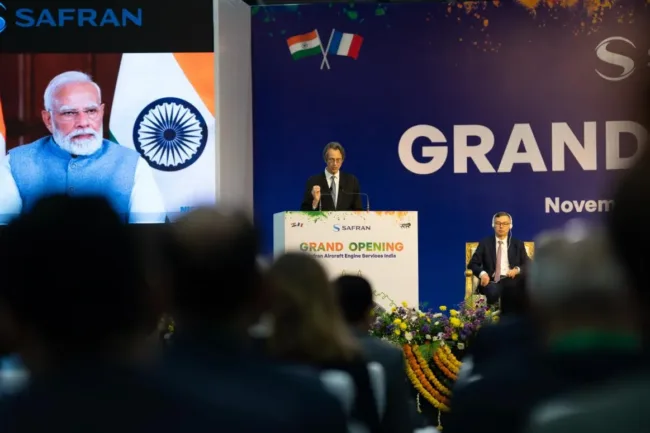
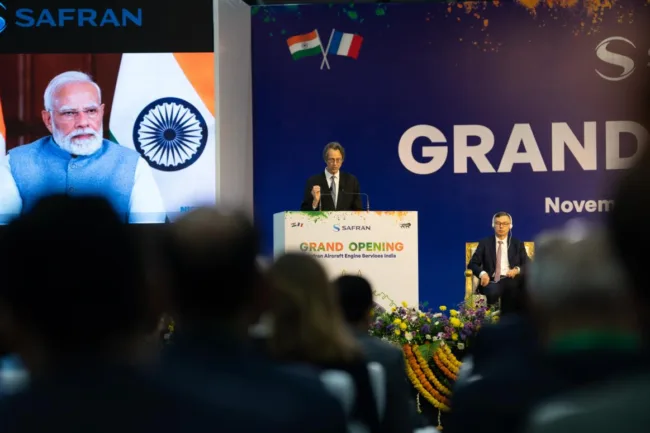
Safran has inaugurated its largest global maintenance, repair, and overhaul facility for CFM International’s LEAP engines in Hyderabad, India, while also breaking ground on a new site dedicated to M88 fighter jet engines. The French aerospace group expects to triple its revenue in India to over €3 billion by 2030, supported by a multi-pronged expansion across civil aviation, military propulsion, and local weapons production.
Speaking at the launch ceremony attended by Prime Minister Narendra Modi and Safran Chief Executive Officer Olivier Andriès, the group confirmed that the Hyderabad site will be operational in 2026 and will eventually service up to 300 LEAP engines annually. Safran is also establishing a 5,000-square-metre facility next to the LEAP shop to support MRO services for the M88 engine, which powers Dassault Aviation’s Rafale fighter aircraft.
This infrastructure buildout follows a recent surge in Indian airline fleet orders, growing interest in domestic MRO capacity, and rising localization demands under the Indian government’s Make in India and Aatmanirbhar Bharat policy frameworks. According to executives, half of Safran’s projected India revenue will be generated from local sites, and the group plans to increase sourcing from Indian suppliers fivefold over the same period.
What Safran’s LEAP engine facility in Hyderabad means for Indian civil aviation growth
The new LEAP engine facility, branded as Safran Aircraft Engine Services India (SAESI), is located within the GMR Aerospace and Industrial Park Special Economic Zone at Rajiv Gandhi International Airport. With an investment exceeding ₹1,300 crore (approximately €200 million), the 45,000-square-metre facility will be among the world’s largest engine maintenance centers. It will include a next-generation test bench and ramp up to full capacity over the next decade, eventually employing over 1,100 highly trained personnel.
LEAP engines, manufactured by CFM International, a 50:50 joint venture between Safran Aircraft Engines and GE Aerospace, power many of the world’s most widely flown narrowbody aircraft, including the Airbus A320neo and Boeing 737 MAX. India has become CFM’s third-largest market, with more than 400 LEAP-powered aircraft already in service and 2,000 additional engines on order.
Industry analysts believe that building a LEAP MRO hub within India is a strategic milestone for the country’s civil aviation sector. The Indian market is now the third-largest domestic aviation market in the world, but around 85 percent of MRO work has historically been done abroad, creating high costs and long aircraft downtimes. This facility addresses that gap by localizing engine overhaul capacity, significantly reducing turnaround time and foreign exchange outflow for Indian carriers.
How Safran’s M88 engine facility will support India’s fighter jet programs
Adjacent to the LEAP center, Safran has committed over €40 million toward establishing an MRO shop for the M88 engine, which powers Dassault’s Rafale aircraft. The facility will support MRO for more than 600 modules annually and employ up to 150 people when fully staffed. Priority will be given to engines on Rafales operated by the Indian Air Force, though the site is expected to eventually support other M88 export customers globally.
India has already inducted 36 Rafale jets and recently placed an additional order for 26 Rafale M variants for naval operations. It also operates 47 Mirage 2000 aircraft, further reinforcing Safran’s relevance in India’s military propulsion segment. With the new MRO capability coming online, India will become less reliant on overseas maintenance for frontline fighter jets, aligning with its long-term defense modernization and indigenization strategy.
Why Safran’s joint venture with Bharat Electronics signals deeper defense collaboration
In a move to enhance India’s domestic weapons manufacturing ecosystem, Safran has signed a joint venture and cooperation agreement with Bharat Electronics Limited to locally produce the Hammer air-to-surface weapon. Developed by Safran Electronics & Defense, the Hammer (Highly Agile Modular Munition Extended Range) is compatible with multiple aircraft types, including Rafale and HAL Tejas.
This marks a significant step toward defense co-development and manufacturing within India. By integrating such modular weapons onto Indian-origin platforms, the partnership could reduce import dependency while enhancing India’s capability for rapid deployment and interoperability across legacy and next-gen aircraft.
According to government officials, Safran’s decision to manufacture Hammer weapons domestically underscores the strategic direction set by the Government of India. It aligns with reforms that allow up to 74 percent foreign direct investment in defense via automatic routes and aims to convert India into a full-spectrum defense manufacturing hub with global export potential.
What Safran’s total India footprint now looks like—and how it is evolving
Safran has operated in India for over 70 years and currently employs more than 3,000 people across 18 sites. In February 2025, the group announced two additional investments: an engineering center in Bengaluru focused on avionics and actuators, which has since become operational with 250 employees, and a new electronics and actuation manufacturing facility, also in Bengaluru, that will employ around 400 workers starting in 2026.
Safran’s long-standing helicopter engine partnership with Hindustan Aeronautics Limited, including the SAFHAL joint venture, has evolved further. SAFHAL is leading the design of the Aravalli engine, slated to power two future heavy-lift helicopter platforms for the Indian Armed Forces. These projects reflect a broader shift toward joint R&D and co-design of core propulsion systems within India, rather than relying solely on assembly or component production.
The group’s cumulative India investment plan, now exceeding €300 million across multiple segments, positions it as one of the most committed global OEMs to Indian aerospace manufacturing and design.
How government support and policy reforms have enabled MRO scale-up
Prime Minister Narendra Modi emphasized during the inauguration that India’s aviation sector has reached an inflection point. With domestic fleet orders surpassing 1,500 aircraft and MRO demand expanding rapidly, he noted that India cannot afford to outsource critical maintenance capabilities.
He pointed out that Safran’s Hyderabad facility is the first example of a global OEM setting up deep-level servicing in India and called it a blueprint for transforming the country into a full-fledged MRO hub. Modi highlighted that India’s aerospace aspirations include not only civil and military aviation but also MRO development for the shipping sector and other adjacent domains.
Multiple regulatory reforms have facilitated this transformation. These include the simplification of MRO guidelines in 2021, tax rationalization through GST reforms in 2024, and the National Civil Aviation Policy of 2016, which improved the operating environment for aviation service providers. Additionally, the Production Linked Incentive schemes and the National Single Window System have reduced compliance burdens and streamlined approvals for high-tech manufacturing.
Why global aerospace suppliers are betting on India as a co-creation partner
Beyond policy incentives, Safran’s expansion is driven by a structural shift in how global aerospace majors view India. The country offers a combination of rapid market growth, a skilled engineering talent pool, a maturing regulatory environment, and increasingly credible supply-chain capabilities. The Indian government has allowed 100 percent FDI via automatic routes in most sectors, including aviation, with 74 percent permitted in defense.
Prime Minister Modi reiterated that investors in India are viewed not just as capital providers but as co-creators of a future-ready industrial base. This is seen as a strong endorsement for global OEMs like Safran to move beyond low-value sourcing and toward high-value co-design and manufacturing of engines, avionics, weapons, and propulsion systems.
Analysts believe that India’s positioning as a trusted partner in global aviation supply chains is accelerating, especially amid geopolitical shifts that are pushing Western manufacturers to diversify away from single-country dependencies.
Can India become a global MRO and aerospace co-development hub?
Safran’s expanded footprint and its €3 billion revenue ambition for India underscore a deep realignment in aerospace supply chains. The group’s dual commitment to civil aviation and defense, combined with localization of high-value MRO, puts India on the path to becoming more than just a market—it is emerging as a strategic node in the global aviation infrastructure.
For Indian stakeholders, the challenge now is to scale quickly and sustainably. Workforce training, supplier readiness, and technology transfer timelines will determine how quickly these investments pay off in operational capability. If executed as planned, India could reduce its foreign exchange burden on aviation services, improve airworthiness turnaround times, and increase self-reliance in defense MRO and co-developed weapons platforms.
What are the key takeaways from Safran’s India expansion and Hyderabad MRO facility launch?
- Safran has inaugurated its largest global LEAP engine MRO facility in Hyderabad with an investment of over ₹1,300 crore, aiming to make India a global aviation service hub.
- The facility will handle up to 300 engine shop visits annually and support Indian airlines operating more than 400 LEAP-powered aircraft, with 2,000 additional engines on order.
- Safran has also begun construction of an MRO shop for the M88 engine, which powers Dassault Aviation’s Rafale fighters; the facility will prioritize Indian Air Force fleet readiness and export support.
- A new joint venture with Bharat Electronics Limited will localize production of the Hammer modular air-to-surface weapon, compatible with Rafale and HAL Tejas aircraft.
- Safran expects to triple India revenue to over €3 billion by 2030, with half coming from operations within the country and a fivefold increase in local sourcing.
- Two earlier investments in Bengaluru include an avionics and actuators engineering centre, and an upcoming electronics and actuation manufacturing facility employing a combined 650+ staff.
- Prime Minister Narendra Modi emphasized India’s policy-driven support for MRO infrastructure, including simplified regulations, GST reforms, and openness to global OEMs.
- The Hyderabad facility positions India to significantly reduce MRO outsourcing, foreign exchange leakage, and long turnaround times for engine repair.
- Safran’s expansion deepens India’s aerospace capabilities across civil, defense, and weapons systems, and reinforces its co-development credentials in the global supply chain.
- Analysts believe this could mark the beginning of India’s transformation into a full-spectrum aviation and defense manufacturing hub for the next decade.
Discover more from Business-News-Today.com
Subscribe to get the latest posts sent to your email.


